The discussion around AI translation vs human translation is often reduced to a simple quality debate. In practice, modern businesses face a broader strategic question: which approach supports operational scale, accuracy requirements, and financial sustainability over time?
Translation today influences more than communication. It impacts product data integrity, SEO performance, regulatory compliance, and international market entry. The decision between AI translation and human translation should therefore be evaluated through multiple dimensions: accuracy, scalability, cost structure, operational risk, and long-term growth alignment.
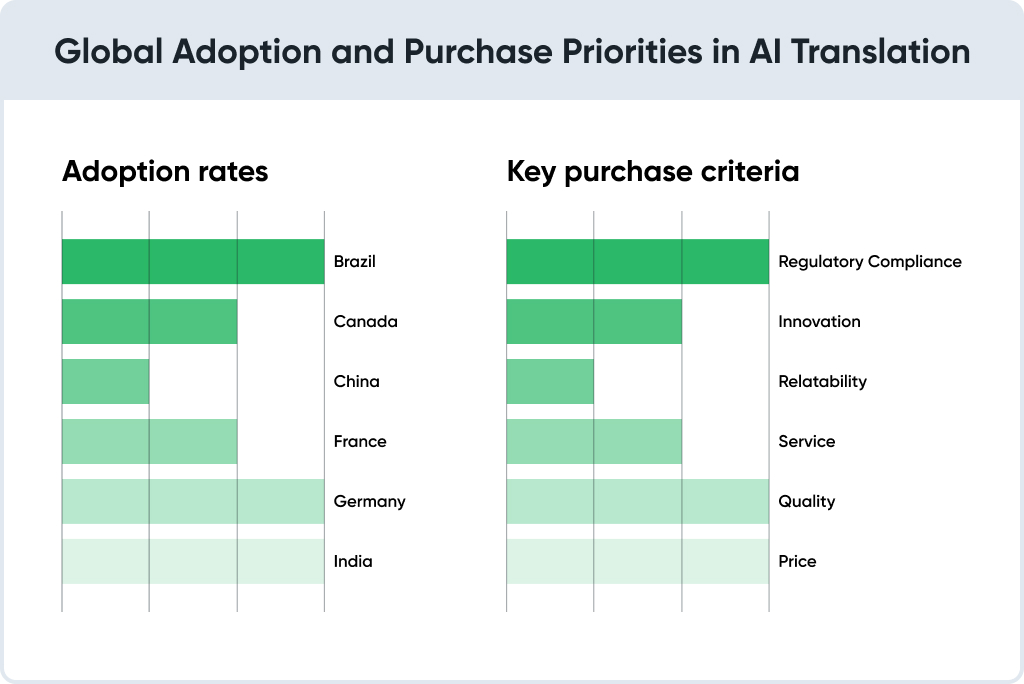
At first glance, the adoption rates simply confirm that AI translation is gaining ground globally. However, the spread across countries suggests something more practical than hype. Markets with strong e-commerce, export activity, or digital services are moving faster. Translation in those environments is not occasional. It sits inside daily operations.
The second chart shifts the focus from adoption to accountability. Regulatory compliance and quality appear as top purchase criteria. That reframes the AI vs human translation debate. Businesses are not choosing tools based on novelty. They are evaluating exposure, workflow stability, and long-term scalability.
Innovation ranks high, yet in this context, it usually means system compatibility. Decision-makers look for solutions that connect directly to CMS platforms, PIM systems, product databases, and support environments. Standalone tools create friction.
Price shows up, but it does not dominate. That often indicates companies are thinking beyond per-word cost and toward total operational impact.
Key takeaways:
- AI translation adoption reflects operational maturity, not experimentation.
- Compliance and quality drive decisions more than cost alone.
- Integration capability influences purchase choices as much as accuracy.
- Translation is increasingly treated as infrastructure rather than a linguistic service.
Together, these signals show that the question is shifting. It is less about whether AI or human translation is better in theory and more about which structure aligns with how a business operates at scale.
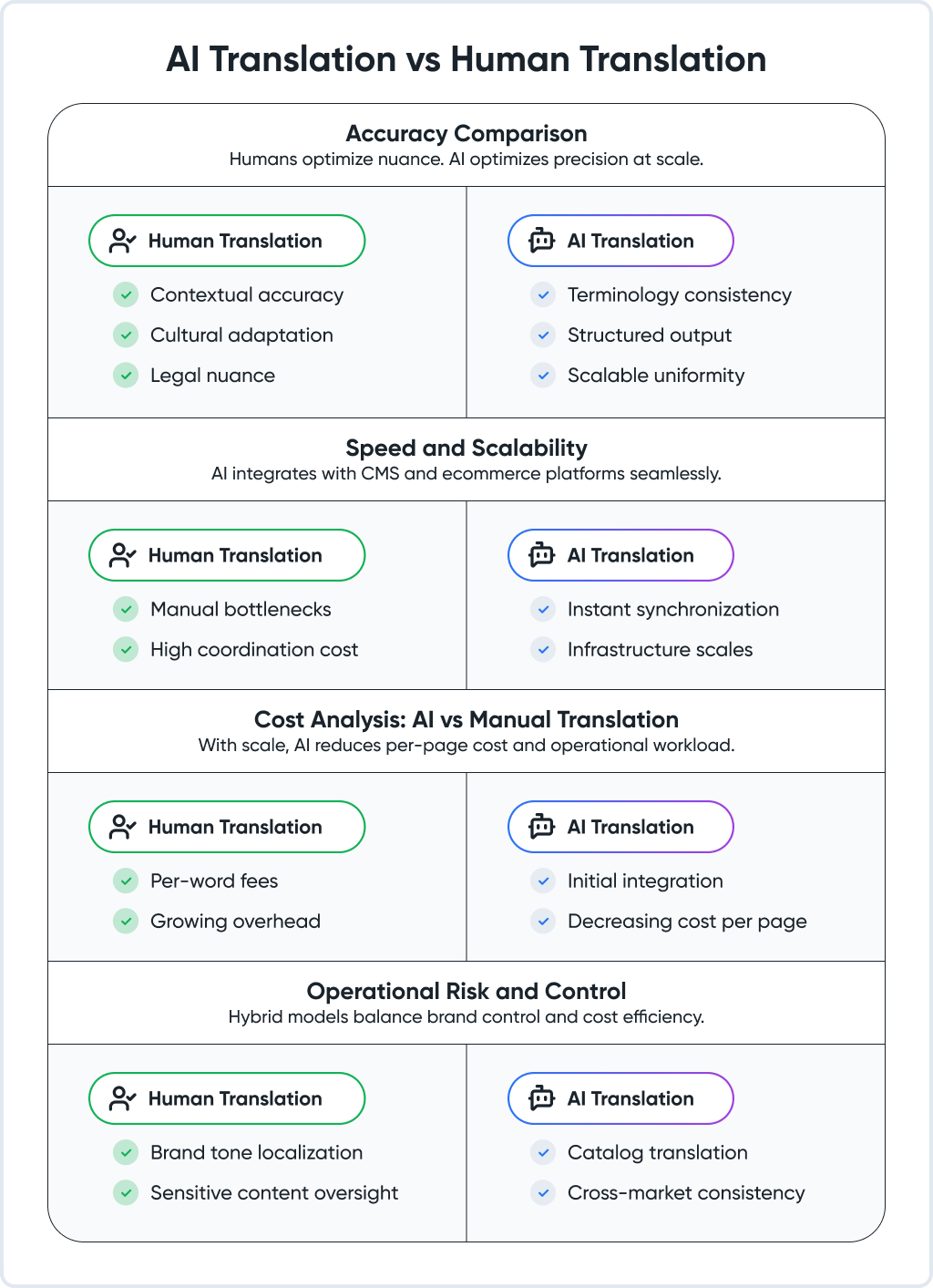
Below is a structured comparison of AI vs human translation across critical factors.
1. Accuracy Comparison
Accuracy remains the most cited concern in the debate around AI translation accuracy comparison.
Human Translation: Contextual and Cultural Precision
Human translators provide:
- Cultural sensitivity and idiomatic nuance
- Creative adaptation of brand messaging
- Legal and compliance precision
- Contextual judgment in ambiguous scenarios
In highly sensitive environments such as contracts, medical documentation, or executive communication, this level of interpretation remains essential.
However, consistency across large distributed teams can become challenging. Terminology may vary between translators, and maintaining uniform language across thousands of pages requires strict coordination.
AI Translation: Structural and Terminology Consistency
Modern AI language models have significantly improved contextual processing compared to early rule-based systems. In structured environments, AI translation demonstrates strong performance in:
- Product descriptions
- Technical documentation
- Catalog specifications
- Informational content at scale
Where AI excels is consistency. Once glossary rules and terminology standards are configured, output remains uniform across thousands of entries.
In the AI-powered translator assistant project for a building materials store, more than 30,000 pages were translated while maintaining strict terminology alignment across the catalog.

- 30,000+ pages translated automatically with high accuracy
- Less than $25 cost to translate all product and blog pages
- 100% complete translations via error-handling system
The comparison is therefore contextual rather than absolute. Human translation optimizes nuance. AI translation optimizes structural precision at scale.
2. Speed and Scalability
Speed is often underestimated until international expansion begins.
Human Translation Workflow
Manual workflows typically follow this sequence:
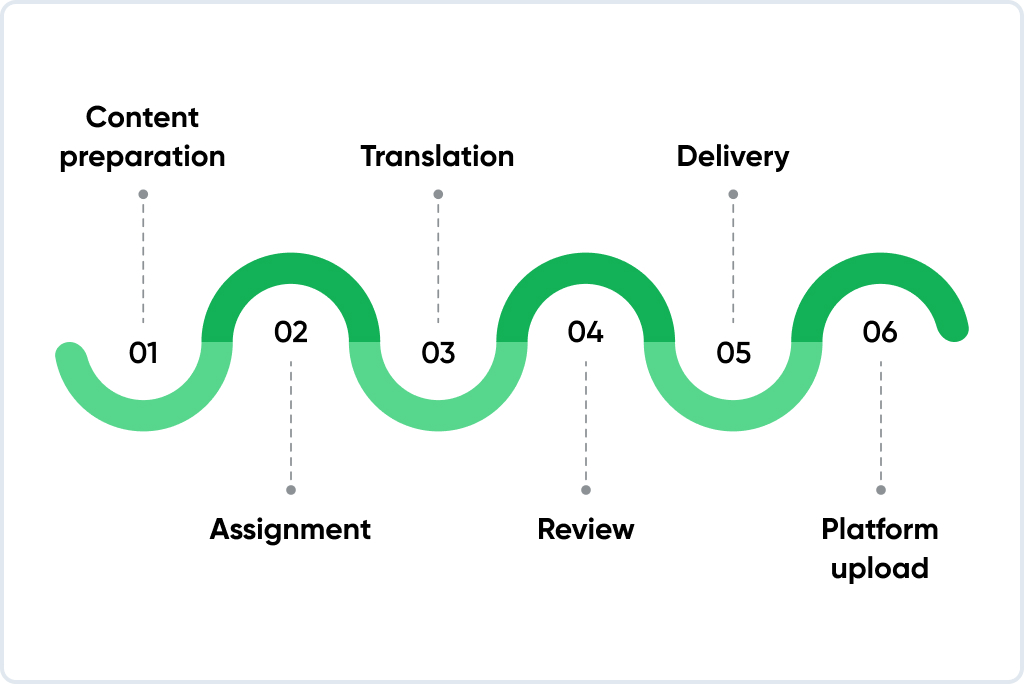
Each additional language multiplies coordination steps. Frequent updates introduce repeated cycles. As content volume increases, bottlenecks emerge.
This model works for controlled volumes. It becomes increasingly complex for e-commerce or SaaS platforms operating in multiple regions simultaneously.
AI Translation Workflow
With properly implemented translation software integrated into digital systems, localization occurs in parallel with content updates.
When a product description changes inside a CMS or e-commerce platform, translation automation processes the update automatically. Language versions remain synchronized without external coordination.
GoMage AI Translation integrates directly with Magento 2, WooCommerce, and custom platforms, embedding localization within the operational workflow rather than treating it as an external task. Scalability becomes a function of infrastructure rather than headcount.
3. Cost Analysis: AI vs Manual Translation
When businesses compare the cost of AI vs manual translation, they often focus on per-word pricing. This comparison overlooks structural expenses.
Human Translation Cost Drivers
- Per-word or per-project fees
- Project management coordination
- Repeated updates for minor content changes
- Delays in regional product launches
- Manual content migration between systems
As content volume grows, these costs scale proportionally.
AI Translation Cost Structure
AI translation services introduce:
- Initial integration investment
- Ongoing automated processing
- Optional human review for selected content
Over time, per-page cost decreases as volume increases. More importantly, operational overhead declines.
In the UNIT.City multilingual WordPress implementation, automated localization significantly reduced manual coordination while preserving CMS integrity and SEO structure: For content-heavy environments, cost efficiency compounds as scale increases.
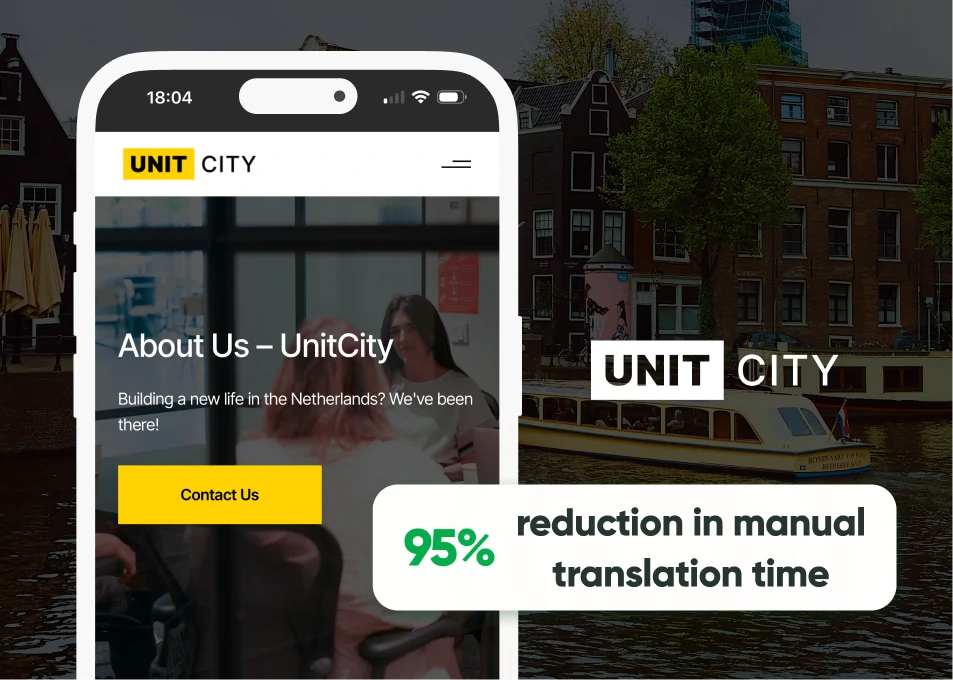
- 95% reduction in manual translation time
- 30 seconds average translation time
- 18 languages added
4. Operational Risk and Control
Risk management differs between approaches.
Human translation reduces reputational risk in high-impact content but introduces operational risks, including delays and inconsistencies at scale.
AI translation reduces coordination risk and ensures synchronization across markets. However, it requires proper configuration, terminology governance, and workflow control.
The most resilient model in modern digital ecosystems is hybrid:
- AI manages structured, repetitive, high-volume content.
- Human expertise is applied selectively to high-impact material.
This allocation of resources balances risk and efficiency.
Best Use Cases for Each Method
Rather than asking “Is AI translation better than human translators?” it is more effective to define optimal use scenarios.
Human Translation Is Strategically Stronger When:
- Legal responsibility is significant
- Brand voice requires creative adaptation
- Cultural interpretation directly influences perception
- Content volume remains limited
AI Translation Is Strategically Stronger When:
- Managing large ecommerce catalogs
- Updating structured product attributes frequently
- Operating multilingual SaaS platforms
- Synchronizing documentation across regions
- Supporting rapid international rollout
For businesses asking “which translation method is best for business,” the answer depends on scale, update frequency, and revenue sensitivity to time-to-market.
Strategic Conclusion
The comparison between machine translation and human translation is no longer ideological. It is structural.
Human translation provides interpretive depth and creative nuance.
AI translation provides scalability, speed, and operational alignment.
For modern e-commerce, SaaS, and digital platforms expanding internationally, translation becomes part ofthe core infrastructure. Infrastructure must scale predictably.
GoMage AI Translation was designed for environments where content volume, update frequency, and cross-market synchronization require structured automation rather than manual coordination:
The most effective strategy for modern businesses is not choosing one method exclusively, but allocating each where it delivers the highest value.
FAQ
It depends on what you are trying to solve. If the goal is to translate thousands of product pages and keep them aligned across markets, AI translation usually handles that more efficiently. If the goal is to refine a brand manifesto or legal document, human translators still bring judgment that automation does not replace. In real business settings, companies rarely choose one in isolation.
AI translation accuracy has improved a lot in structured environments. For technical descriptions, specifications, and catalog content, the output is often stable and consistent. In an AI translation accuracy comparison focused on ecommerce or SaaS documentation, the gap is smaller than many assume. The difference becomes more visible in creative or emotionally nuanced texts.
The difference is not only linguistic. Machine translation vs human translation reflects two operational models. AI systems process volume quickly and consistently. Human translators interpret meaning and adapt tone. One prioritizes scalability. The other prioritizes interpretation.
The cost of AI vs manual translation changes over time. Manual translation scales linearly with content volume and coordination effort. AI translation usually involves integration and setup, but ongoing updates become less expensive at scale. For businesses with frequent product changes, the long-term cost difference becomes noticeable.
There is no universal answer. The translation method that is best for business depends on how fast you expand, how often content changes, and how many markets you operate in. High-volume digital platforms tend to rely more on AI translation services, while selective human review remains part of the process.
It can support it, especially when integrated into a multilingual website translation solution. AI translation helps keep metadata, descriptions, and page structures aligned. Still, SEO performance depends on regional keyword research and intent alignment, not translation alone.
Yes, and this is where it often makes the most sense. Large catalogs introduce repetition and frequent updates. Automated translation reduces the need to manage thousands of individual text revisions manually. When connected directly to an e-commerce platform, multilingual AI tools keep content synchronized.
In certain areas, absolutely. Legal texts, regulatory disclosures, and strategic messaging benefit from human review. AI translation handles volume effectively, but human translators still contribute in areas where interpretation and accountability matter.
AI translation tends to deliver stronger ROI when content volume is high and updates are frequent. In e-commerce, where new products are added regularly, translation automation reduces delays and coordination effort. The benefit grows as the platform scales.
Instead of treating AI vs human translation as a binary choice, most companies assess content types separately. Structured content may be processed through AI translation services, while high-impact pages are reviewed manually. This layered approach balances efficiency with control.