International growth used to move at the speed of localization. Companies could plan expansion, secure partnerships, and prepare marketing campaigns, yet still wait weeks for translated content to be reviewed and deployed.
Today, that delay often becomes the bottleneck.
As digital businesses scale, content updates happen continuously. Product catalogs expand. Regional storefronts multiply. Support teams operate across time zones. In this environment, AI translation services help companies keep pace without multiplying operational overhead.
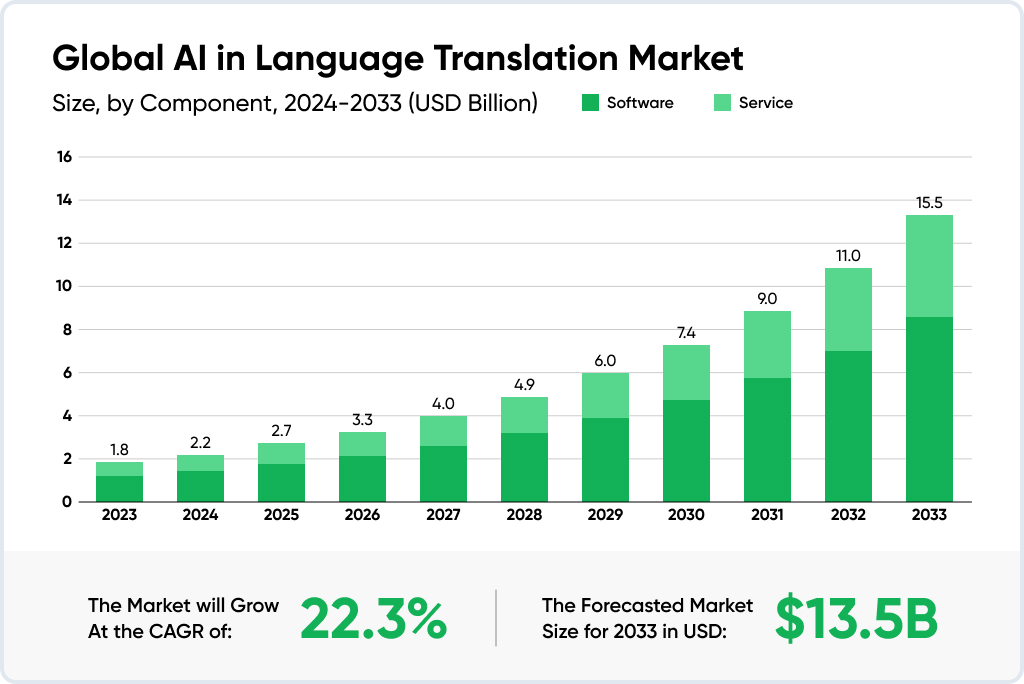
The AI language translation market is projected to grow from $1.8 billion in 2023 to $13.5 billion by 2033, with an annual growth rate of 22.3%.
Below are the most practical benefits businesses see when they implement scalable translation solutions.
Faster Global Expansion
Speed matters in international markets. The ability to test demand, launch localized pages, and adjust messaging quickly can determine whether expansion succeeds or stalls.
With traditional translation models, market entry requires sequential steps. Content is prepared, sent for manual translation, reviewed, and finally published. Each cycle adds delay.
With automated translation, the workflow changes:
- Product data flows directly into the localization layer
- AI generates translated versions instantly
- Glossaries maintain terminology consistency
- Updates synchronize across regions
Instead of waiting for full manual localization, companies can launch multilingual storefronts in stages and refine based on real performance data.
GoMage’s AI Translation solution is built precisely for this use case. It integrates directly with e-commerce platforms and CMS environments, allowing businesses to localize continuously rather than in batches.
Multilingual Customer Support Without Operational Overload
Customer experience often reveals the limits of manual translation.
Support teams must handle inquiries in multiple languages. Help center content must stay aligned with product updates. Delays create confusion and duplicate work.
Multilingual AI tools allow companies to:
- Translate help articles automatically
- Keep FAQs synchronized across languages
- Reduce manual reformatting
- Support real-time responses in international markets
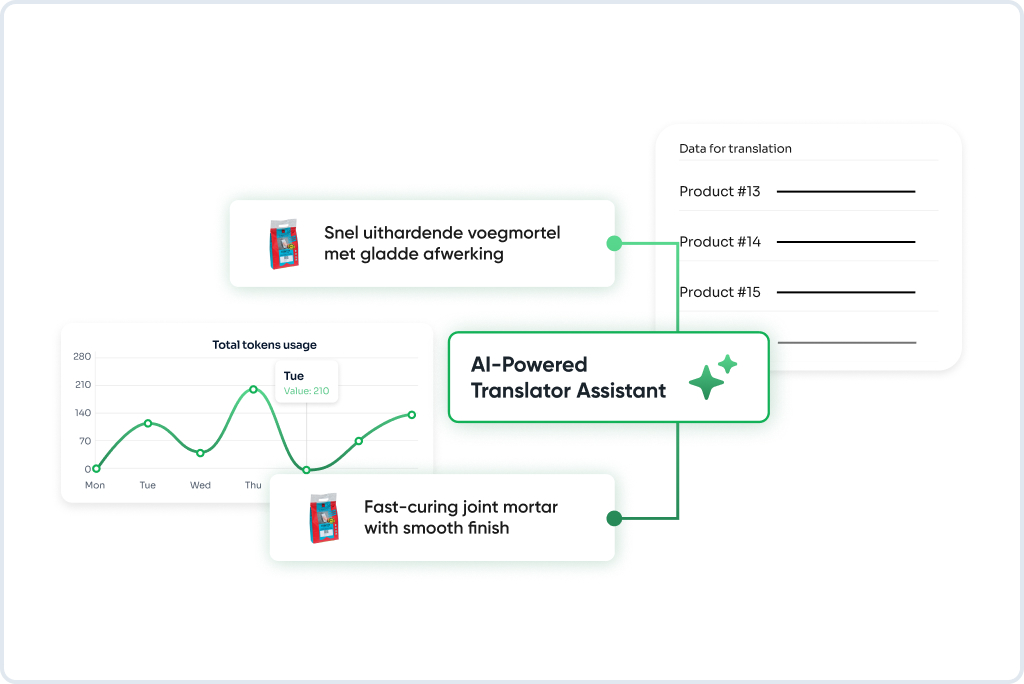
In one GoMage project for a building materials store, an AI-powered translator assistant processed more than 30,000 pages with high accuracy while maintaining consistent terminology across the catalog.
Automation reduced repetitive manual tasks, allowing teams to focus on higher-value communication.
Scalable translation solutions make multilingual support sustainable instead of reactive.

- 30,000+ pages translated automatically with high accuracy
- Less than $25 cost to translate all product and blog pages
- 100% complete translations via error-handling system
SEO Localization Advantages
Translating content word-for-word rarely produces strong search performance.
Search engines evaluate:
- Contextual relevance
- Regional search intent
- Metadata consistency
- Structured technical implementation
A proper multilingual website translation solution integrates localization into SEO workflows.
AI translation software helps teams:
- Adapt metadata dynamically
- Maintain consistent URL structures
- Localize headings and descriptions
- Prevent duplicate content issues
In the UNIT.City case, GoMage developed an AI-powered multilingual translation plugin for WordPress that automated content localization directly inside the CMS. The system helped maintain alignment between languages while preserving the technical structure required for search performance.
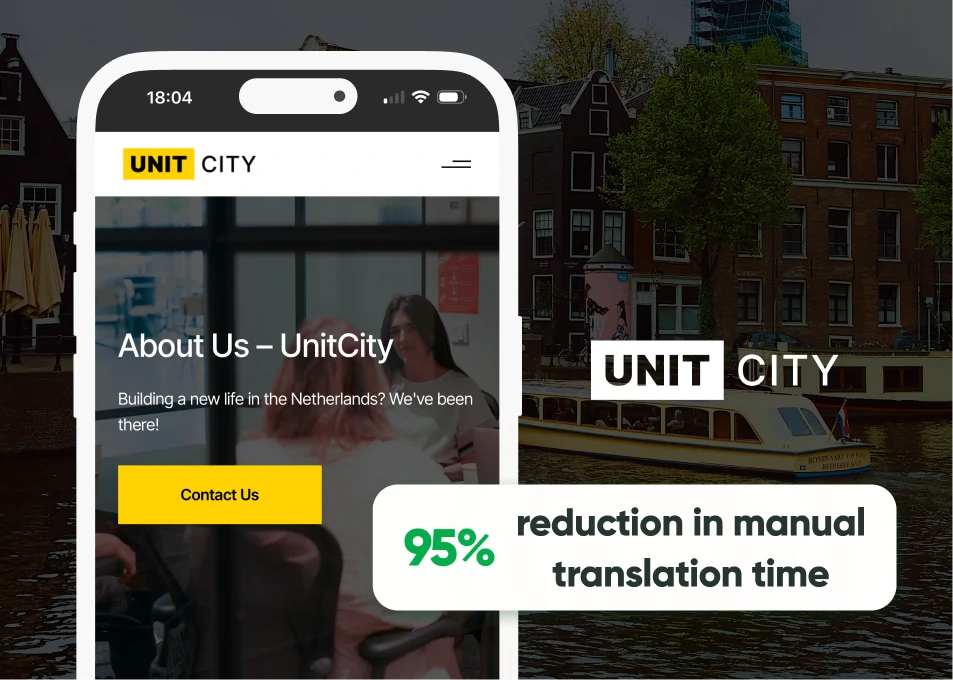
- 95% reduction in manual translation time
- 30 seconds average translation time
- 18 languages added
ROI of AI Translation
The financial impact of AI translation services extends far beyond simple cost-per-word comparisons. The real return appears in operational structure, speed, and scalability.
1. Reduced Coordination Overhead
Manual translation introduces repetitive coordination cycles. Content must be queued, assigned, reviewed, approved, and re-uploaded. As content volume grows, these cycles multiply.
2. Faster Localization Cycles
When translation automation is integrated into e-commerce or CMS systems, localization happens in parallel with content updates.
3. Continuous Synchronization Across Markets
AI localization services ensure that product descriptions, specifications, and CMS updates remain aligned across language versions.
4. Lower Operational Costs at Scale
While reduced per-word cost is important, the greater savings come from eliminating repeated manual handling.
When ROI Becomes Most Visible
AI localization services for e-commerce environments deliver the strongest return when specific conditions apply:
High Catalog Volume
Large product databases create an exponential translation workload. Automation stabilizes that growth.
Frequent Specification Updates
Industries with changing product data benefit from continuous synchronization rather than periodic retranslation.
Multiple Regional Storefronts
Maintaining alignment across several markets becomes operationally complex without integrated translation software.
Revenue-Sensitive Time-to-Market
When delayed localization means delayed sales, automation directly supports revenue timing.
Choosing the Best AI Translation Tools for Business
Not every translation software solution is designed for scale. Many tools work well for occasional content translation but struggle when integrated into complex e-commerce or enterprise environments.
Choosing the right AI translation tool is less about features and more about operational fit. The wrong system creates bottlenecks. The right one becomes invisible inside your workflow.
Below is a practical framework to evaluate scalable translation solutions.
1. Integration Comes First
Before evaluating accuracy or pricing, check integration depth.
If translation requires exporting files, sending content externally, and re-uploading localized versions, the process will not scale efficiently.
A strong multilingual website translation solution should:
- Connect directly to your e-commerce platform or CMS
- Automatically detect content updates
- Synchronize changes across all language versions
- Preserve layout and data structure
2. Glossary and Terminology Control
Accuracy is not only about grammar. It is about consistency.
In technical industries, terminology drift can damage credibility or create compliance risks. Even in retail, inconsistent naming across languages weakens brand identity.
When evaluating AI localization services, ask:
- Does the system support glossary integration?
- Can terminology rules be enforced automatically?
- Can industry-specific vocabulary be trained or customized?
3. Structured Product Data Support
Many businesses underestimate the complexity of structured content.
Product attributes, specifications, metadata fields, and variant data require careful handling. A tool that translates text blocks but ignores structured product data creates technical inconsistencies.
The best AI translation tools for business should:
- Recognize structured data fields
- Maintain attribute consistency across languages
- Adapt metadata for multilingual SEO
- Avoid breaking formatting or database logic
4. Automation of Continuous Updates
Scalability depends on how updates are handled.
A translation tool that works well for initial localization may fail when content changes weekly.
Ask these practical questions:
- Does translation trigger automatically when content updates?
- Are multilingual versions synchronized in real time?
- Can the system process bulk updates without manual intervention?
5. Human Review Flexibility
Full automation is rarely appropriate for every content type.
Legal disclaimers, policy documents, and high-impact brand messaging may require human oversight. The right system enables selective review rather than forcing manual processing for everything.
Look for:
- Optional human-in-the-loop workflows
- Role-based approval controls
- The ability to flag sensitive content
6. Scalability Across Markets
Businesses planning international growth must consider future expansion, not just current needs.
A scalable translation solution should allow you to:
- Add new languages without restructuring workflows
- Maintain SEO consistency across regions
- Handle increased content volume without additional complexity
7. ROI and Operational Impact
Finally, evaluate the financial and operational impact.
The ROI of AI translation services typically appears in:
- Faster time-to-market
- Lower per-word and coordination costs
- Reduced internal workload
- Improved multilingual SEO performance
- More stable cross-regional consistency
For e-commerce brands, SaaS platforms, and marketplaces, scalable translation solutions shift localization from a cost center to a growth enabler.
Final Checklist for Decision-Makers
Before selecting an AI translation tool, confirm:
- It integrates natively with your platform
- It supports glossary and terminology control
- It processes structured product data accurately
- It automates continuous updates
- It allows human review where needed
- It scales with market expansion
The best AI translation tools for business are not defined by marketing claims. They are defined by how well they support real operational workflows.
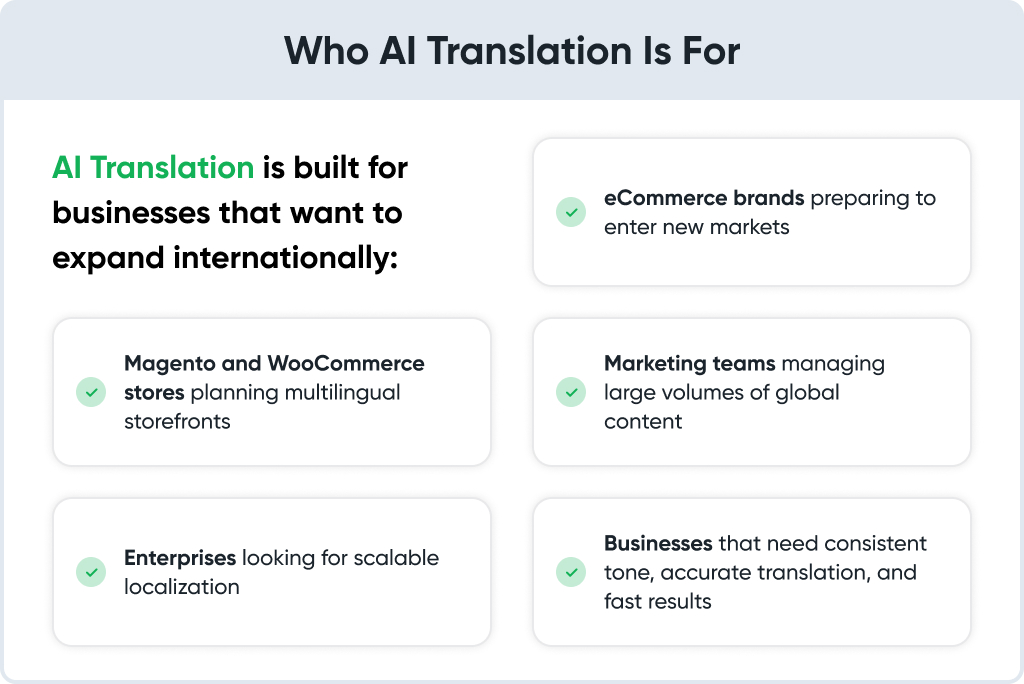
GoMage AI Translation is built for businesses that operate at scale. The solution integrates directly with Magento 2, WooCommerce, and custom platforms, automates continuous content updates, and maintains terminology consistency across multilingual storefronts.
Final Thoughts
International scaling depends on operational alignment as much as market strategy.
AI translation services help businesses move faster, maintain consistency across languages, and reduce the hidden costs of manual localization. When integrated properly, multilingual AI tools become part of daily workflows rather than an afterthought.
FAQ
If we are talking about structured content like product descriptions, help center articles, or technical documentation, modern AI translation services perform consistently. They work especially well when connected directly to a CMS or e-commerce platform.
Not exactly. Machine translation used to mean literal sentence conversion. AI language translation goes further. It analyzes context, patterns, and vocabulary over large datasets. The result is closer to natural phrasing, especially for e-commerce or SaaS environments. The difference becomes visible when you translate thousands of SKUs rather than a blog post.
Yes, and this is where it makes the most sense. A multilingual website translation solution built on automated translation keeps product updates aligned across regions. Without that, teams often end up updating five storefronts manually. That rarely scales well. For e-commerce platforms, AI localization services are less about convenience and more about operational stability.
For some content, yes. Legal documents, sensitive brand campaigns, and compliance materials benefit from human review. Most businesses use AI translation services for volume and then apply human oversight selectively. That hybrid model is practical. Full manual translation for everything usually becomes expensive very quickly.
Faster global expansion is one. Lower coordination overhead is another. Multilingual AI tools also reduce content backlog and help teams avoid version mismatches between markets. The financial benefit grows as content volume increases.
The ROI of AI translation often comes from structure, not just price. If translation software is integrated properly, updates happen continuously instead of in batches. That shortens the time to market. In e-commerce, that timing can affect revenue directly. The larger the catalog, the more noticeable the impact.
They can support SEO localization, but they do not replace keyword research. AI translation software can adapt metadata and structure across regions, but regional search intent still requires strategic planning. Automated translation supports SEO. It does not design it.
Start with integration. If the tool does not connect directly to your e-commerce platform or CMS, you will feel friction immediately. Then check glossary control, structured data handling, and automation of continuous updates. These factors determine whether the solution is truly scalable.
Yes, especially where documentation changes frequently. Translation automation prevents multilingual help centers from falling behind product releases. For SaaS companies operating globally, that alignment matters more than perfect stylistic nuance.
No. Smaller ecommerce brands also benefit when content volume grows. The question is not company size. It is the update frequency and complexity. If you manage multiple languages and constant content changes, scalable translation solutions reduce pressure quickly.