The path from a Magento checkout to a customer’s door is where brand promises get kept or broken.
Magento gives merchants more control over their storefronts than almost any other platform. Custom product pages, configurable checkout flows, advanced catalog management, multi-store support – it’s a serious ecommerce engine. And for mid-market and enterprise retailers, that power is worth the investment.
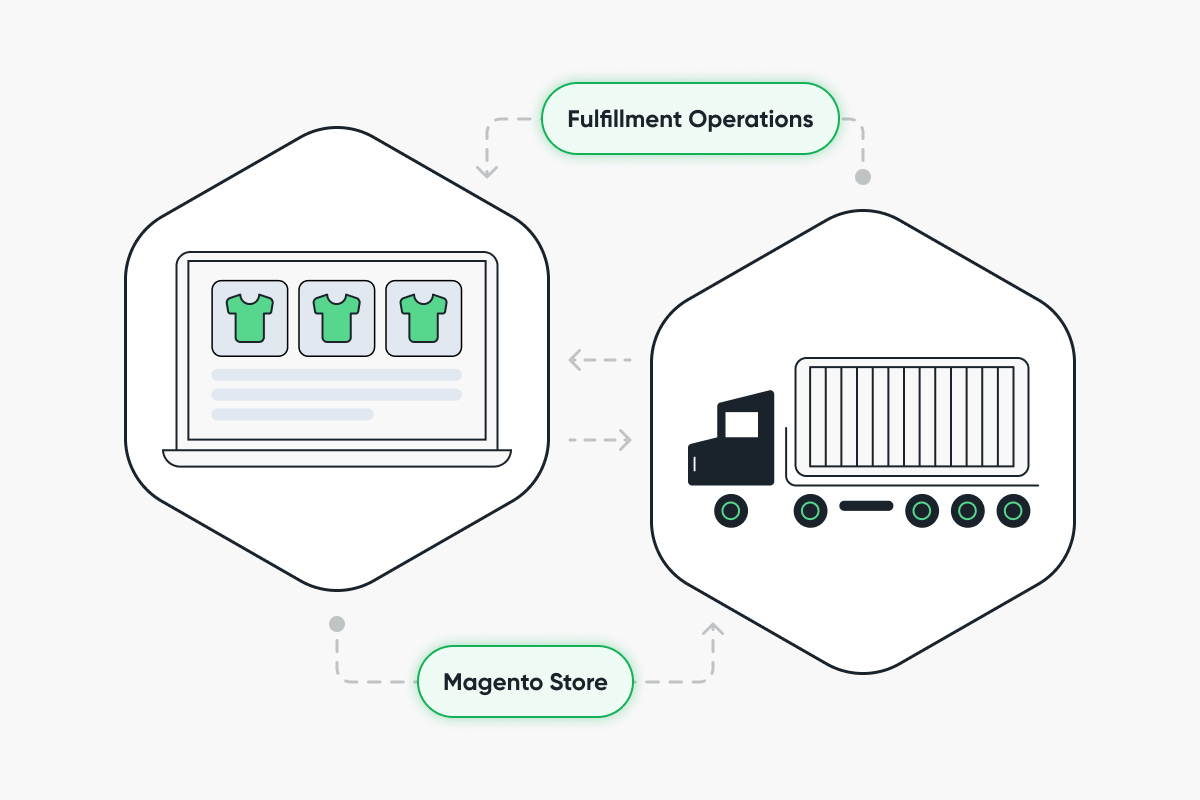
But there’s a gap most Magento builds don’t talk about. The development work stops at the checkout page. What happens after a customer clicks “Place Order” is handled by an entirely separate operational layer – one that often gets far less attention than the Magento build itself. That gap is where customer loyalty gets made or lost.
If a customer waits too long, gets the wrong item, or can’t track where their order is, they’re not going to blame your fulfillment provider. They’re going to blame your store. The Magento build becomes irrelevant the moment the delivery experience falls apart.
What Magento Merchants Are Up Against
Magento’s scale is real. The platform processes about $155 billion in transactions annually, according to 2024 data from Digiteon, and about 20% of the Internet Retailer Top 1,000 stores in the U.S. and Canada run on it, per mgt-commerce.com. That’s the enterprise tier – stores where customers arrive with high expectations baked in.
Those expectations extend to shipping. A 2025 Opensend analysis found that 69% of shoppers won’t return to a retailer after a late delivery. The same data show that 43% have abandoned a cart or switched retailers entirely because of slow shipping. That’s not a fringe behavior – it’s the majority of customers reacting to a fulfillment failure.
Building a reliable retail fulfillment operation means more than shipping boxes on time. It means accurate inventory, carrier rate optimization, returns handling, and the kind of real-time order visibility that customers now expect as standard. For Magento merchants who’ve typically invested heavily in their storefront experience, letting the fulfillment side underperform leaves a lot of that investment on the table.
Fulfillment has become a competitive differentiator – not a back-office commodity. Two stores can run identical Magento builds and achieve opposite customer retention results, depending entirely on how well they execute after the order is placed.
The Hidden Cost of Ignoring Fulfillment
The numbers on fulfillment failure are specific enough to take seriously. Bain & Company research shows that shoppers who receive their first order within 2 days have a 40% higher Customer Lifetime Value (CLV) over the following 12 months. That’s not a marginal edge – it’s the kind of number that changes how you think about what “fast shipping” is worth.
Fulfillment errors compound quickly on Magento stores with large catalogs. More SKUs means more picking complexity, more opportunity for mis-ships, and a higher base rate of returns. According to Opensend’s 2025 data, each fulfillment error costs roughly $50-75 when you factor in returns processing, reshipments, and customer service contacts. At scale, even a small error rate becomes a significant monthly expense.
Returns tell a similar story. Online return rates are about 24.5%, compared to 8.9% in physical retail, per Opensend. That gap reflects the inherent uncertainty of buying without handling the product, but poor fulfillment (wrong item, damaged goods, slow delivery) pushes that rate higher than it needs to be.
Fulfillment Is Now Part of the Customer Experience
Customers don’t think of fulfillment as a logistics function. They think of it as part of the buying process. Opensend’s 2025 data show that 73% of consumers want real-time order tracking, and 24% abandon purchases when they can’t see a delivery date estimate. These aren’t power-user preferences – they’re baseline expectations.
The implication for Magento merchants is direct: all the UX work in a custom Magento build is evaluated, in part, by how the shipping confirmation email looks and whether the order shows up on time. The customer experience doesn’t end at checkout. It ends at the doorstep.
Tracking ecommerce performance metrics like order accuracy rate and on-time delivery percentage alongside conversion and revenue figures gives a much clearer picture of where a Magento store’s growth ceiling actually sits.
How Magento’s Architecture Supports Fulfillment Integration
Magento’s design makes it technically well-suited for fulfillment integration – when merchants use it that way. The platform’s API-first architecture enables direct integrations with third-party logistics (3PL) warehouse management systems, OMS platforms, and carrier networks.
The native order workflow – pending, processing, complete, closed – maps directly to the fulfillment handoff stages that 3PL providers use. Understanding how to process an order in Magento is the foundation for any fulfillment integration, because the status transitions are where the Magento system communicates order state to the warehouse.
Adobe’s native Magento OMS reached the end of support in October 2024. Merchants who relied on it now need a third-party or custom fulfillment solution. That’s actually a useful forcing function: it pushes Magento stores toward purpose-built fulfillment integrations that are often more flexible and more capable than the native tool was.
Magento Marketplace has over 5,000 extensions, including a range of shipping and fulfillment connectors. Options for configuring shipping methods in Magento span basic carrier rate integrations all the way to multi-carrier rate shopping and real-time inventory sync with 3PL systems. The technical flexibility is genuinely useful – but it means merchants have to be deliberate about what they build and with whom.
Choosing the Right Fulfillment Model for a Magento Store
There are three main fulfillment models for Magento merchants, and the right choice depends on order volume, geographic reach, and operational capacity.
In-house fulfillment works for stores processing fewer than about 50 orders per day. You keep full control over the process and can catch errors quickly. The problem is that it doesn’t scale cleanly. Peak season demand spikes, warehouse lease costs, and hiring pressures all become constraints that limit growth rather than support it.
Third-party logistics (3PL) is the right model for most growing Magento stores. Opensend’s 2025 data show that 3PL providers achieve a 29% improvement in on-time delivery for their ecommerce clients, and that strategic inventory positioning across multiple locations delivers 71% faster delivery compared to single-location fulfillment. Those are material improvements in the metrics that directly affect customer retention. Shopify’s ecommerce fulfillment guide covers the tradeoffs in fulfillment model selection in useful detail, particularly for merchants weighing control against scale.
Hybrid fulfillment is common among enterprise Magento merchants. D2C orders are processed through in-house operations, where the brand experience can be tightly controlled. Retail and wholesale fulfillment, which have different velocity and packaging requirements, go through a 3PL. This model works when the operational complexity of managing two fulfillment streams is lower than the cost of scaling one stream to handle both.
The technical requirement for any of these models is the same: the fulfillment partner needs a direct API connection to Magento for real-time inventory sync. Manual exports and batch updates introduce lag that leads to overselling, inaccurate delivery estimates, and customer service backlogs. Don’t accept anything less than a live integration.
What to Look For in a Retail Fulfillment Partner
When evaluating fulfillment partners for a Magento store, the shortlist should start with these criteria.
Magento-native integration capability matters more than general e-commerce experience. A 3PL that connects to Magento via API – not manual file exports or batch sync – is the minimum threshold. Real-time inventory visibility across all channels is part of the same requirement.
Warehouse network coverage determines last-mile performance. Last-mile delivery accounts for about 53% of total shipping costs, per industry data, so positioning inventory closer to your customers directly reduces costs and delivery times. Multi-location warehouse networks are a core differentiator among 3PL providers.
Accuracy rate is the first thing to ask about. Best-in-class fulfillment providers hit 99.5-99.9% order accuracy. For a Magento store processing 500 orders per day, a 1% error rate means 5 errors per day, each costing $50- $ 75 to resolve. That adds up to $75,000-$136,000 per year in recoverable waste.
Bain & Company’s research on retail fulfillment and customer lifetime value makes the case clearly: fulfillment speed and accuracy aren’t just service metrics. They’re direct drivers of long-term revenue. A 2-day delivery window that turns a first-time buyer into a repeat customer is worth more than any acquisition campaign.
Returns management capability is non-negotiable for Magento merchants in fashion, electronics, or any other high-return category. The 3PL needs to handle returns intake, inspection, and restocking as a core service – not an afterthought add-on.
Finally, peak-season capacity. Magento’s architecture can handle 80,000+ orders per hour. Your fulfillment partner needs to match that throughput during Q4 surges without sacrificing accuracy.
Fulfillment Is Where the Magento Investment Pays Off
Magento development is the foundation – and it’s a genuinely powerful one. But the platform’s capabilities only translate into business results when the operational layer behind the storefront can match what the technology promises.
The global e-commerce fulfillment market is estimated at $123.7 billion in 2025 and is projected to exceed $272 billion by 2030, according to Opensend. That growth reflects how seriously the industry is treating fulfillment as a strategic priority, not a logistics afterthought. The infrastructure for building a world-class fulfillment operation is now accessible to mid-market Magento merchants.
Merchants who’ve invested in a custom Magento build and haven’t looked hard at their fulfillment stack have a clear next move. Audit your order accuracy rate, your on-time delivery rate, and your returns processing cost. If there’s a gap between what your Magento store promises and what customers actually experience, that’s where the growth opportunity sits.