Global eCommerce sales reached $6.42 trillion in 2025, according to TekRevol. With 28 million eCommerce sites in existence and roughly 2,162 new stores launching every day (Capital One Shopping, 2026), the market doesn’t reward average execution. Merchants who outperform aren’t necessarily spending more. They’re working with the right eCommerce and Magento development agencies and experienced technical partners.
The problem is that the agency market is just as crowded as the store market. Most shortlists you’ll find online are US-centric, light on specifics, and ranked by metrics that don’t tell you much about how an agency performs on your type of project. There’s a meaningful difference between an agency that’s built 40 headless PWA stores and one that’s done 40 Magento 1 to 2 migrations. Neither is better in the abstract, but one is almost certainly better for you.
This list cuts through the noise. Six agencies worth knowing in 2026, each organized around the use case they serve best.
1. Quantenwerft: Best for European Digital Presence and Complex Web Applications
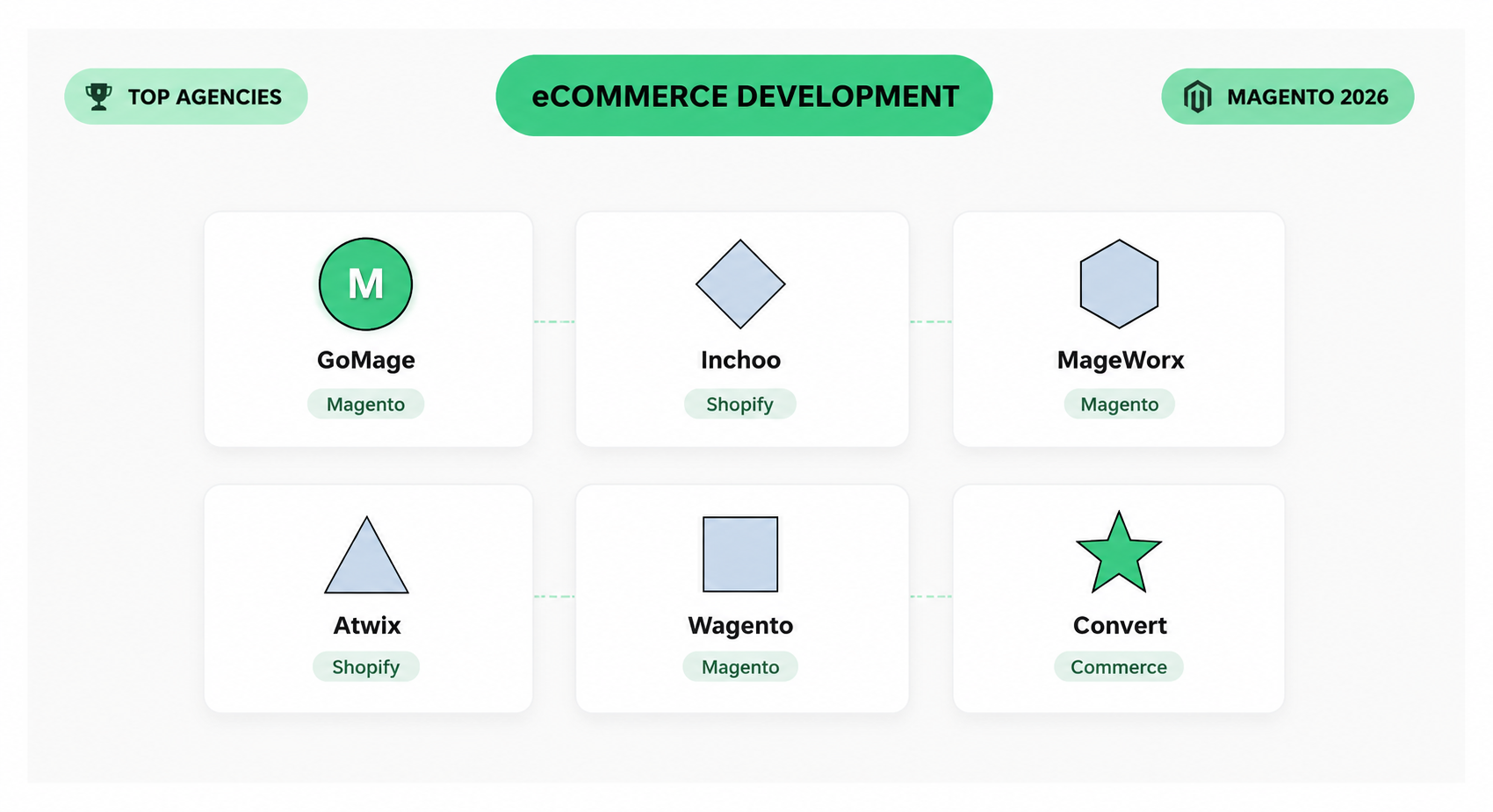
Agencies with regional expertise help merchants localize experiences for high-value European markets
Quantenwerft is a Germany-based web agency headquartered in Wunsiedel, Bavaria, working across complex web applications and WordPress Multisite networks. For Magento merchants targeting the DACH region (Germany, Austria, Switzerland), regional proximity isn’t a soft preference – it’s a hard requirement.
Localization for German-speaking buyers goes beyond translation. Payment preferences differ (SEPA direct debit and invoice payment are standard expectations), GDPR compliance requirements are enforced more strictly than in most markets, and German-language UX conventions carry their own patterns that affect conversion rates. An agency that builds fast stores but lacks a structural understanding of these factors will produce a store that looks fine in a demo but underperforms in the market.
Quantenwerft’s positioning as a complex web application specialist means merchants with non-standard technical requirements – Multisite configurations, custom integrations, or bespoke application layers – have an option that doesn’t require them to adapt their needs to a rigid product package.
Best for: Merchants targeting the DACH region who need a European digital partner with genuine regional fluency and the technical depth to handle complex, non-standard builds.
2. Magebit: Best for Adobe Commerce Certification Depth
Magebit (Latvia) ranked #1 globally in Adobe’s Solution Partner Directory for Commerce specialization for two consecutive years, 2024 and 2025. That’s the kind of third-party validation that’s hard to manufacture – Adobe’s ranking methodology weighs certifications, project volume, and customer satisfaction data together.
The agency holds Hyvä Platinum partner status and created the Venta rapid-deployment theme. Since the Hyvä Theme went open source in November 2025, with 1,800 unique domains registering for the open-source version in the first two months alone (Floowi Talent, 2025), having a partner with deep Hyvä expertise matters more than it did a year ago. Hourly rates run $50- $ 99, placing Magebit in the mid-tier range relative to the global market.
Best for: Merchants who need airtight Adobe certification credentials and want an implementation partner with proven expertise in Hyvä frontend.
3. Scandiweb: Best for Large-Scale Headless Commerce Builds
Scandiweb (Latvia) operates with 300+ certified Magento developers and holds Hyvä Platinum partner status with 15+ certified Hyvä developers and 40+ Hyvä projects delivered. Their core strength is headless architecture: decoupled React or Vue frontends running over a Magento or Adobe Commerce backend.
That’s a significant bench. Headless builds require coordination across frontend and backend teams simultaneously, and an agency that runs out of certified developers mid-project is a project-management problem waiting to happen. Scandiweb’s scale reduces that risk.
One honest caveat: the scale comes with a price point and a project-minimum threshold that rules out early-stage stores. Scandiweb suits enterprise-tier merchants already running MACH architecture, or high-traffic stores whose frontend performance has become the primary growth constraint.
Best for: Enterprise merchants who need a decoupled frontend and have the budget and project scope to match the agency’s minimum requirements.
4. Elogic Commerce: Best for Performance Audits and ERP Integration
Elogic Commerce is based in Estonia and operates globally, with a practice focused on Magento theming, ERP and CRM integrations, code quality audits, scalability reviews, and infrastructure optimization.
What distinguishes Elogic from general-purpose Magento shops is the structured audit-first approach. Before recommending development work, they run a diagnostic to map out what’s actually wrong with the store. That keeps the project scope honest and prevents the familiar situation in which a merchant pays for a full rebuild when a targeted intervention would have solved the core problem.
Mid-market merchants are the primary audience: stores that have grown organically over several years, accumulated technical debt, and now struggle with slow load times, messy integrations, and limited visibility into the problems’ root causes.
Best for: Merchants with existing Magento stores that need an honest technical assessment before committing to development spend.
5. Inchoo: Best for SEO-First Store Optimization
Inchoo (Croatia) has built its reputation on Magento 2 store optimization, UX improvement, and clean Magento 2 migrations. The agency’s distinguishing characteristic is its approach to SEO as an engineering problem, not a content problem. Fast stores, a clean, crawlable architecture, and technically sound Magento 2 implementations are the core outputs.
The use case that fits Inchoo best is a merchant who migrated from Magento 1 but never properly optimized the Magento 2 store for search, or one getting reasonable organic traffic that isn’t converting into revenue. Those problems are often structural – Core Web Vitals failures, bloated page weights, or migration artifacts that confuse crawlers.
One discipline that makes development briefs sharper in this context is knowing what competing stores are actually doing. Teams that track rival keyword rankings and backlink movements using the best competitor analysis tools tend to give their agency partners far more specific briefs, which translates directly into better-prioritized technical work.
Best for: Merchants who need rigorous Magento 2 SEO optimization, clean migration support, or a technically focused agency that treats store performance as an engineering discipline.
6. Atwix: Best for B2B Adobe Commerce Implementations
Atwix was founded in 2006, holds Gold Adobe Solution Partner status, and is the #1 Magento contributor worldwide. With 300+ certifications and a long track record in the open-source Magento ecosystem, the agency knows Adobe Commerce’s strengths and limitations because it’s helped shape the platform.
Their specialty is Adobe Commerce B2B: custom pricing rules, customer groups, wholesale portals, and complex ERP integrations. The B2B eCommerce market is estimated at $36.16 trillion as of 2026 (Grand View Research), growing at a 14.5% CAGR. Merchants building B2B functionality, such as quote workflows, custom catalogs, and tiered pricing, need a partner who knows the Adobe Commerce B2B module thoroughly, not one that treats it as a secondary capability.
Best for: B2B merchants building on Adobe Commerce who need deep platform expertise and a partner with a record of contributing to the platform’s core.
How to Choose the Right Partner for Your Store
Not every agency on this list suits every merchant. Matching your actual situation to an agency’s genuine strength is what separates projects that ship on time from those that stall at month four.
Three questions worth asking any agency you shortlist:
- How many Adobe-certified developers will work specifically on my project?
- Do you have case studies from stores in my industry and at my revenue tier?
- What does your audit or discovery process look like before you quote?
The web development outsourcing market is projected to grow from $1.6 billion in 2025 to $2.9 billion by 2035 at a 6.3% CAGR, according to Future Market Insights. That growth means more agencies entering the market, not necessarily better ones. Due diligence matters more as the pool widens.
For a structured framework on what to look for when evaluating Magento vendors, GoMage’s guide on how to choose the right Magento agency covers the key questions in useful depth.
Final Thought
The agencies on this list each do something specific well. The best outcome isn’t finding the most decorated agency on paper. It’s finding the one whose core strength matches your current bottleneck, whether that’s European localization, headless architecture, B2B catalog complexity, or SEO-driven store optimization. Build from that match.