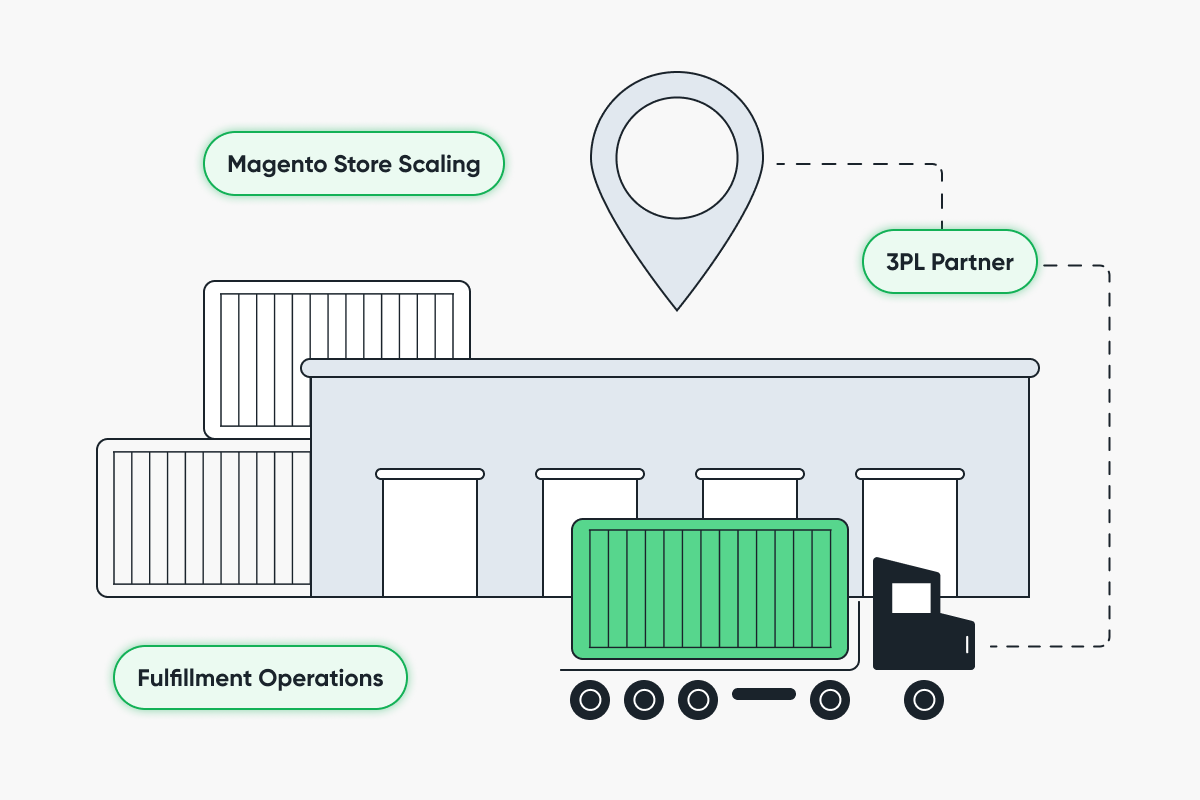
A well-built Magento store and a well-run fulfillment operation are not separate concerns. At scale, they function as a single system, with the seams between your backend and 3PL partners as the source of most scaling problems.
There’s a familiar breaking point around the 200-orders-per-month mark. Conversion rates are healthy, ad spend is paying off, and the Magento backend is humming. Then the one-star reviews start: late packages, wrong items, stockout errors the storefront never caught. The platform isn’t failing. The fulfillment layer is.
This is the fulfillment paradox. A Magento developer can deploy a performance fix, push a new extension to staging, and go live before lunch. Warehouse capacity, trained pick-and-pack staff, and carrier contracts don’t operate on deployment schedules.
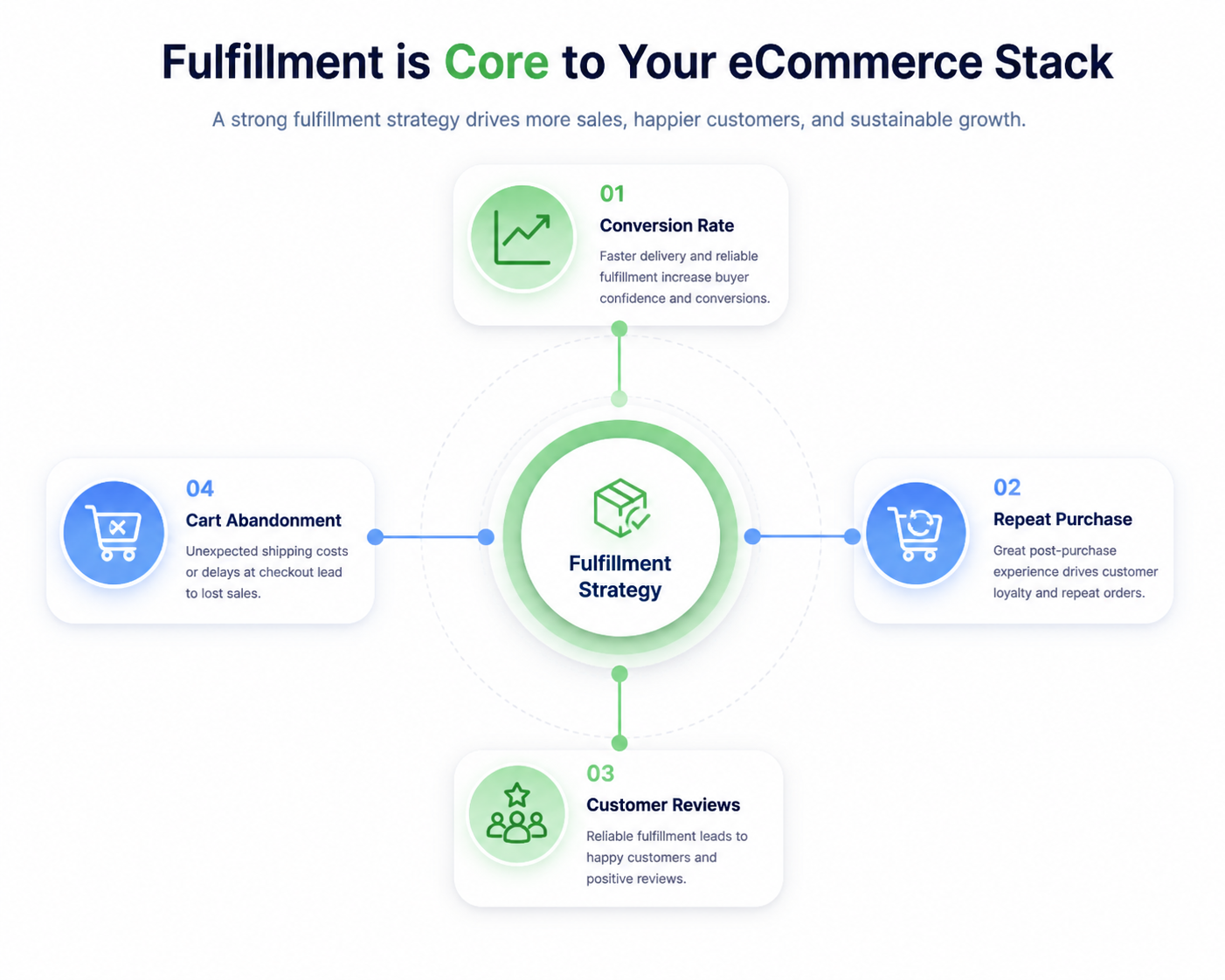
According to the Baymard Institute’s 2024 research, 48% of online shoppers abandon their carts due to high shipping costs added at checkout. That’s not a Magento development problem; it’s a fulfillment cost problem surfacing at the worst point in the conversion funnel. This article covers how 3PL partners and integrations work inside Magento’s architecture, what the real cost structure looks like, and what separates a 3PL partner that extends your platform from one that creates new integration debt.
How a 3PL Integrates with Your Magento Store
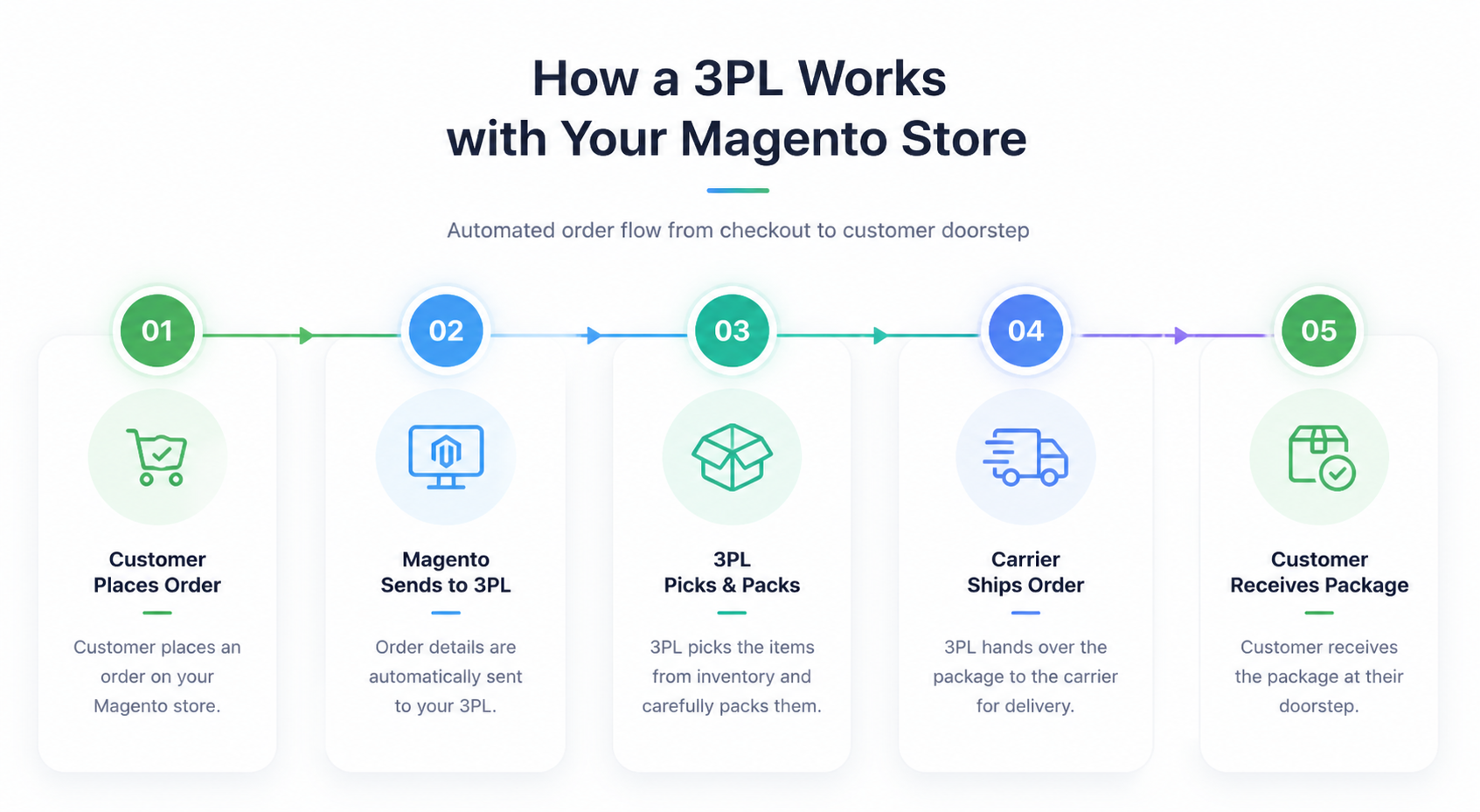
The 3PL model offloads the physical layer warehousing, picking, packing, and shipping, and connects it to your Magento order pipeline through direct data integration.
Magento provides three main integration paths for 3PL connections. First: a native extension from the Adobe Commerce Marketplace, which maps Magento order objects to the 3PL’s WMS schema without custom development. Second: a REST API integration using Magento’s Orders API (/V1/orders), typically triggered by a cron-based sync or a custom observer on order placement. Third and most reliable for high-volume stores, an event-driven architecture built around Magento’s native observer system, firing the sales order place after the event to push order data to the WMS in real time, the moment checkout completes.
Magento’s Multi-Source Inventory (MSI) module, introduced in 2.3, is the feature most merchants overlook when planning 3PL integrations. MSI lets you define multiple inventory sources, including external warehouses managed by a 3PL, and assign them to sales channels with configurable sourcing algorithms. A properly configured MSI setup means Magento routes each order to the geographically optimal warehouse automatically, without a line of custom code.
When the integration is running correctly, the sequence is invisible to the customer: order placed, WMS receives the event, picker grabs the item, it ships same day or next business day, inventory counts decrement automatically in Magento. No CSV imports, no overnight batch jobs. For Magento merchants serving the western US, a fulfillment Utah provider positions inventory within a two-day ground shipping range of roughly 35% of the US population — covering West Coast and Central US customers without express freight premiums.
Why Fulfillment Infrastructure Belongs in Your Magento Architecture
Fulfillment is not a back-office system that happens to connect to Magento. It is a runtime dependency of the customer experience the store delivers.
Most development teams treat fulfillment integrations as a final phase, something wired up after the core Magento build is stable. That sequencing creates technical debt. When fulfillment is architected alongside the storefront, you get cleaner order state management, fewer edge cases in the status workflow, and a cancellation and return flow that actually maps to how the 3PL processes exceptions.
The right way to think about it is through Magento’s own service contract model. A modular eCommerce store architecture where the 3PL is a swappable service behind a defined interface lets you migrate providers, add warehouse nodes, or adjust routing logic without touching storefront code. The 2025 Third-Party Logistics Study found that 91% of shippers report that outsourcing to a 3PL improved their supply chain effectiveness. That figure reflects merchants who built the integration deliberately.
The merchants who figure this out early stop treating fulfillment as a cost center to minimize. They start treating it as a configurable feature of their platform, one that ships improvements on a roadmap, not just during crises.

- +45% Increase in online sales
- 3× faster subscription
- 70% reduction in manual tax
The real cost of fulfillment: metrics Magento merchants should track
Most merchants miscalculate fulfillment cost by looking only at carrier fees. The real number includes storage, pick-and-pack labor, packing materials, returns processing, and the developer hours spent maintaining whatever integration is holding the pipeline together.
Industry data puts total fulfillment costs at 5-15% of revenue for most eCommerce businesses, rising to 12-20% when returns are included. The National Retail Federation’s 2024 data puts the average eCommerce return rate at 16.9%, with $890 billion in returned product annually. In-house returns processing typically costs 20-65% of the original item value.
A 3PL converts most of these fixed costs to variable ones. Slow months mean lower storage and labor fees. Peak months scale without emergency hiring or renegotiated contracts. For Magento stores running flash sales or influencer-driven traffic spikes, the cost elasticity is worth more than the per-unit rate savings.
On the platform side, the key metric to connect is the cart abandonment rate against the delivery estimate accuracy. Tracking eCommerce conversion metrics alongside fulfillment KPIs, average dispatch time, order accuracy rate, and transit time by zone gives you a clearer picture of what is actually driving customer behavior. If abandonment is climbing at the same time average delivery time is climbing, you are looking at a fulfillment cost bleed already visible in your checkout.

- 120% increase in revenue
- 50% increase in average session duration
- 2,500% decrease in bounce rate
What to look for when choosing a 3PL partner
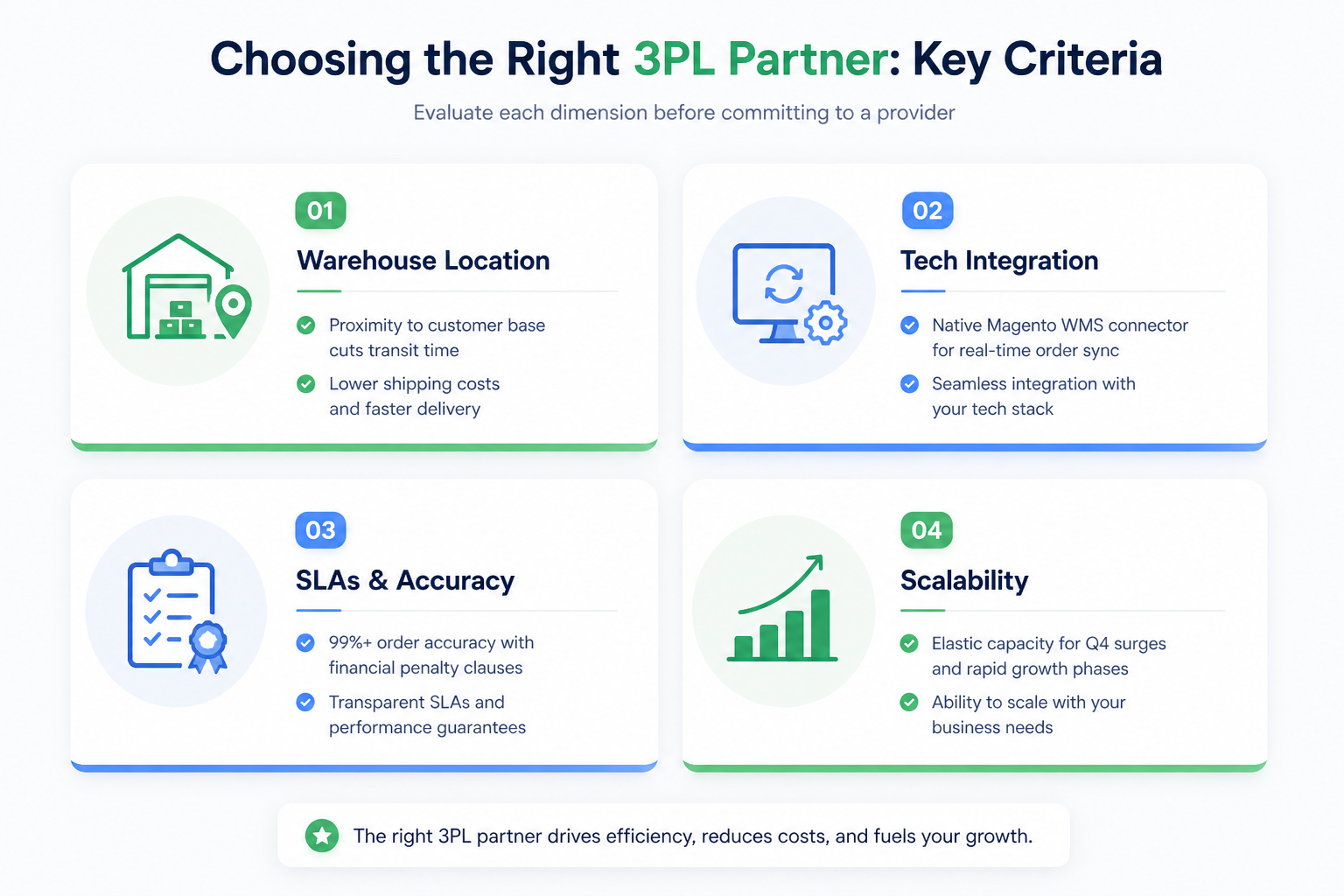
Choosing a 3PL is partly a logistics decision and partly a technical integration decision. The evaluation needs to cover both dimensions.
Start with warehouse geography relative to your customer concentration. ShipBob’s 2024 data shows that distributing inventory across multiple fulfillment centers cuts average shipping time by 71% compared to single-location fulfillment. Even one well-sited facility can push the majority of orders to 2-day ground without express freight a direct impact on cart abandonment at checkout.
API quality and documentation are non-negotiable for Magento stores. Before signing any contract, request the 3PL’s REST or webhook documentation and test it against a staging environment. If they are syncing orders via scheduled CSV uploads, that is a daily failure point during any traffic spike. The right provider has a sandbox environment, versioned API docs, and can speak to Magento-specific integration patterns, not just generic eCommerce connectors.
SLAs and order accuracy must be contractual. Look for 99%+ order accuracy guarantees with financial penalties for misses. A 3PL that won’t put its accuracy rate in writing doesn’t have a number it is comfortable defending.
Scalability is where most evaluations miss the real risk. Ask directly: What happens to our account during Q4? If the answer involves renegotiating terms or getting deprioritized, that is a risk to your peak-season order throughput. You need a provider whose infrastructure scales with your Magento store’s traffic.
For a broader evaluation framework, including SLA benchmarks and contractual terms to review before sending RFPs, Shopify’s 3PL complete guide is worth reading in full.
Building fulfillment as a scalable Magento feature
The merchants who break through the $2-5M ceiling treat fulfillment the same way they treat any other Magento module: with an owner, documentation, and a roadmap.
When a 3PL handles warehousing, picking, shipping, and returns through a stable API integration, the development team stops spending sprint capacity on logistics firefighting. That capacity moves to performance optimization, feature development, and the Magento improvements that actually move conversion metrics. The platform and the fulfillment operation improve in parallel rather than competing for the same engineering attention.
There is a real tradeoff to acknowledge. Outsourcing fulfillment means the order handling process is no longer under direct engineering control. When the 3PL has a WMS outage or an API error, your Magento order queue is affected and the fix is a support ticket, not a deploy. The answer is not to avoid 3PLs — it is to build the integration with proper error handling, order status fallbacks, and retry logic on the Magento side so that WMS disruptions do not propagate into customer-facing failures.
The connection to checkout optimization is direct. Magento merchants with a 3PL providing reliable lead times can display specific, accurate delivery estimates at checkout. Shoppers who see a credible delivery date convert at higher rates than those who see ‘ships in 3-5 business days.’ The fulfillment SLA becomes a checkout copy improvement without any front-end development work.
Conclusion
Fulfillment is not a logistics problem that lives outside your Magento architecture. It is a runtime dependency that shows up in your conversion rate, your order state management, and the customer experience your platform delivers.
For Magento merchants scaling past the point where in-house shipping makes sense, a properly integrated 3PL partner offers cost variability, measurable shipping speed gains, and the engineering headroom to keep improving the storefront. The eCommerce fulfillment market is valued at $138.25 billion in 2025 and growing at nearly 12% annually, according to Mordor Intelligence’s 2025 report.
The practical starting point is an integration audit: map your current order flow from checkout completion to the customer’s door and identify every manual step, every batch sync, and every place where a delay in one system causes a failure in another. Those gaps are where a well-integrated 3PL replaces fragility with a tested, contractual service level.