Artificial intelligence has become part of daily communication, search, and work routines. Among the growing number of AI tools, two names appear most often in 2025: ChatGPT VS Perplexity.
ChatGPT, developed by OpenAI, is designed for conversation and creation. It helps people write, explain, plan, and communicate in a way that feels natural. Perplexity follows a different path. It focuses on verified information, collecting answers from live web sources and providing clear references.
The scale of use is enormous. In May 2026, ChatGPT reached 5.49 billion visits in a single month. Perplexity also continues to grow, with more than 22 million active users and hundreds of millions of queries every week.
This article explores how these tools differ, what each one does best, and how businesses and professionals can use them to improve their daily work.
Key Features and Capabilities Compared
ChatGPT and Perplexity both help people work with information, but their focus is not the same.
ChatGPT
- Content creation
Writes articles, emails, and reports in different tones. Handles both short texts and detailed explanations with ease. - Context understanding
Keeps track of previous messages, so conversations stay logical and connected. - Multimodal support
Reads images, documents, and charts. Useful for research, design, and visual analysis. - Integration options
Works smoothly with tools such as Google Drive, Slack, and Canva, reducing manual effort. - Creative flexibility
Adapts language and tone to fit business or personal communication. Always finds a natural flow of words.
Perplexity
- Real-time information
Collects data from live web sources instead of static knowledge. Perfect for checking current topics. - Verified answers
Shows clear links to the sources. You can confirm accuracy without extra searching. - Efficient summarisation
Turns long texts into concise notes that capture key details. - Interactive exploration
Suggests follow-up questions, making the research process feel continuous and intuitive. - Research accuracy
Delivers factual results trusted by analysts, journalists, and students.
Practical takeaway
ChatGPT encourages creativity and expression. Perplexity values precision and truth. Together, they offer a complete balance between thinking and knowing.
Which AI Conversational Tool Is Better for Businesses?
Every company looks for tools that can save time without losing quality. ChatGPT and Perplexity do this in different ways, so the choice depends on what kind of work a team does most.
ChatGPT fits companies that work with content, communication, or customer interaction. Marketing teams use it to shape campaign ideas and write short promotional copy. Customer support teams prepare response templates that sound friendly and professional. Project managers rely on it for meeting summaries and quick planning notes. The platform works well when the main task involves creating or refining written communication.
Perplexity often becomes a research companion. Businesses use it to collect information before a product launch, monitor competitors, or check facts during reporting. Analysts appreciate how it connects directly to live data and provides visible sources. When accuracy matters more than tone, this tool gives a clear advantage.
Some companies use both. ChatGPT helps start a conversation or prepare text that feels human, while Perplexity confirms whether the information behind it is current and reliable. Together, they reduce routine work and help teams make decisions based on both creativity and truth.
The most successful businesses in 2026 are not choosing between the two. They combine them, letting ChatGPT write the story and Perplexity make sure it is real.
Read also our article “The Top 11 AI Technologies You Should Know About” to explore the tools shaping the future of artificial intelligence.
Ease of Use: Which Platform Is More User-Friendly?
Both platforms are simple to start with, yet the experience they create is not the same.
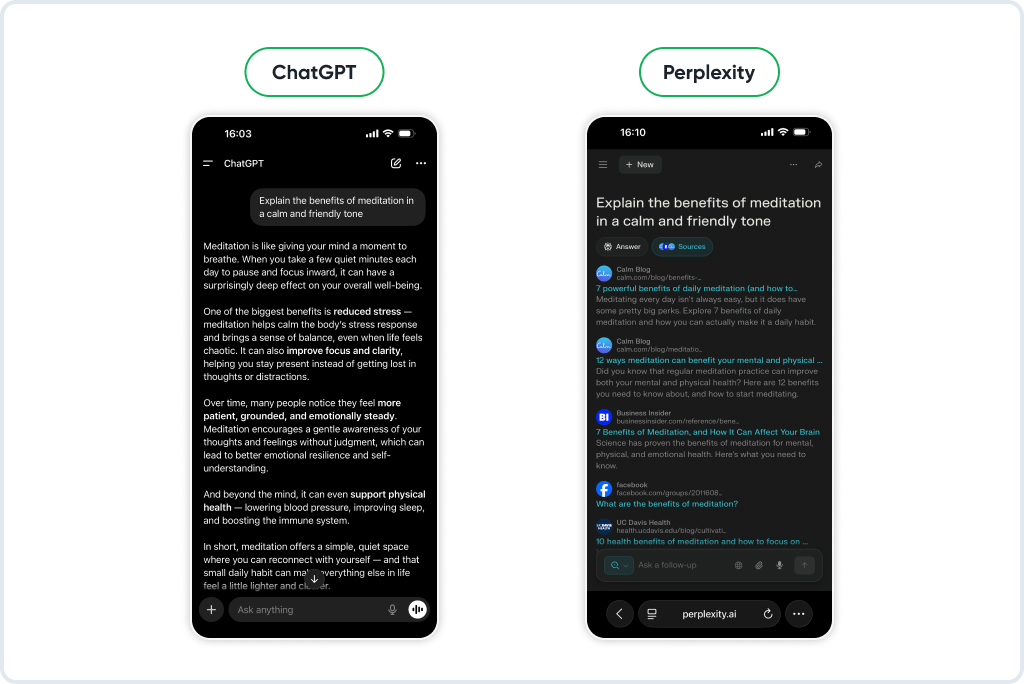
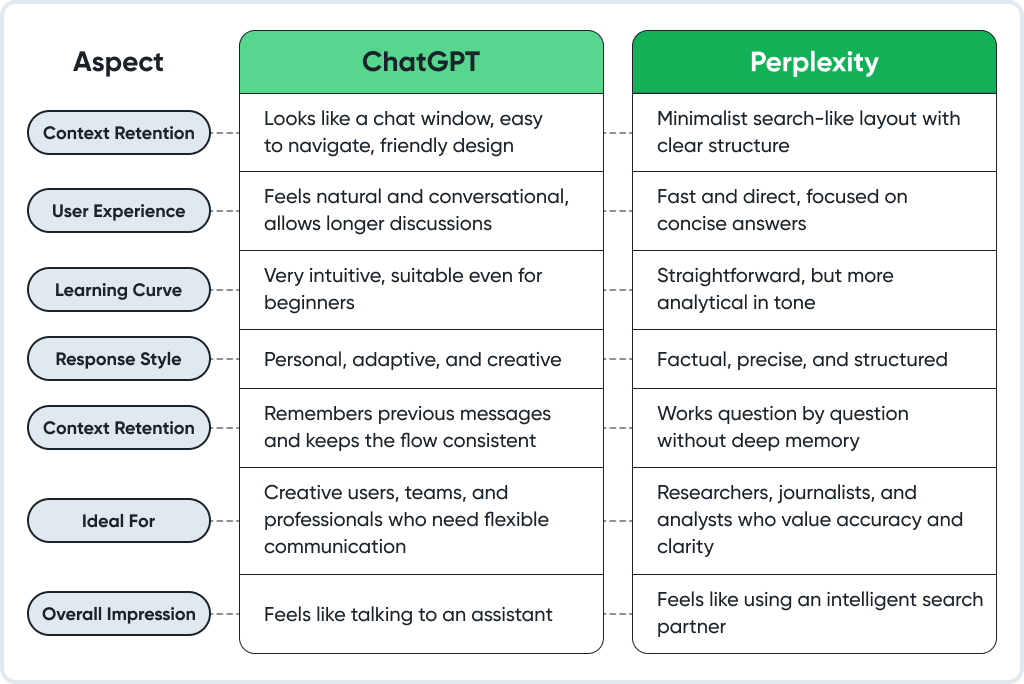
ChatGPT welcomes users with a clear chat window. You type a question and receive an answer right away. The exchange feels easy and personal. It supports longer discussions, follow-up questions, and text editing within one flow. Many people use it to plan projects, write drafts, or solve technical problems. Even new users understand how it works after a few minutes of trying.
Perplexity feels more structured. The layout looks closer to a search page than a chat. It gives short, organized answers and shows the sources underneath. The tool focuses on clarity and calm rhythm. It suits users who prefer reading quick summaries instead of long conversations.
Each platform has its own audience. ChatGPT feels like a creative partner who helps shape ideas. Perplexity works more like a quiet analyst who finds and confirms facts. The choice depends on what you value more, imagination or precision.
What One Can Do That the Other Cannot
At first glance, ChatGPT and Perplexity seem similar, but the way they work is not the same. Each platform offers something unique that the other cannot fully replicate.
What ChatGPT can do that Perplexity cannot
ChatGPT creates rather than searches. It can write, imagine, and adapt its voice to match the situation. The same tool can sound formal in a report or friendly in a conversation. It builds long exchanges that stay consistent in tone and meaning. For creative teams, this continuity feels close to working with a colleague who understands context.
It also senses nuance. ChatGPT can change the emotional tone of text or shape it to fit a purpose, such as persuasion or storytelling. It helps when the goal is to express an idea, not only to find information.
What Perplexity can do that ChatGPT cannot
Perplexity connects to the live web. It retrieves the most recent data, checks facts, and provides summaries based on current information. ChatGPT depends more on what it learned during training, so it sometimes misses recent updates. For research and analytics, this difference is significant.
Another thing Perplexity does better is transparency. Every answer includes visible references. Users can open a link and see the original source immediately. ChatGPT often provides fluent answers, but it does not always explain where the information came from.
In short
ChatGPT gives language shape and emotion. Perplexity gives it structure and proof. One helps people create, the other helps them confirm.
ChatGPT and Perplexity in Different Industries
People in nearly every field now use conversational AI regularly. ChatGPT and Perplexity both show up in workflows, but they solve different problems depending on the job.
Marketing and Communication
ChatGPT helps teams sound consistent. Marketers use it to draft campaigns, adjust tone, or rewrite copy until it feels right. Perplexity digs into data instead. It pulls insights from multiple places and helps build arguments backed by actual numbers rather than guesses.
Education
Students ask ChatGPT to break down topics they don’t understand. Teachers use it for lesson planning or turning dense material into something clearer. Perplexity works better for research since it points to real sources you can cite, which matters when accuracy counts.
Healthcare
Clinics use ChatGPT to draft patient summaries, treatment instructions, and internal reports that doctors review later. It speeds up documentation. Perplexity adds another check by surfacing medical studies and current protocols from reputable journals and databases.
Both tools earn their place, just in opposite corners. ChatGPT makes expression easier. Perplexity makes verification faster. Used together, they let people work quicker, communicate better, and decide with more confidence.
Pricing and Access Options
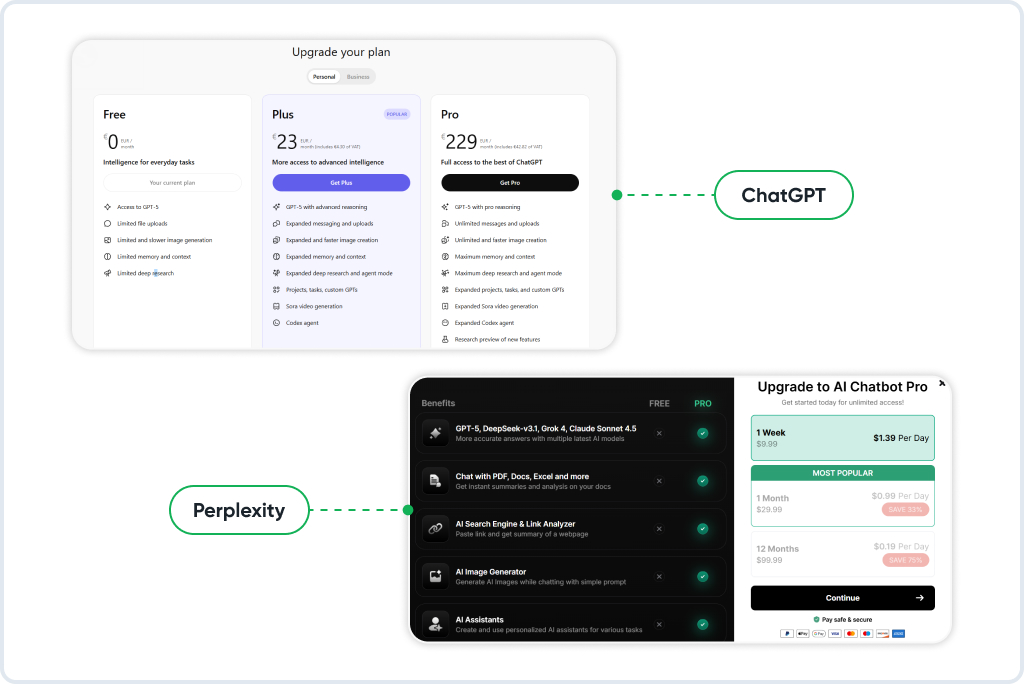
ChatGPT comes in a few tiers. The free version runs on GPT-3.5, which handles everyday tasks. GPT-4 and GPT-4 Turbo sit behind a paywall and deliver faster, sharper answers. Teams and Enterprise plans let groups share workspaces, control who sees what, and plug the system into their own tools.
Perplexity keeps it straightforward. Free users get standard search with source links. Perplexity Pro unlocks better reasoning and lets you upload files. It’s built for people who need correct answers with proof, not polished prose.
Both work in browsers and on mobile, so you can jump between devices without starting over.
Which One Should You Choose?
It comes down to what you’re doing. Writers, marketers, and teachers lean toward ChatGPT because it helps them sound clear and human. Researchers, analysts, and students pick Perplexity since it brings real sources and tracks what’s actually true.
Plenty of people run both at once. One turns messy ideas into readable text. The other checks whether that text holds up. Together they cover creativity and accuracy, which most teams now need in tandem.
FAQ
ChatGPT builds and shapes written content. You give it rough ideas, it turns them into something readable. You can shift tone, rewrite sections, or explore different angles. Perplexity pulls information from the web and shows you exactly where it found each piece. If you need sources you can cite or verify, that’s what it does best.
The free tier can’t. It only knows what it learned during training, which has a cutoff. Paid plans add browsing, so ChatGPT can grab fresh info when you ask about recent events or changing topics. Still, it’s not a search engine. It’s more like having web access added on top of conversation.
Researchers, students, analysts, journalists. Anyone building something that needs backup. If your work involves reports, studies, or anything where citations matter, Perplexity saves hours. It hands you facts with links attached so you can check them yourself.
Depends on what you’re doing. Market research, competitive analysis, compliance work? Perplexity fits because it delivers traceable data. Running campaigns, drafting internal comms, creating content? ChatGPT handles that better since it helps teams write consistently and quickly.
No. They knock out grunt work and speed things up, but people still review outputs, apply judgment, and make final calls. These tools assist. They don’t think strategically or understand nuance the way humans do.
All the time. Pull research with Perplexity, then feed it into ChatGPT to write reports, articles, or presentations. One gets you accurate info, the other makes it readable. That combo keeps work both credible and engaging.
ChatGPT. It talks like a person and adjusts to how you ask questions. Perplexity expects you to evaluate sources and interpret search results, which takes practice if you’re not used to research work.
Nope. It searches the web live to pull current info and source links. No internet means it can’t function. That real-time searching is what makes it useful, but offline access isn’t an option.