Artificial intelligence is no longer something you only hear about at tech events. It shows up in hospitals, in shops, and even in the way we scroll through our phones. A doctor might use it to scan an X-ray, a store to guess what you are likely to buy, while many of us simply meet it in the form of a chatbot answering basic questions.
Think about your own routine. Maybe you asked your phone for directions this morning. Maybe Netflix or Spotify suggested something that actually matched your taste. Or you glanced at the screen and it unlocked just by spotting your face. That is AI working quietly in the background.
Plenty of new tools keep coming out, but not all of them matter equally. A smaller group of technologies is pushing industries forward, and understanding these can be useful for anyone who wants to stay prepared for what is next.
What Are the Key Types of AI Technologies?
AI shows up in very different ways. One system might scan medical images, another helps an app recommend music, while in an office setting it may just move numbers from one table to another. Here are a few areas where it is most visible:
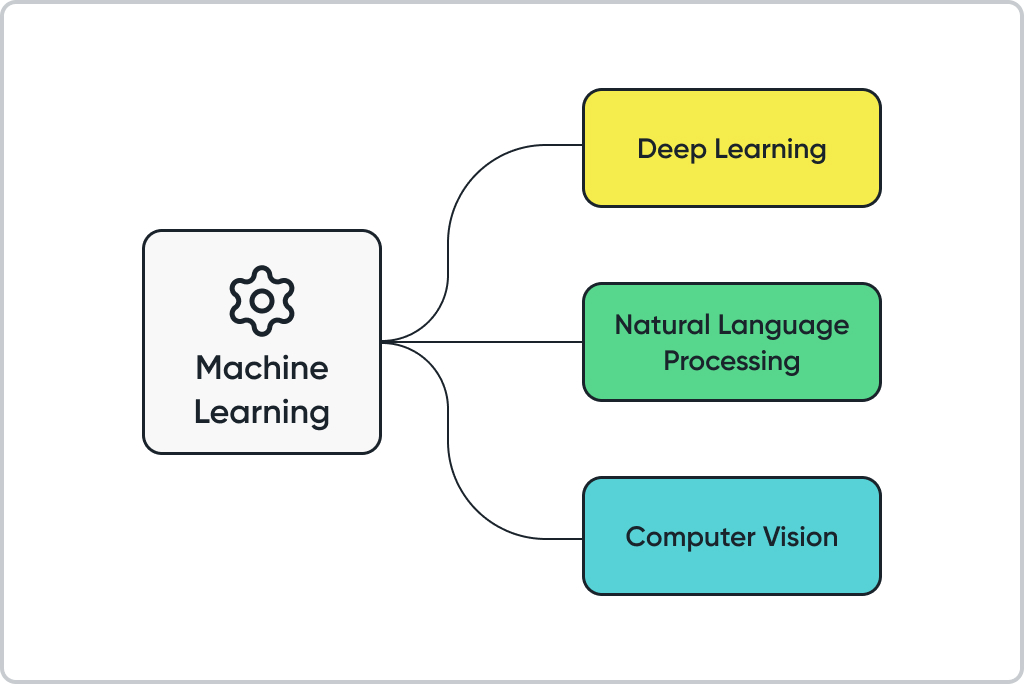
- Machine Learning. Instead of giving a computer a strict rulebook, we let it learn from examples. Businesses often leverage Machine Learning Development Services to build intelligent systems that improve over time through data-driven learning.
- Deep Learning. This is the branch that copies the way our brains handle information. It makes face recognition work, supports driverless cars, and powers some of the smarter chat tools around.
- Natural Language Processing. Better known as NLP, this is the reason apps can translate text, assistants like Siri can talk back, and customer service bots can reply in full sentences.
- Computer Vision. With this, machines can make sense of pictures. Hospitals rely on it for X-rays, factories use it to spot defects, and airports for faster security checks.
- Robotic Process Automation. Often shortened to RPA, it quietly takes care of digital chores such as filling out forms. Offices run smoother because of it.
Most of the impressive AI tools people talk about today are not based on just one of these technologies, but on a mix of several.
Deep Learning: A Key to Advancements in AI
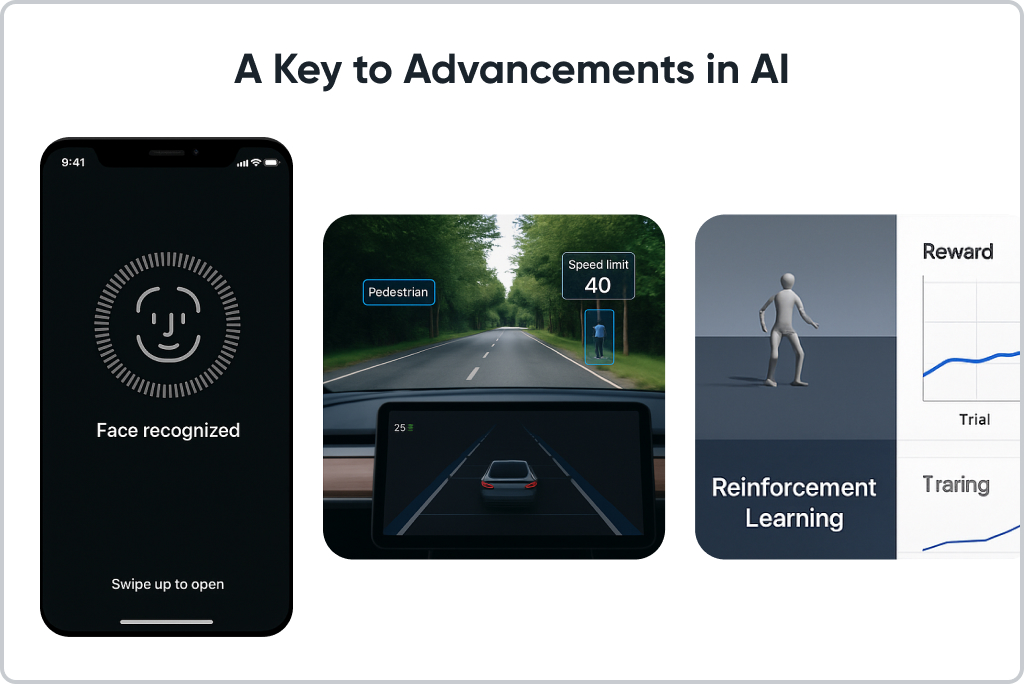
Deep learning now stands at the center of modern artificial intelligence. Instead of being told exactly what to do, these systems use digital “neurons” that work in layers, almost like the pathways in the human brain. Because of this structure, they can notice details that older programs would simply ignore.
You see its results every day. A quick glance unlocks your phone. A car can slow down when it spots a pedestrian. Streaming platforms suddenly know what movie you feel like watching. These small moments are powered by the same method.
There is also reinforcement learning, which takes things further. The system tries, fails, and improves, much like a person practicing a sport. Robots trained this way learn to walk across uneven ground or to play complicated games without being given exact steps.
Deep learning on its own is powerful, but its real strength comes when it works together with other types of AI. That is when machines stop acting like simple tools and start behaving more like adaptive systems that improve with every experience.
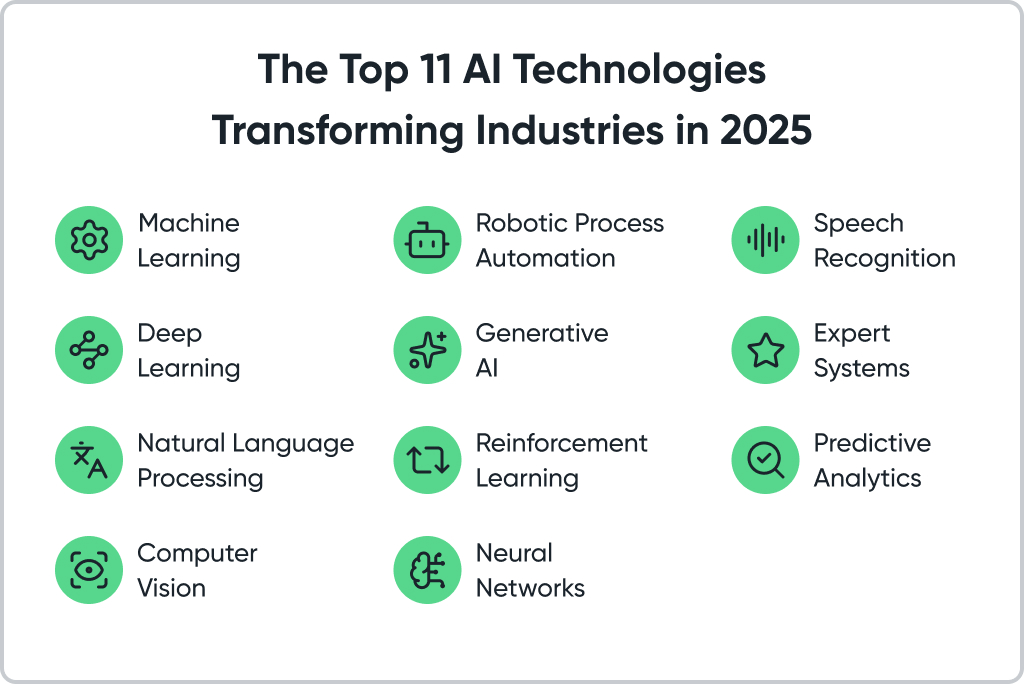
Top 11 AI Technologies Transforming Industries in 2025
Here are eleven that stand out in 2025:
- Machine Learning
Computers improve by learning from data. Think of Netflix recommending the next series or banks spotting unusual transactions.
- Deep Learning
A branch of machine learning that uses many layers of neural networks. It powers face recognition on phones and advanced medical image analysis.
- Natural Language Processing (NLP)
The technology behind Google Translate, Siri, and chatbots. It allows machines to understand and respond to human language.
- Computer Vision
Systems that “see” and interpret images and video. Used in self-driving cars, airport security, and hospital diagnostics.
- Robotic Process Automation (RPA)
Software that takes over repetitive office work such as filling in forms or moving data between systems. Quiet but effective.
- Generative AI
Tools that create text, images, video, or even music. They are changing creative industries from advertising to film production.
- Reinforcement Learning
Training machines through trial and error. It helps robots walk, drones fly, and AI beat humans in complex games.
- Neural Networks
The architecture is inspired by the human brain. It forms the basis for many other AI methods and is key to progress in deep learning.
- Speech Recognition
Turning spoken language into text. Essential for virtual assistants, call center automation, and hands-free devices.
- Expert Systems
One of the earliest forms of AI, built to copy the decision making of specialists. Still used in areas like healthcare and engineering.
- Predictive Analytics
Using data and algorithms to forecast outcomes. Retailers use it to manage inventory, and doctors use it to anticipate patient needs.
Together, these technologies show how broad AI has become. Each works in a different way, but their real power appears when they are combined.
How Deep Learning and Reinforcement Learning Are Advancing AI Applications
- Deep Learning
- Works best with huge amounts of data
- Powers face recognition on smartphones
- Suggests shows or music on platforms like Netflix and Spotify
- Helps doctors spot hidden details in medical scans
- Reinforcement Learning
- Learns through trial and error
- Makes mistakes, corrects them, and improves over time
Examples: robots learning to walk, AI mastering complex strategy games
- When Combined
- Self-driving cars use deep learning to “see” the road and surroundings
- Reinforcement learning helps decide the next safe move
- Together they build intelligent systems that can both recognize and act
The Rise of Generative AI and Its Impact on Creative Industries
Generative AI has become one of the most talked about technologies in 2025. Unlike traditional AI tools, it does not only analyze data but creates new things: text, pictures, videos, even music.
It is already visible in creative industries:
- Marketing teams use it to draft campaigns in hours instead of weeks.
- Film studios experiment with AI-made visuals and storyboards.
- Fashion brands test digital collections before producing real clothes.
The impact is huge. Content that once required large budgets can now be produced by small teams. At the same time, it brings new questions about originality, ownership, and ethics.
The future likely belongs to collaboration. Human creativity sets the vision, and AI provides speed and endless variations. Together they open a new chapter for design, media, and entertainment.
Final Thoughts
Artificial intelligence is already changing how people work, shop, and create. The technologies we covered are not theories anymore, they are tools shaping industries right now.
At GoMage, we help businesses turn these AI opportunities into real results. From smarter e-commerce solutions to innovative automation, our team knows how to make AI work for growth.
If you want to explore how AI can transform your business, we are ready to guide you.
FAQ
You’ll mostly hear about machine learning, deep learning, NLP, computer vision, and generative AI. These are the tools shaping how we build, sell, and even think about technology today.
They sound similar, but they work differently. Machine learning looks for patterns in data, while deep learning uses many connected layers to handle more complex things like sounds or images.
Almost anything digital. It writes, draws, edits, and designs. Many people use it to speed up creative work or get fresh ideas when starting a new project.
Not by itself. It follows rules step by step. But once AI gets involved, it starts to learn from data and make smarter decisions instead of repeating the same actions.
Finance, healthcare, and retail lead the way. Logistics, manufacturing, and media are close behind, exploring how automation and insights can cut costs and boost performance.
Absolutely. You don’t need a big budget anymore. Cloud platforms make it easy to use AI for marketing, analytics, or customer support.
Not in the way many fear. It removes repetitive work but creates new roles focused on creativity, critical thinking, and communication.
Start small. Play with basic machine learning tools or simple models, then move toward deep learning and NLP once you feel confident.
At GoMage, AI helps us build smarter eCommerce. We use it to personalize product recommendations, improve search results, and automate daily operations for online stores.