For roughly twenty years, before the shift toward AI SEO, the mechanics of eCommerce SEO were stable enough that you could build a repeatable playbook around them. Find the keywords your customers use, put those words in the right places on the right pages, acquire links from sites with authority, and track where you ranked. Agencies standardized it. Tools automated pieces of it. Entire content departments were staffed around it.
What shifted since 2024 is not a refinement of that playbook. When a growing share of searches end with the user reading an AI-generated summary and never clicking through to any site, the equation that connected rankings to traffic to revenue starts behaving differently. The brands figuring this out fastest are the ones that stopped treating AI search changes as temporary turbulence and started treating them as a different operating environment entirely.
What Changed and When
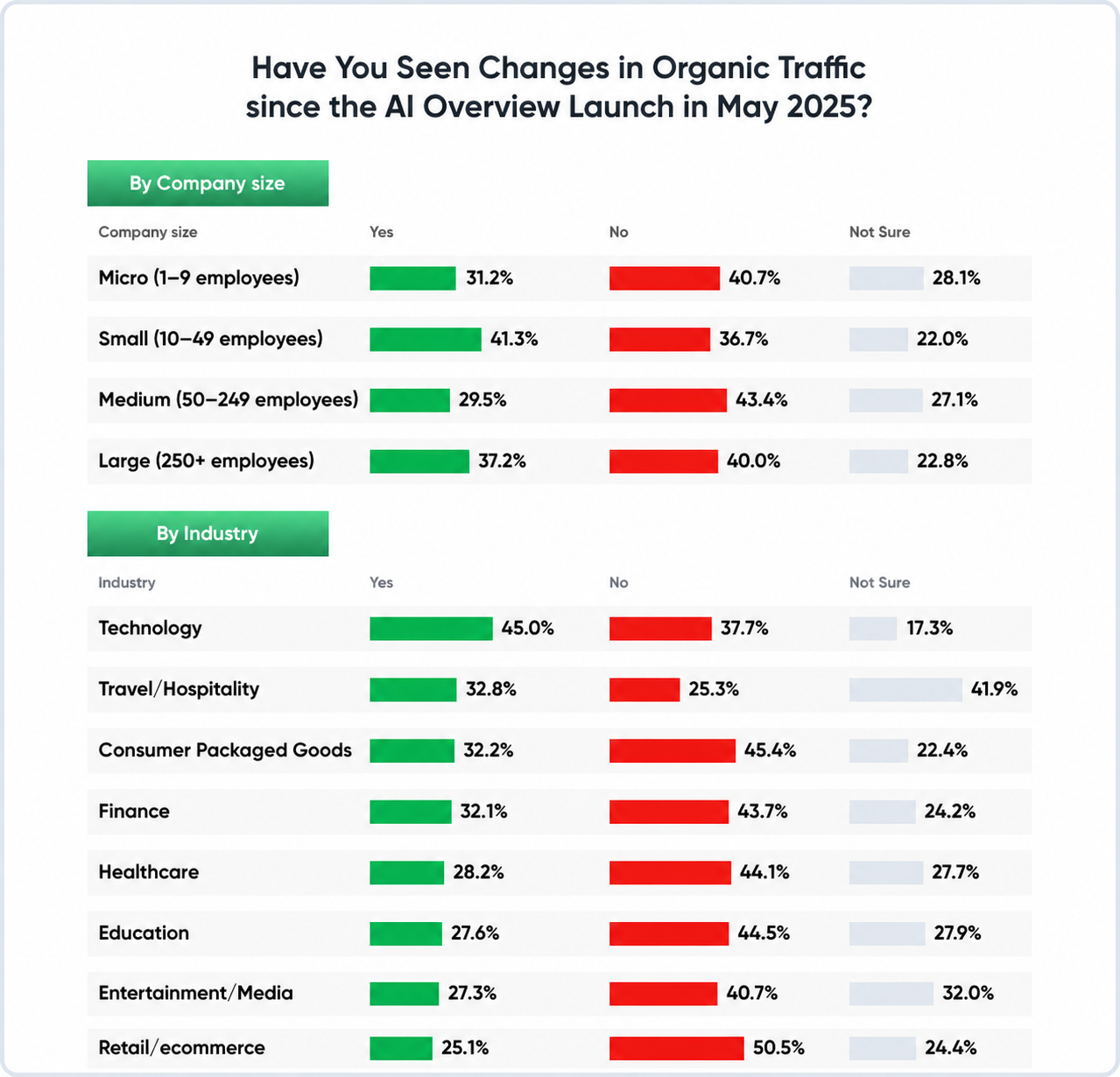
Google’s AI Overviews began rolling out at scale in mid-2024. By early 2025, they were appearing across a wide range of query types, hitting informational ones hardest. Simultaneously, Perplexity and ChatGPT’s search integrations began pulling real users away from Google for research-oriented queries. Bing’s AI features have matured. The combined effect was a measurable drop in click-through rates on organic results for queries where AI tools could synthesize a satisfactory answer without sending anyone anywhere.
For eCommerce brands, the category most affected was informational content: buying guides, comparison articles, roundups, and how-to content. That content was always somewhat indirect, intended to introduce shoppers to a brand during the research phase. AI tools now handle a significant portion of that research themselves. Whether the answer they deliver is accurate is another question. Whether it sends someone to your site is answered by the data, and the answer is often no.
The zero-click problem existed before AI. Featured snippets created a version of it years ago. What is different about AI Overviews and dedicated AI search tools is scope: they synthesize answers to complex multi-part questions, not just simple factual lookups. A shopper researching standing desks used to need several site visits to form an opinion. Now they can get a thorough synthesis in a single response.
Which Queries Still Send Traffic
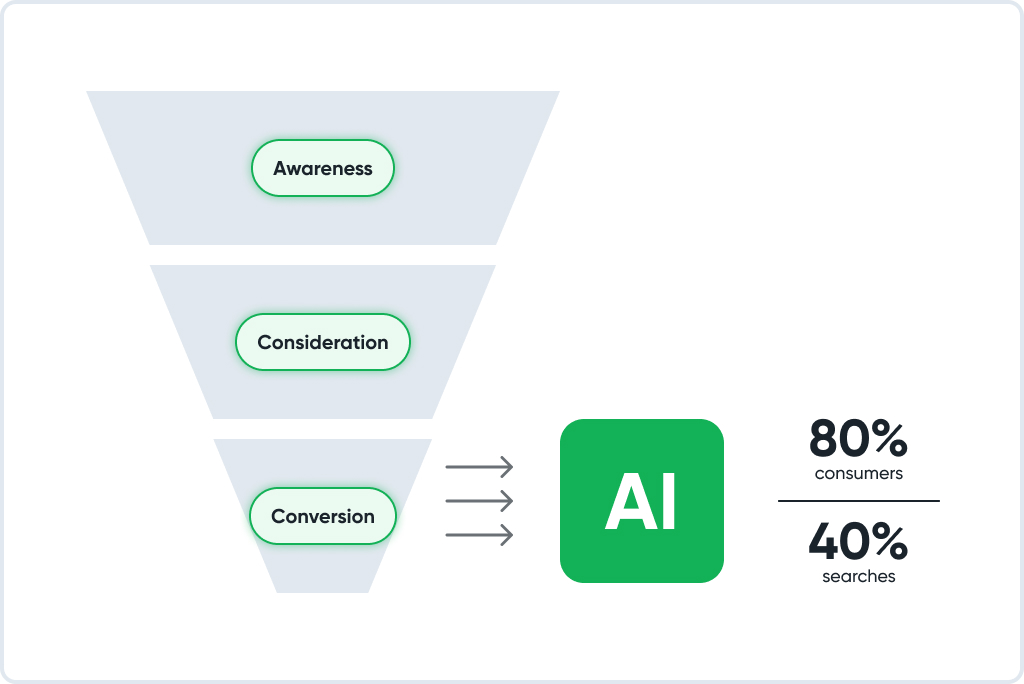
Not everything is changing at the same pace. Here is how the funnel breaks down right now:
Transactional queries are holding. Someone searching for a specific product model, a brand name, or a category with purchase intent is still being sent to actual pages. AI tools are less useful here because the user needs to buy something from somewhere, and a summary does not fulfill that need. “Ceramic cookware set under $200” or “Patagonia nano puff jacket” still drive clicks.
Informational queries are in decline. Content built around questions starting with “how,” “what,” “why,” or “best” is under real pressure from AI Overviews. Traffic to this content has dropped materially for many eCommerce sites since mid-2024, and that trend has not reversed.
Niche technical queries are mixed. AI tools have less reliable training data in specialist categories, which means their synthesized answers are weaker and users are more likely to click through to actual sources. Brands in specific technical niches sometimes fare better in AI search than in traditional SEO for exactly this reason.
Local and highly specific queries sit somewhere in between, depending on how much reliable information exists on the topic and how well-structured the available sources are.
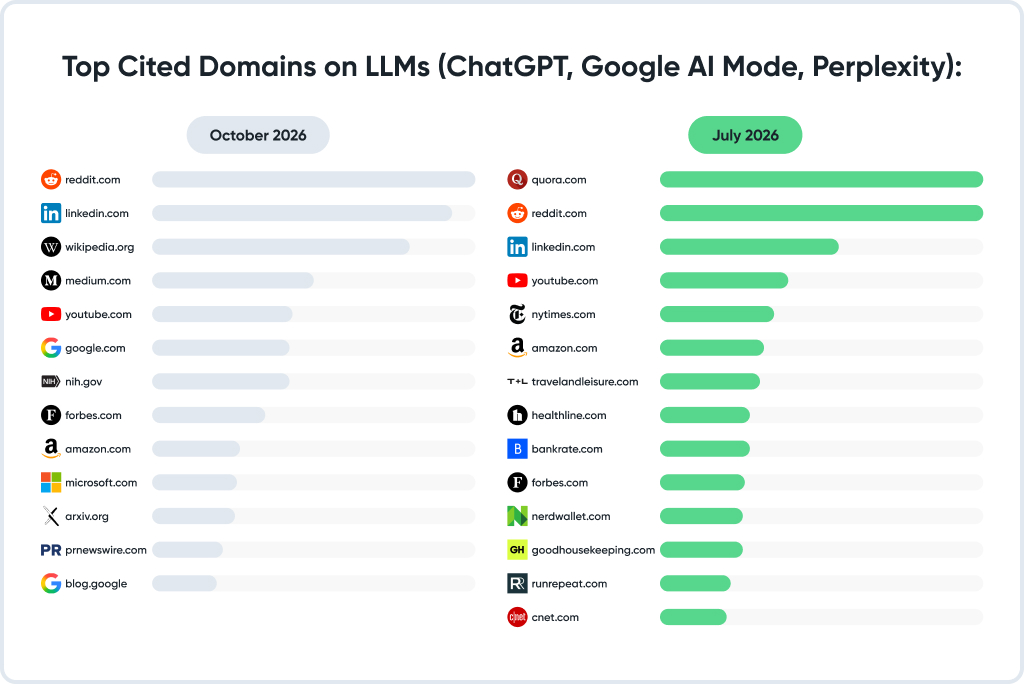
How AI Search Tools Decide What Gets Cited
When an AI tool constructs a synthesized answer, the selection logic is different from a ranking algorithm. Understanding what actually influences citation is where strategy starts to diverge from traditional SEO.
- Pages that answer one specific question thoroughly tend to get cited more than pages that cover ten topics shallowly. AI tools are reasonably capable of identifying whether content genuinely addresses a subject or just surrounds it.
- Domain authority still matters because AI tools weigh sources they have reason to consider reliable. A well-argued page on a new domain gets less benefit of the doubt than comparable content on an established one.
- Structured, scannable organization gives the model cleaner signals. Defined terms, comparison tables, numbered steps, and clear headings help AI tools extract specific facts more accurately than dense continuous prose.
- Freshness matters when the right answer changes over time. Content last updated in 2022 on a topic where specifications and recommendations shift regularly gets weighted below more recent sources.
What does not work the same way as before is keyword density and exact-match optimization calibrated for query string matching. Writing for AI citation means writing content that is actually good at answering a specific question.
The Structural Problem with Most eCommerce Content
A large portion of the content that eCommerce brands published between 2018 and 2023 was built to capture informational traffic and convert it to brand awareness. The theory was sound at the time: rank for questions people ask during research, introduce your products as part of the answer, and pick up customers who would not have found you through product searches alone.
That theory assumed the informational traffic would keep arriving. When AI tools handle more of the research phase directly, the top of the funnel that content was designed to intercept gets shorter. Buyers arrive with more formed opinions and more specific intent. They show up on product and category pages rather than blog posts, evaluating a purchase decision rather than gathering preliminary information.
The content that handles that kind of visitor well looks different from awareness-stage blog content. Product pages need to be more complete. Category pages need to work harder for a visitor who knows what they want but is deciding where to get it. Comparison and review content positioned near the purchase decision holds up better than broad educational content.
This is not a reason to delete existing content wholesale. The useful exercise is an audit that asks two questions for each piece: is this still getting traffic, and does that traffic lead anywhere? The answers divide content into three groups pretty cleanly: keep and improve, consolidate, or retire.
Brand Signals and Why They Matter Now
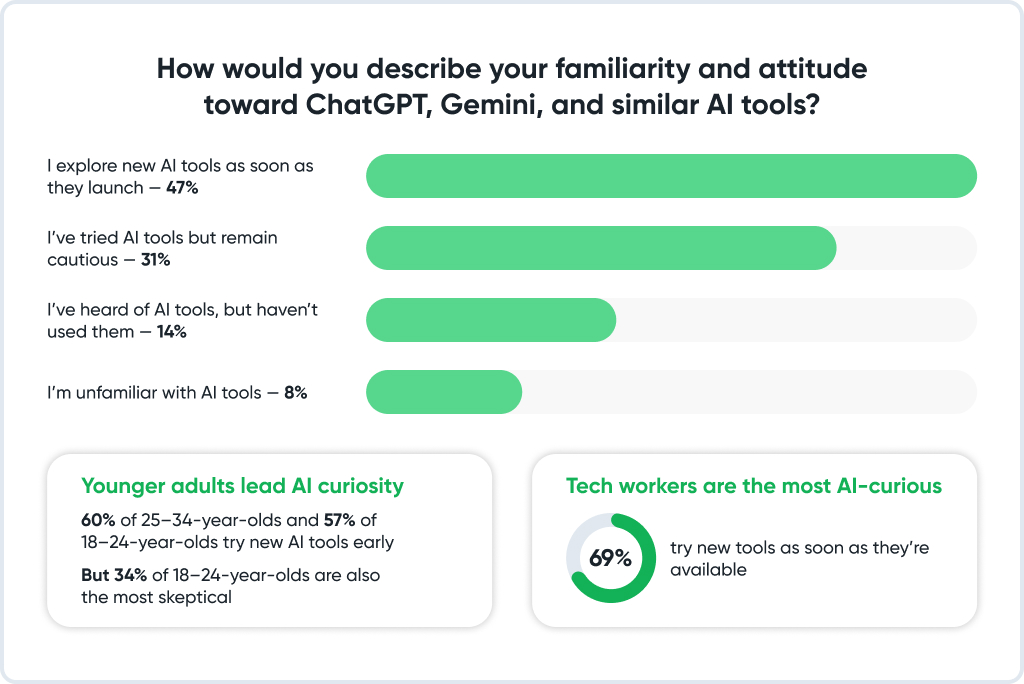
One dimension that tends to get underemphasized is how AI tools develop associations between brands and product categories. A few things worth knowing:
- Brands that appear repeatedly in authoritative contexts develop ambient recognition in AI search. Queries involving their product category are more likely to surface them.
- Mentions and references contribute to how the model understands what a brand is known for, in a way that functions somewhat like off-page authority but through a different mechanism than backlinks.
- A brand with genuine coverage in industry publications, product review sites, and credible third-party content shows up in AI-generated answers for its category more readily than a brand with equivalent on-page optimization but a thin external presence.
- PR, content partnerships, and visibility that used to be considered brand marketing are now part of an SEO strategy in a way they were not three years ago.
The practical implication is that brand-building and SEO are less separable than they have ever been. External presence feeds AI citation. AI citation feeds brand recognition. Brand recognition feeds branded search. The loop is tighter now.
Technical Priorities That Shifted
The fundamentals still matter. Page speed, mobile experience, and crawlability remain important because AI tools and search crawlers both need clean signals to understand what a site contains. What changed is where the leverage sits within the technical stack.
Structured data is now a higher priority than most stores treat it. Schema markup for products, reviews, pricing, FAQs, and breadcrumbs gives AI tools accurate machine-readable information about page content. Stores with comprehensive, current structured data are cited more accurately in AI-generated answers than stores where the schema is incomplete or inconsistent across page types. Google’s own documentation on AI features in Search confirms that the same technical requirements that apply to standard search results also govern eligibility to appear in AI Overviews, meaning clean indexing and proper markup are prerequisites, not optional extras.
Internal linking architecture sends signals that AI tools use. A site that links deliberately from high-authority pages to the content it considers most important communicates something about relative authority that a site with haphazard internal linking does not.
Duplicate content issues that were tolerable before are more consequential now. When AI tools are trying to identify a single authoritative source for a query, multiple pages covering the same topic without meaningful differentiation create noise. Canonical cleanup and consolidation of thin content has a more direct payoff than it did in 2021.
Practical Steps by Priority
If you are deciding where to put SEO effort in the current environment, here is how to sequence it:
- Audit existing content by query type. Separate what targets transactional queries from what targets informational ones. Look at what is actually getting traffic and whether that traffic converts. The informational bucket will need an honest evaluation.
- Invest in product and category pages first. Buyers arriving via AI-assisted research have higher intent than top-of-funnel blog traffic. Complete product information, strong review signals, and fast load times on these pages have direct and measurable conversion effects.
- Implement structured data comprehensively. If schema markup across product, review, FAQ, and pricing pages is incomplete, fixing that is one of the clearest near-term investments with a legible return in both traditional and AI search.
- Build content that earns external citation. Original research, proprietary testing, expert perspectives that cannot be synthesized from existing sources: these formats get referenced by other credible sites, which builds the kind of authority AI tools weigh. This is a longer-horizon play, but it compounds in ways keyword-optimized content does not.
- Monitor AI citation directly. Search your target queries in Google, Perplexity, and ChatGPT periodically to see whether your content appears as a source. There is no comprehensive tracking tool equivalent to rank tracking yet, but manual checking surfaces patterns quickly.
If working through this audit and implementation process independently feels like too much to take on alongside running the store, GoMage’s eCommerce SEO services cover exactly this kind of structured review, from technical health and structured data gaps through to content strategy recalibrated for the current AI search environment.
FAQ
Google still accounts for the majority of search traffic for most eCommerce businesses, so it remains the primary focus. Perplexity and ChatGPT search are growing but represent a smaller share of total volume for most stores. The good news is that the content and technical practices that help with Google AI Overviews overlap substantially with what helps with other AI search tools, so you are not maintaining two entirely separate strategies.
There is still a point, but the purpose shifts. Content cited in AI Overviews builds brand recognition even when the click does not happen. Content that supports purchase decisions for buyers already in the consideration phase holds up better than pure awareness-stage content. The case for publishing purely to rank for informational queries, without any other purpose, is significantly weaker than it was two years ago.
Often less severely. AI tools have less training data for specialist categories and tend to synthesize weaker answers, which means users are more likely to click through to actual sources. Niche brands that have built genuine topical authority sometimes fare better in AI search than in traditional SEO, where they were competing against large generalist sites with more overall domain authority.
Complete structured data implementation across product and category pages, if it is not already in place. Schema markup for products, reviews, pricing, availability, and FAQs gives AI tools the clearest possible signals about what pages contain. The investment is technical, the return shows up in both traditional search rankings and AI citation, and many mid-size brands are still running on incomplete implementations from several years ago.
Test it manually by searching your target queries in Google, Perplexity, and ChatGPT, and checking whether your content appears as a source. Some SEO platforms added citation tracking features in 2025, though coverage is still inconsistent. Branded search volume trends can also indicate whether AI search is generating awareness even when direct click-through does not happen at the AI result stage.
Generally no. The practices that help with AI citation, depth, specificity, structured data, external authority, and updated content overlap substantially with what traditional search algorithms reward. A page improved for AI citation is almost always a better page by traditional SEO measures as well.