Most AI SEO tools look impressive during demos. Dashboards, charts, scores, suggestions.
The reality is quieter.
They help the most when work becomes repetitive. When the site grows. When nobody remembers which pages were updated six months ago and which were not.
They help far less when the problem is strategic. No AI tool can tell you why users don’t trust a page, or why a product feels interchangeable. That part is still on people.
How SEO Teams Really Use AI Tools Day to Day
Very few teams open ten tools every morning.
In practice, it usually looks like this:
- One main SEO platform stays open all the time.
- One content tool gets opened only when something is being written or updated.
- Everything else is used occasionally, usually when something breaks or traffic starts sliding.
Most AI SEO tools fail not because they are bad, but because teams expect them to replace thinking. They don’t.
Where AI SEO Tools Save the Most Time
The biggest time savings rarely come from content generation.
They come from:
- clustering keywords without doing it manually
- spotting content decay before traffic drops hard
- prioritizing technical issues instead of fixing everything
- finding internal links no one remembered to add
These are boring tasks. That’s exactly why AI works well there.
Top AI SEO Tools
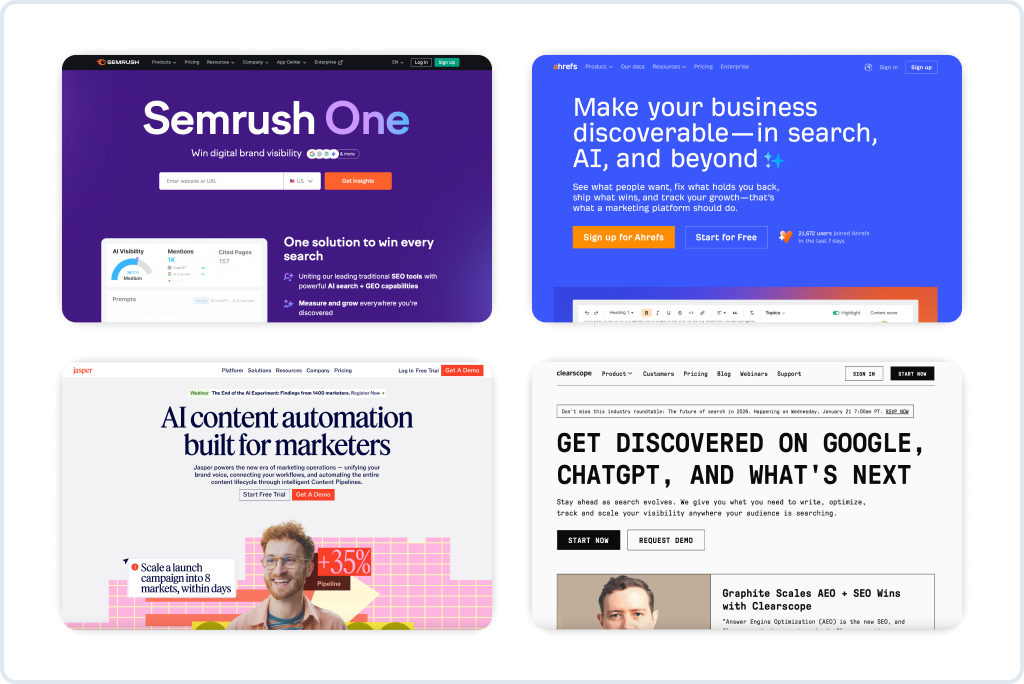
1. SEMrush
SEMrush remains one of the strongest all-in-one SEO tools, but its AI layer has become the real differentiator.
It is widely used for keyword clustering, intent analysis, competitive research, and AI-assisted content recommendations.
Best for: full-spectrum SEO, competitive markets
AI strength: keyword intent, SERP pattern analysis
2. Ahrefs
Ahrefs has leaned heavily into AI-driven insights for content gaps, internal linking, and ranking potential.
Its data depth makes it especially useful for content-heavy sites and publishers.
Best for: content strategy, backlink analysis
AI strength: topic modeling, content gap detection
3. Surfer SEO
Surfer is one of the most recognizable AI search engine optimization tools for on-page SEO.
It compares your content against top-ranking pages and gives structural, semantic, and coverage recommendations.
Best for: content writers, on-page optimization
AI strength: semantic coverage, SERP-based structure
4. Clearscope
Clearscope focuses on content quality and relevance rather than volume.
Its AI evaluates topical depth and helps align content with search intent.
Best for: editorial teams, long-form content
AI strength: topic authority scoring
5. MarketMuse
MarketMuse uses AI to analyze entire sites, not just single pages.
It helps prioritize what to write, update, or remove based on topical authority.
Best for: large sites, SEO strategy planning
AI strength: site-wide content modeling
6. Frase
Frase is often used at the research stage.
It analyzes SERPs, extracts common themes, and helps structure content before writing begins.
Best for: fast content research
AI strength: SERP summarization
7. Jasper (SEO use case)
Jasper is not an SEO tool by default, but it is heavily used in AI for SEO workflows.
When paired with Surfer or Clearscope, it speeds up draft creation without losing structure.
Best for: scaling drafts
AI strength: controlled content generation
8. Screaming Frog + AI integrations
Screaming Frog remains the technical backbone for many SEO teams.
With AI integrations, it now helps prioritize issues instead of listing everything equally.
Best for: technical SEO
AI strength: issue prioritization via pattern detection
9. ContentKing
ContentKing monitors websites in real time and uses AI to detect changes that may affect rankings.
It is especially useful for ecommerce and large dynamic sites.
Best for: large sites, live SEO monitoring
AI strength: anomaly detection
10. Google Search Console (AI-assisted analysis)
Not an AI tool by itself, but widely used with AI layers for interpretation.
Teams increasingly use AI to analyze GSC data for intent shifts and performance decay.
Best for: performance validation
AI strength: AI-assisted insight extraction
11. RankMath (AI features)
RankMath integrates AI directly into content and technical SEO workflows for WordPress sites.
It is popular among smaller teams that want AI without heavy tooling.
Best for: WordPress SEO
AI strength: inline optimization suggestions
12. NeuronWriter
NeuronWriter is often compared to Surfer, but with a stronger AI focus on semantic relevance and NLP scoring.
Best for: semantic SEO
AI strength: NLP-based content scoring
Choosing the Right AI SEO Tools for Your Business
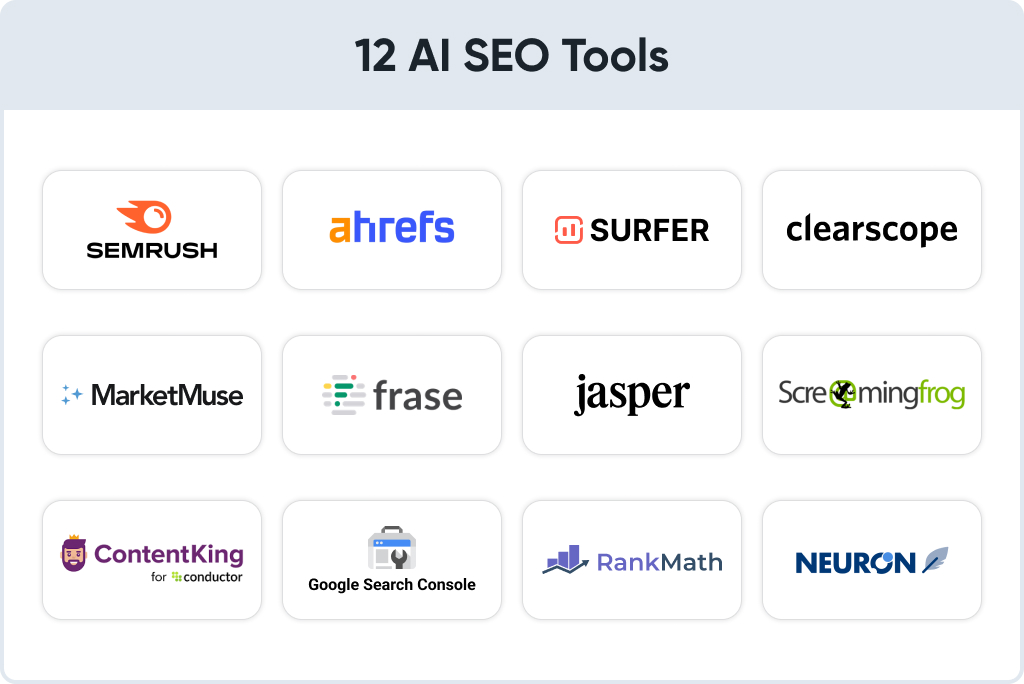
You do not need all twelve.
Most teams combine:
- one core SEO platform
- one content optimization tool
- one technical or monitoring tool
The value of AI search engine optimization tools is not in automation alone, but in decision support. The best tools reduce uncertainty and help you act faster with more confidence.
Common Mistakes When Using AI for SEO
AI tools save time, but they also introduce new risks. Many ranking drops in 2025 were not caused by algorithms, but by misuse of AI.
The most common mistakes include:
- trusting AI recommendations without manual review
- optimizing content only for scores, not for readers
- scaling content before validating performance on smaller samples
- ignoring internal linking because “AI already handled it”
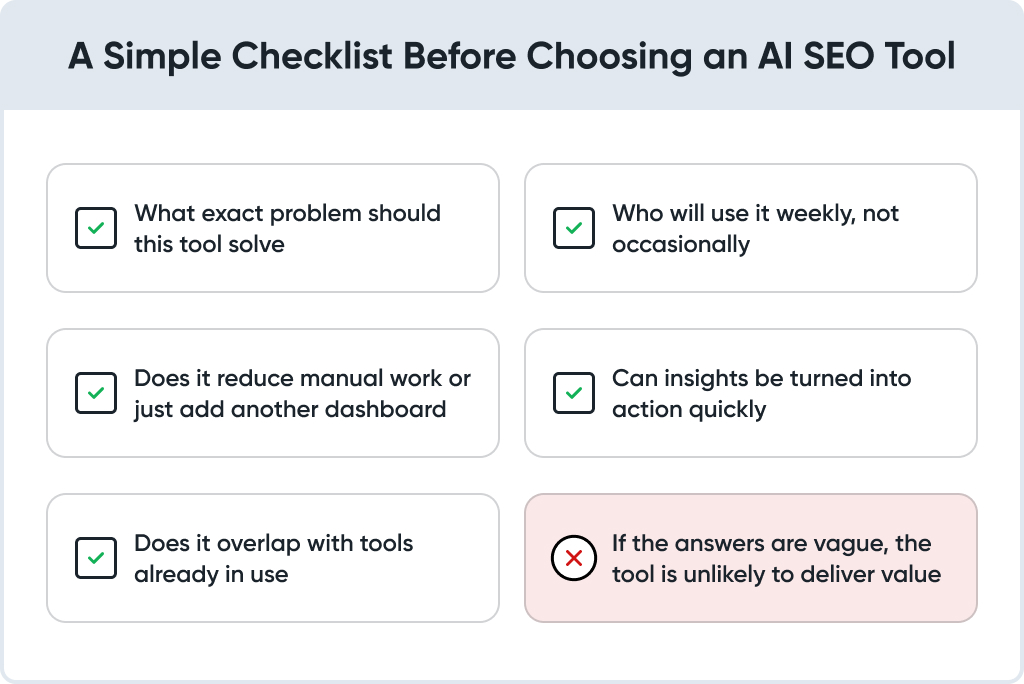
- using too many tools that overlap instead of solving different problems
AI works best as a second brain, not as an autopilot.
AI SEO Tools vs Traditional SEO Tools: Where AI Really Helps
AI does not improve every SEO task equally.
It helps the most when:
- patterns need to be found across many pages
- intent needs to be classified at scale
- priorities must be set fast
- content decay needs early detection
It helps less when:
- brand tone matters
- niche expertise is required
- conversion issues are caused by UX or pricing
- search demand is very small or unstable
Understanding this difference prevents unrealistic expectations from AI for SEO.
When AI SEO Tools Are Not the Right Answer
There are cases where AI tools add little value.
For example:
- brand-new websites with no data
- projects where SEO issues are purely technical and obvious
- niches with very low search volume
- situations where strategy is unclear and tools are used instead of thinking
In these cases, fundamentals matter more than automation.
How to Measure the Real Impact of AI SEO Tools
Rankings alone are not enough to evaluate AI tools.
Better indicators include:
- faster time from idea to published content
- fewer pages losing traffic silently
- clearer prioritization of technical fixes
- reduced manual research time
- more consistent SEO decisions across teams
When AI tools work well, SEO becomes calmer and more predictable.
Final Comment
AI SEO tools are now part of the baseline.
Not using them puts teams at a disadvantage.
Using them without restraint does the same.
The teams that win in 2026 are not the ones with the most automation, but the ones who know exactly where to stop.
FAQ
They are SEO tools that use machine learning to speed up analysis. Instead of checking everything manually, you get suggestions faster. That’s basically it.
You can work without them, but it usually takes longer. Most teams use AI tools because they help spot issues earlier, not because they want automation everywhere.
No. They handle patterns and repetition. Decisions still come from people. When teams try to let tools “decide”, results usually get worse, not better.
One main SEO platform and one content-focused tool is usually enough at the beginning. More tools don’t automatically mean better results.
They’re not risky on their own. Problems start when suggestions are applied without checking intent, structure, or real usefulness for users.
They help with research, but new sites mostly need solid basics. Without data, AI tools don’t have much to work with.
They reduce manual work. Keyword grouping, spotting weak pages, prioritizing fixes. Things that normally take hours get done faster.
They scale too fast. Too much content, too many changes, too little validation. AI doesn’t fix bad assumptions.