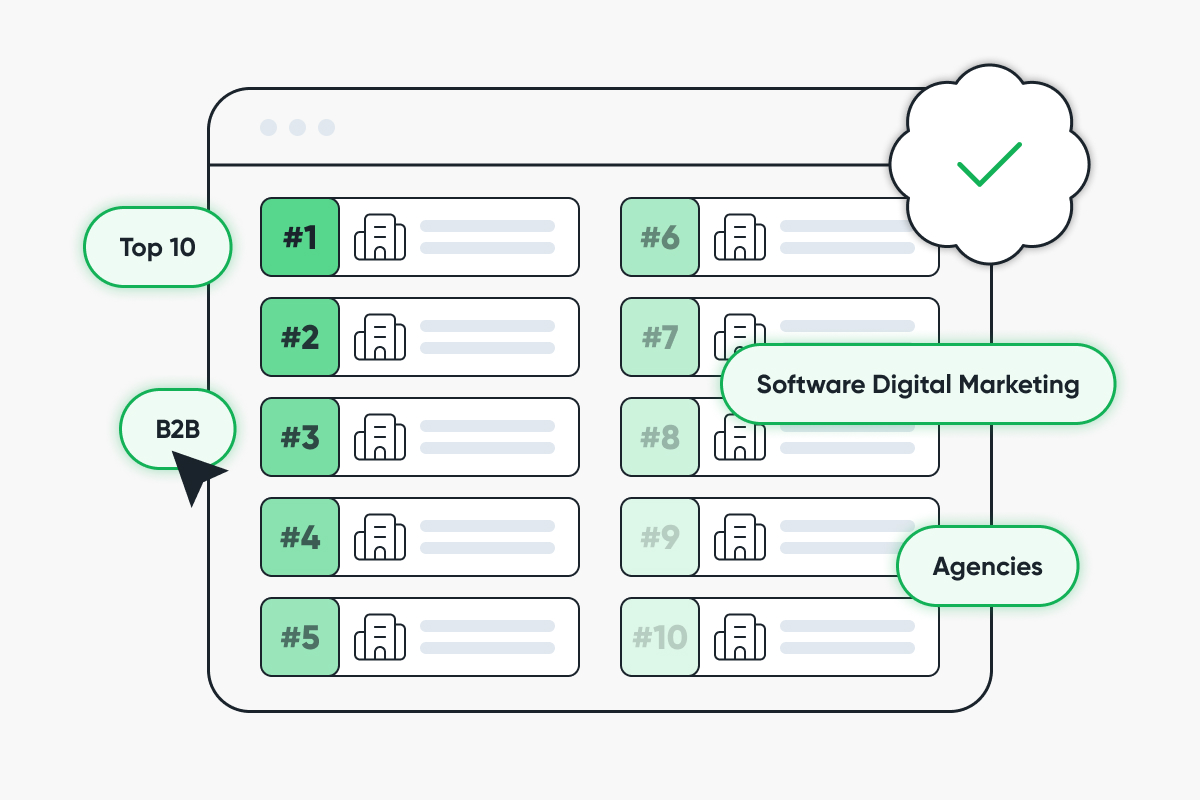
Enterprise software deals don’t close because a campaign was clever. They close because every person with a say in the purchase had what they needed when they needed it. That is a harder problem than most traditional marketing agencies are built to solve, which is why specialized B2B Software Digital Marketing Agencies focus on mapping content to complex buying journeys rather than just generating surface-level traffic.
The buyers have changed, too. Before a vendor makes it onto a serious shortlist today, the research has already happened. Technical documentation has been read, or hasn’t been found. Peer reviews have been consulted. An AI-powered search has surfaced a competitor’s case study instead of yours. Analyst commentary has shaped an opinion that your sales team will never get the chance to correct.
The proof stack is built long before the first sales conversation, and it is built from public sources that your marketing team may not even be tracking.
Choosing the right agency partner in this environment isn’t about finding the longest service menu. It’s about identifying which layer of your proof stack is weakest and finding the firm most qualified to strengthen it.
1. SeedX: Revenue Proof and Pipeline Visibility
SeedX b2b software digital marketing agency occupies a unique and genuinely valuable position in the business-to-business software market. The firm connects marketing activity directly to what is happening in the sales pipeline, using financial terms that a CFO or board member can understand without translation.
SeedX closes the gap between campaign metrics and commercial reality, where dashboards aren’t able to answer the specific questions that matter most to a growing company:
- Which piece of content moved an account into procurement review?
- What did buyers engage with that convinced them to champion the evaluation?
- Where exactly did a deal that looked healthy in January go quiet by March?
Resolving these questions requires your CRM, your attribution model, your channel data, and your sales logs to speak to each other rather than producing disconnected versions of reality.
SeedX builds that connective layer. This is not a superficial reporting exercise, but the actual operational infrastructure a software business needs to make defensible growth decisions. An evaluation cycle lasting nine months and involving multiple independent stakeholders produces an immense amount of data signals, but most of it typically goes uncaptured.
The companies that get the most from SeedX already have active marketing programs running, but they suffer from limited visibility.
SeedX provides the clarity needed to separate meaningful pipeline progression from empty noise, showing leadership exactly which channels are driving results and which programs need to be cut.
2. MarketOne: Account Journey Orchestration
Enterprise software purchases are rarely decided by a single person having a good conversation with a salesperson. By the time a contract is signed, a technical evaluator has validated architecture fit, a security team has run its own review, a finance lead has approved the budget, procurement has negotiated terms, and an executive sponsor has made the internal case to leadership. These people are often working through the evaluation at different speeds, with different information, on different timelines.
MarketOne thrives on this exact complexity. They excel at guiding large, diverse stakeholder groups through the enterprise buying journey, by aligning automation, CRM workflows, stakeholder mapping, and nurture sequences.
This solves a frustratingly common software sales trap where your technical champion gives you an enthusiastic “yes,” only for the deal to stall for months in committee limbo without an internal sponsor to push it through.
MarketOne works best for enterprise software companies where the sales cycle is long, the buying group is large, and the current approach to nurture is either absent or one-size-fits-all.
3. ROI·DNA: Global Performance and Discoverability
Global performance marketing is easy to plan but incredibly difficult to execute. The reality is that local teams often adopt their own tracking methods and optimize paid media using the easiest local data. Central leadership is left guessing which activities truly advance contracts and which are just busywork. Add the fact that AI search heavily influences what international buyers find before engaging with sales, and these market inconsistencies transform from minor friction into major pipeline loss.
ROI·DNA resolves this chaos by bringing global execution, search architecture, entity optimization, and multi-market analytics into a single unified ecosystem. The companies that benefit most from their expertise usually have reasonable local performance but a blurry corporate view. They are trapped in a cycle where leadership cannot tell which countries are driving the pipeline and which are burning budgets on empty awareness.
If your international strategy has devolved into a patchwork of disconnected market reports, it is worth exploring how ROI·DNA centralizes your global marketing.
4. Clear Digital: Website Experience for Self-Directed Buyers
A significant proportion of enterprise software buyers today prefer to reach their own conclusions before speaking to a sales team. They want to review use cases, understand implementation realities, find technical documentation, and assess whether the product fits their environment, without a demo request standing between them and the information they need.
Most enterprise software websites prioritize capturing leads over supporting the buying process. This backfires when sophisticated technical buyers leave without answers because they can’t access the data they need because its is gated, hidden in a PDF, or completely absent.
Clear Digital builds digital experiences that facilitate instead of disrupting independent evaluation. They create seamless conversion paths, accessible proof assets, targeted use case content, and deep technical insights that is easily accessible to buyers when they want it. If your website is a known bottleneck in the customer journey, this is exactly where you should invest.
5. DemandLab: Data Infrastructure and Attribution
Most B2B software marketing teams don’t need more data; they need connected data. Right now, marketing automation tracks one thing, the CRM tracks another, and product usage sits in a separate silo. Customer success has its own reporting, and sales log activities are inconsistent. As a result, nobody can reliably answer the one question executives care about most: how much revenue did marketing generate?
DemandLab is engineered for companies facing this exact roadblock. They build the data and operational infrastructure that links marketing activity directly to revenue outcomes. This means integrating disparate systems, cleaning legacy data, creating measurement frameworks that hold up under intense board scrutiny, and designing attribution models that reflect how enterprise buyers actually make decisions instead of relying on a flawed final touch model.
Software companies with advanced marketing strategies but broken data infrastructure quickly realize that DemandLab solves a problem they have spent far too long trying to patch together themselves.
6. Red Lorry Yellow Lorry: Third-Party Credibility
There is a category of buyer skepticism that owned marketing channels simply cannot address. A case study on your own website proves that you produced a case study. An analyst endorsement, a media mention in a publication the buyer already trusts, or a recommendation from a peer in the same industry proves something different: that people outside your organization consider you credible.
Enterprise buyers are evaluating platforms independently before creating vendor shortlists. They read analyst commentary, track editorial coverage, consult peer networks, and audit review platforms. When a software company lacks a presence in these channels, buyers notice the silence. This creates a subtle, unspoken hesitation that can quietly stall a deal.
Red Lorry Yellow Lorry unifies public relations, analyst relations, content strategy, and reputation management specifically for B2B technology providers. They believe that media coverage is not the ultimate goal. Instead, the objective is to place credible proof exactly where enterprise buyers conduct their research.
For software companies in crowded markets where external validation sways purchasing decisions, this overlooked strategy yields massive returns. Outside validation decides deals; this is a critical investment that delivers outsized rewards.
7. Napier: Technical Depth and Analyst Validation
High-stakes software platforms require more than basic marketing. For complex platforms where technical architecture matters just as much as the business case, generic messaging fails to move the right buyers.
Technical teams evaluating infrastructure or compliance platforms need to see technical architecture documentation, rigorous case studies, and independent analyst commentary that prove your platform speaks their language fluently while preserving the necessary technical depth they need to validate this for leadership.
Napier focuses entirely on creating this level of technical trust. Their work sits at the intersection of public relations, analyst relations, and deeply technical content. They deliver the exact evidence required by buyers who scrutinize every detail.
For software brands where the sales cycle involves a technical evaluation that threatens to block a commercial agreement, investing in this proof layer is what keeps deals moving forward.
8. Ledger Bennett: Global Digital Revenue Execution
When software businesses expand into international markets, the majority often hit the same roadblock. On one side, corporate marketing fights for uniform messaging and synchronized global campaigns. On the other hand, local teams recognize that unique procurement habits and cultural nuances will cause rigid corporate assets to fail more often than not. When these two forces clash, companies usually resort to a watered-down compromise that dilutes the brand and misses the local market entirely.
Ledger Bennett’s focus is on resolving this tension through a centralized digital revenue infrastructure that still gives regional teams workable frameworks rather than rigid templates. The firm has experience across global B2B technology companies and understands the operational reality of running coherent international campaigns without steamrolling local market knowledge.
For software vendors at the stage of international scaling where inconsistency is visibly damaging pipeline quality across regions, the firm offers a structure that most agencies simply aren’t built to provide.
9. Heinz Marketing: Business Case and Executive Alignment
Technical evaluators can be enthusiastic. The product can have passed every validation. And still, a deal can stall because the executive sponsor or CFO doesn’t have a clear enough economic reason to prioritize this purchase over everything else competing for the same budget right now.
Heinz Marketing specializes in securing commercial approval for enterprise software deals. They build compelling executive narratives, business case positioning, and financial justification frameworks by building the targeted sales enablement resources that empower internal champions to pitch to leadership and translate technical data into clear strategic priorities.
For software companies where the deal consistently progresses well until it reaches executive or financial review and then slows or dies, this is precisely the gap Heinz is designed to close.
10. Spear Marketing Group: Demand Generation and Nurture Progression
While many software companies easily generate early interest through traffic and downloads, keeping those prospects engaged is a different story. Unfortunately for most companies, a large percentage of these potential buyers loose interest before the sales team can initiate engagement strategies to fix it. This happens because a lack of intentional interaction causes their initial momentum to stall long before they reach the evaluation phase.
Spear Marketing Group specializes in demand generation and lifecycle nurturing for B2B technology companies. The firm builds the nurture logic, lead scoring frameworks, qualification structures, and sales handoff design that keep prospects progressing through a longer evaluation arc without requiring constant manual intervention from the sales team.
Spear helps software companies that have plenty of initial leads but low conversion to qualified opportunities. Instead of trying to mask a poor conversion rate with unneeded top-funnel volume, they repair the structural bottleneck that is stalling your pipeline.
Finding the Weakest Layer Before You Hire
The most common mistake in this decision is hiring for the most visible problem rather than the most consequential one. These are not always the same thing.
Start with an honest assessment of your proof stack.
- Is the financial return of your platform obvious to executives who do not care about the code?
- Can engineers validate product fit without being forced to talk to a salesperson?
- Do procurement, legal, and security teams have what they need before the official review starts?
- Can your internal champions confidently pitch the purchase upward when a deal starts to stall?
- Are buyers uncovering credible proof about you via AI search and peer networks, or are your competitors winning those spaces?
- Is your brand messaging identical across your website, external publications, and public marketplaces?
- Can leadership confidently point to the exact marketing channels driving revenue?
The answers worth hiring for are the one that makes you most uncomfortable.
Complex B2B software is bought when the buyer’s organization can collectively persuade itself that the decision is safe, valuable, and worth prioritizing over everything else.
Building that collective confidence requires proof across multiple layers, distributed across multiple channels, reaching multiple stakeholders at different stages of a process that doesn’t move at a uniform speed.
No single agency solves all of that. The right one solves the part of it that’s currently costing you the most.