The early days of SEO were very much like a long, grueling bout of digital whack-a-mole. You’d drop a bunch of individual keywords onto an empty webpage, slap together 12 separate articles, each containing 800 random words, and hope the search engine spiders liked it. But now, those scattered strategies are long gone. With the changes in the way search engines calculate authority, moving towards rewarding comprehensive topical expertise and user intent over sheer frequency of keyword use, there’s been a change in what kind of architecture works best for this purpose: The educational content cluster.
Establishing yourself as a domain of authority has changed from proving that you know how to create one good article to proving that you own the topic itself. The educational content cluster provides the structure necessary to create a map of an entire ecosystem of information, changing your webpages into a trusted resource library that the search engines recognize.
Shifting from Standalone Articles to Structured Hubs
In order to fully understand the remarkable efficiency of educational content clusters, it is important first of all to study the influence of current information architecture on both humans and search bots. The topic cluster is an architecture in which there is one and only one pillar page, which acts as a source page for the entire big macro-topic, and many cluster pages explore more specialized long-tail topics.
The evolution of information architecture is somewhat similar to the way modern academic institutions develop their curriculum. Rather than teach a student how to calculate using the set of mathematical formulas on a single sheet of paper, the student is offered a whole textbook with an introduction and links to more complicated topics.
When it comes to the use of this hierarchical system in online content, it helps the user to move through the step-by-step process of learning and satisfies his/her needs while providing clear guidelines for search engine spiders.
The Strategic Integration of Intent-Based Content
The true magic of an educational content cluster happens when you map your content directly to the specific nuances of a user’s search intent. When users search for highly specialized resources on writing paper online, they are rarely looking for a single, isolated tip; rather, they need a comprehensive suite of academic formatting tools, citation guides, and structural templates.
Instead of forcing a single webpage to rank for every conceivable variation of that query, an educational cluster distributes the load across tailored sub-pages. For example, a digital platform might design a master pillar page focused broadly on “The Complete Guide to Higher Education Academic Writing.” Branching out from that pillar, the platform can deploy dedicated cluster articles targeting granular search terms.
By positioning a highly targeted page as a supportive node that links directly back to the master academic guide, you create an undeniable semantic relationship. The internal link equity flows seamlessly between the specific tactical tools and the broader conceptual guides. This layout signals to search engines that your root domain is not just casually mentioning academic writing; it offers a comprehensive, deeply structured repository of knowledge.
Data-Driven Proof: How Content Clusters Drive Domain Authority
Topical authority is not merely a popular buzzword tossed out in marketing meetings, but rather, it is a tangible ranking system supported by real industry metrics. Search engines rely on link structure and content density to determine if your website has true E-E-A-T (Experience, Expertise, Authoritativeness, and Trustworthiness). When you address a topic from all possible angles, search engines see a consistent pattern of user happiness and efficient crawling.
Topic cluster content generates about 30% more traffic than individual pieces of content. Moreover, it was found that clustered pages maintain their search engine rankings 2.5 times longer than individual unlinked blog posts.
This stability is achieved as a cluster establishes a safety net of internal link equity. Even if a particular keyword faces a temporary seasonal decline in search volume, the related subtopics bolster the overall authority of the root domain, ensuring that your traffic remains consistent.
Moreover, the advantages of content clustering have transcended traditional search engine results pages (SERPs) and have permeated the contemporary realm of artificial intelligence. According to Yext’s 2025 AI Citation Study, which examined 6.8 million data points, websites that employ topic clusters garner 3.2 times more citations within AI search platforms than their single-page counterparts.
The researchers observed that an astonishing 86% of all AI citations came from websites that contained five or more closely related pages on a specific topic. This demonstrates that both conventional search algorithms and generative AI models significantly prefer comprehensive, well-structured ecosystems over superficial, disjointed content.
The Anatomy of an Authoritative Educational Pillar Page
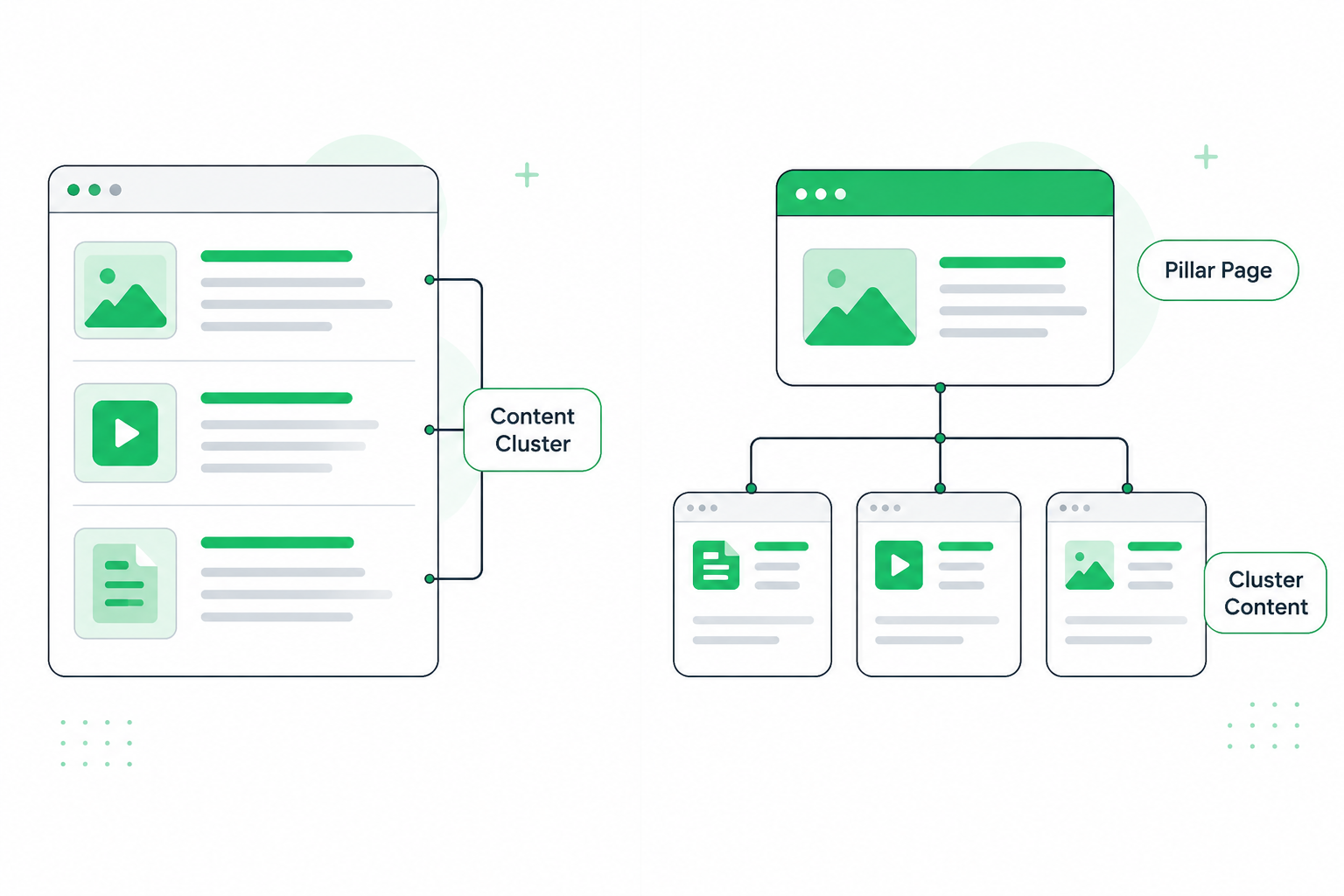
Every successful content cluster relies entirely on the strength of its foundation: the pillar page. Think of the pillar page as the ultimate textbook chapter. It provides an accessible, broad overview of a macro-topic while deliberately leaving the highly granular details to individual sub-pages. An educational pillar page must be designed for ultimate scannability, guiding users through complex concepts without overwhelming them with dense walls of text.
To maximize its effectiveness, an authoritative educational pillar page should incorporate:
- a high-level scope with a core topic must be broad enough to comfortably spawn at least 6 to 12 distinct subtopics. For example, “The Ultimate Guide to Digital Pedagogy” is an excellent pillar topic, whereas “How to Set Up Zoom Quizzes” is far too narrow and serves better as a minor cluster piece.
- an interactive table of contents allows users and search engines to instantly jump to relevant sections, which dramatically improves user engagement metrics.
- strategic internal link routing with descriptive, keyword-rich anchor text that clearly indicates the specific subtopic waiting on the other side.
- downloadable checklists, explanatory diagrams, and embedded instructional videos ensure that the page accommodates different learning styles.
This variety keeps users on the page longer, signals high dwell time, and significantly lowers bounce rates.
Mapping Your Cluster Subtopics for Maximum Coverage
Once you have your pillar page in place, then comes the stage of creating your cluster content. Here, the objective is to respond to every secondary query that could come from an intelligent user after reading your primary content. This calls for moving away from vanity traffic numbers and targeting information-based search intent.
While developing subtopics, the idea should be to organize them in a systematic taxonomy, much like an educational progression of a student or professional. A healthy educational cluster tends to diversify into different segments.
1. Foundational Definitions
Addressing the “what is” and “why it matters” style queries that top-of-funnel users actively search for when they are first introduced to a concept.
2. Methodological Breakdowns
Step-by-step technical guides that teach the reader exactly how to execute a specific task, configure a tool, or apply a theoretical concept in real life.
3. Comparative Analyses
Objective evaluations, such as weighing the pros and cons of different methodologies, software options, academic theories, or structural frameworks.
4. Case Studies
Concrete examples demonstrating how these theories operate in practice, which build deep transactional trust and bottom-of-funnel authority.
As you write these supporting articles, remember that the internal linking rule must be strictly bidirectional. Every cluster page must link back to the parent pillar page using contextual anchor text, and the cluster pages should link to one another whenever a logical conceptual overlap occurs. This creates a tightly knit web of context that prevents search engine bots from encountering dead ends during their crawling cycles.
Measuring and Sustaining Cluster Success
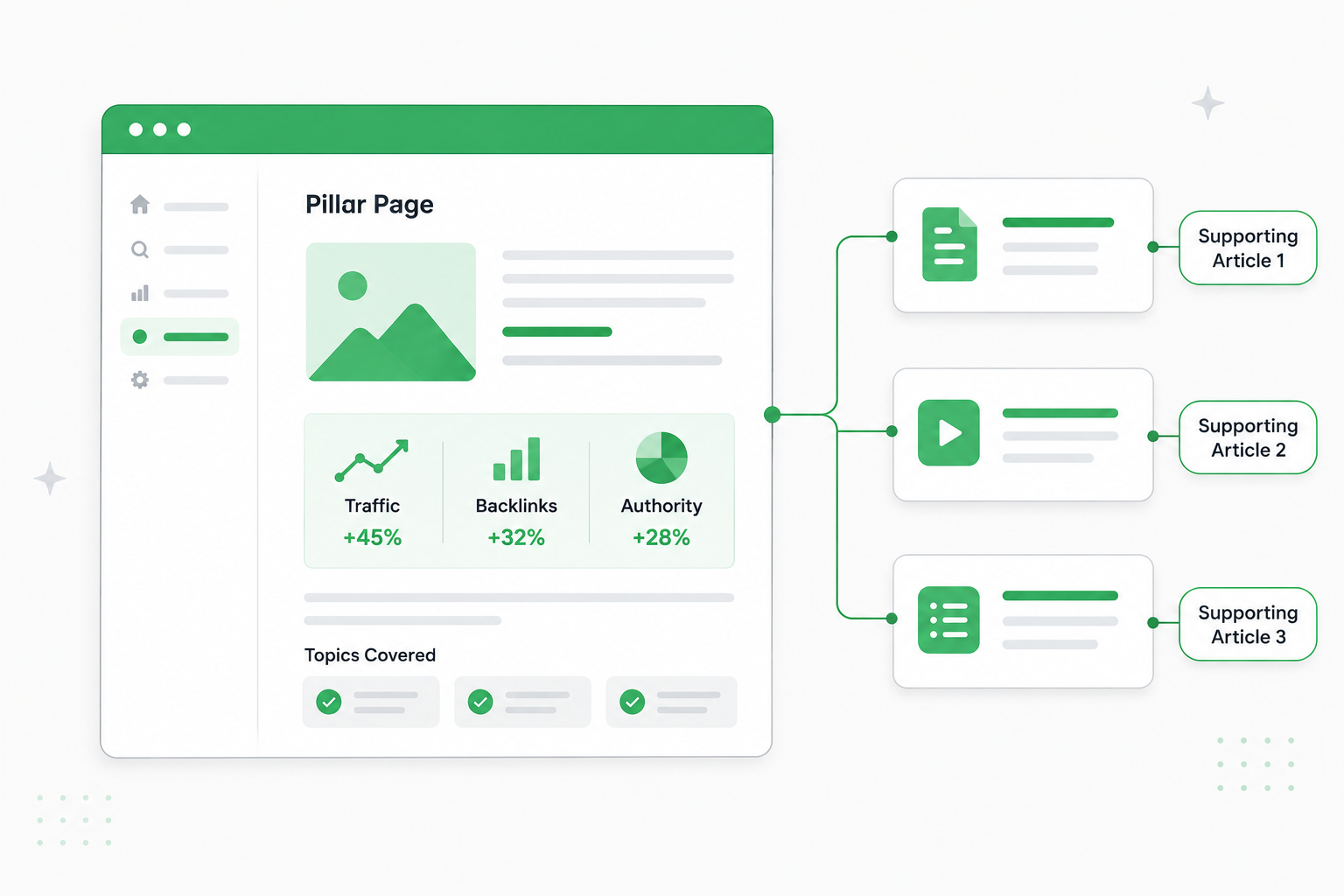
Deploying your content cluster is only half the battle; you must systematically track its performance to ensure your domain authority is moving in the right direction. Because clusters function as a holistic network, measuring their success requires looking beyond individual page views.
To properly evaluate your cluster’s health, closely monitor the following key performance indicators (KPIs):
- Directory-Wide Organic Traffic: Monitor whether the total organic traffic to the entire URL directory (e.g., /blog/academic-writing/) increases month-over-month, rather than fixating on a single viral post.
- Keyword Expansion Rate: Track the total number of long-tail keywords the cluster ranks for in positions 1 through 50. A rising number indicates a growing footprint of topical relevance.
- Internal Click-Through Rates (CTR): High engagement with your internal links proves that users are successfully navigating your educational path rather than bouncing back to the search results.
- AI Overview and Featured Snippet Capture: Watch for an increase in conversational search citations, which directly correlates with the depth and clarity of your cluster’s entity coverage.
Final Thoughts
Constructing educational content clusters is a major investment in building up your digital real estate. The shift from old practices of standalone keyword optimization to an advanced form of structure in which the content clusters serve as the hub and the rest of your site acts as the spokes automatically puts your brand ahead as an indisputable expert within your industry.
It has been proven time and again through the data available that search engines and AI software today have a bias towards highly integrated and interconnected networks of content.