Most Magento merchants spend weeks evaluating platform architecture, payment gateways, and CDN configurations. The wireless connectivity that keeps their warehouse staff, field reps, and remote developers online gets about ten minutes of thought and a consumer phone plan. That gap is costing businesses real money.
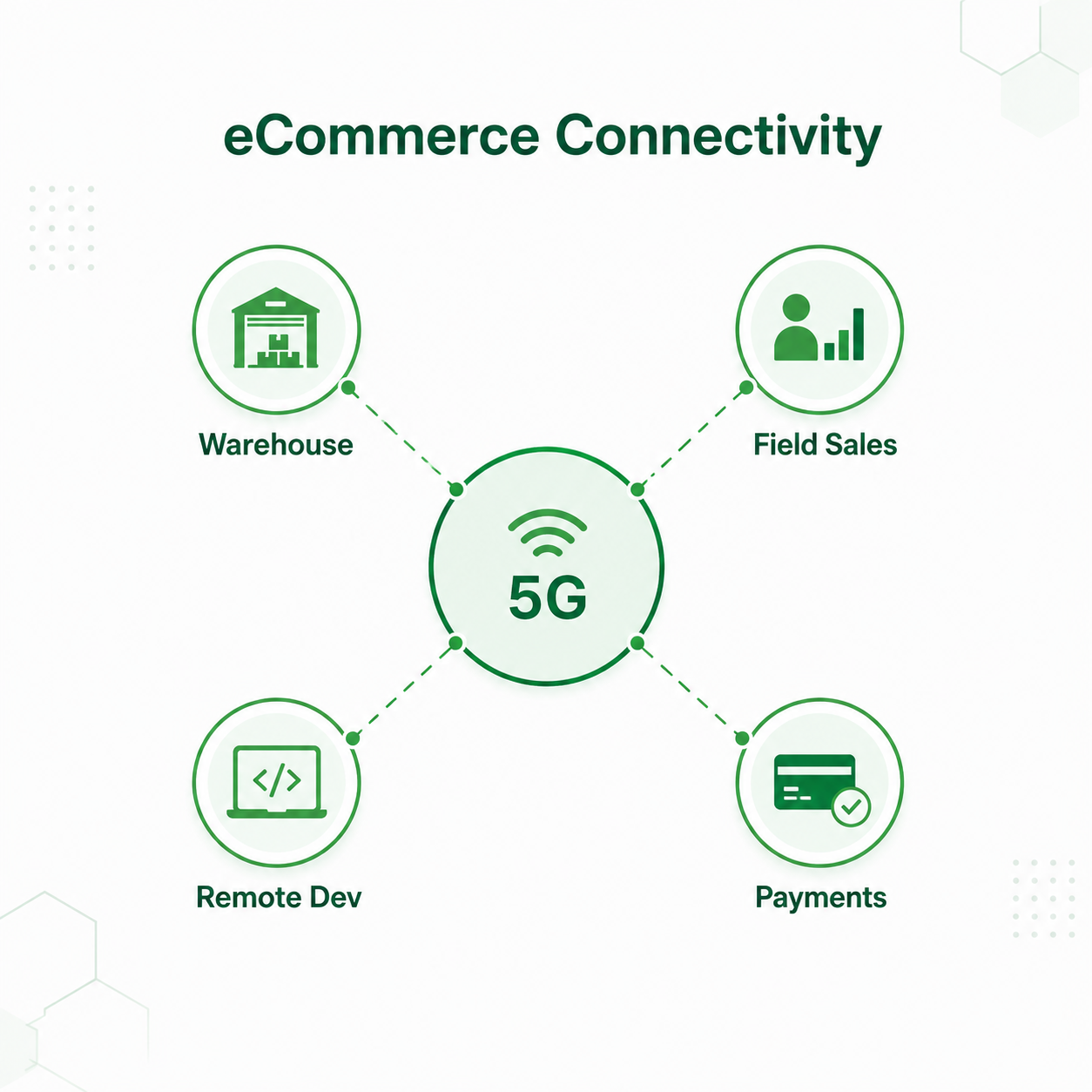
eCommerce operations today aren’t confined to a single building or a static server. They’re distributed: a warehouse team in one zip code scanning inventory on handhelds, a field sales rep three states away processing orders on a phone, and a development team spread across time zones with hotspot connections as their primary link. Every one of those people needs reliable, managed wireless access, and a family plan from a consumer carrier isn’t built to carry that weight.
This article covers what a proper wireless strategy looks like for eCommerce businesses, why consumer-grade plans quietly undermine operations, and how to build a setup that holds up under Black Friday traffic.
What a Corporate Wireless Plan Actually Covers
Consumer phone plans are designed for individuals. A corporate wireless plan is designed for businesses, and the difference in what those two things cover is significant.
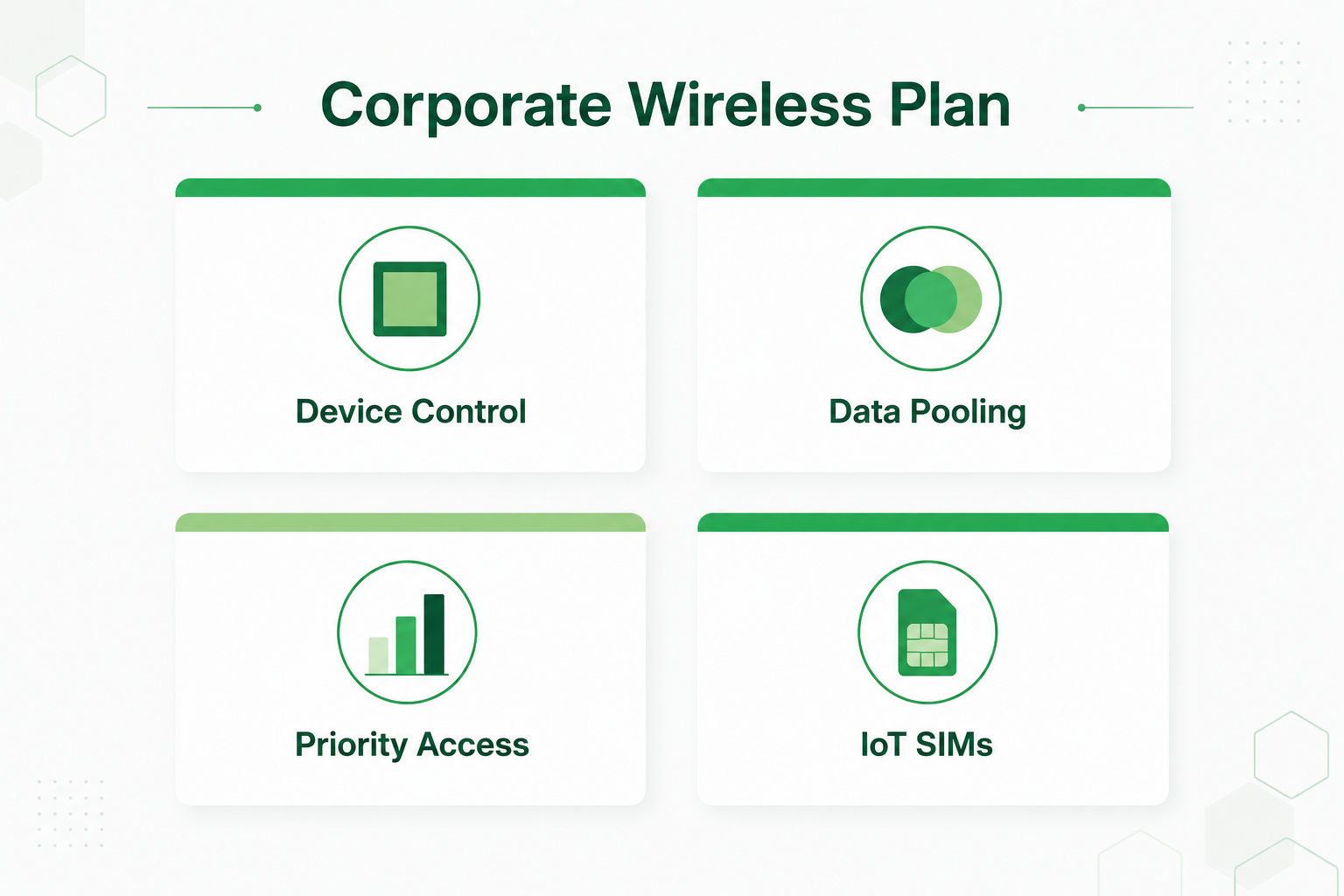
A corporate wireless plan typically includes centralized device management, pooled data across all lines, priority network access during periods of congestion, unified billing, and support from a dedicated business account team. It also covers device procurement, Mobile Device Management (MDM) integration, SLA guarantees on response times, and IoT data options for warehouse scanners, payment terminals, and other connected hardware. Consumer plans don’t include any of that, and trying to bolt those capabilities onto a collection of personal lines creates administrative chaos and security gaps that grow as your team does.
The market for this kind of managed wireless infrastructure is expanding fast. The Business Research Company’s 2025 report found the global mobile workforce management market will grow from $7.18 billion in 2025 to $8.1 billion in 2026, at a CAGR of 12.8%, driven by remote work expansion, field service operations, and BYOD adoption. That growth signals that businesses across sectors are recognizing wireless connectivity as a managed resource, not a commodity utility to be bought on the cheapest plan available.
For eCommerce specifically, the scope of a corporate wireless plan goes beyond voice and data. It covers IoT SIMs for the scanner fleet, hotspot data for remote developers, payment terminal connectivity, and often device lifecycle management so your IT team isn’t manually tracking hundreds of handsets. These aren’t nice-to-have extras. They’re the operational backbone of a distributed eCommerce team.
What to Look for in a Business Wireless Plan
When evaluating corporate wireless options, the criteria that matter most aren’t the same as what you’d weigh for a personal plan. Here’s what to assess:
- Network coverage: Does the carrier’s 5G and LTE footprint cover your warehouse zip codes, not just major metropolitan areas? Rural fulfillment centers are often in coverage dead zones that a consumer-tier map won’t accurately reflect.
- Data pooling: Can data be shared across all lines rather than capped per line, so one heavy user doesn’t throttle the rest of the team during a peak shift?
- MDM integration: Does the plan support enterprise-grade device management, so a lost or stolen device can be wiped remotely before it becomes a data breach?
- Support SLAs: Is there a business-tier support line with guaranteed response times, or is it the same consumer helpdesk queue with multi-hour wait times during peak periods?
- IoT data options: Can the plan accommodate SIMs for non-phone devices – scanners, printers, and payment terminals – at sensible per-SIM rates that don’t blow the telecom budget?
- Scalability: Can you add lines, IoT SIMs, and device types as warehouse automation expands without re-negotiating the entire contract from scratch?
Getting clear answers to those questions before signing a contract saves significant pain when peak season arrives, and there’s no time to fix infrastructure problems.
Why Connectivity Is Now an eCommerce Operations Problem
For Magento merchants, the scale of mobile commerce makes connectivity a front-line operational concern, not a back-office development priority afterthought. According to Shopify’s 2026 global eCommerce data, mobile commerce is forecast to reach $2.4 trillion in 2026. The eCommerce and mCommerce differences in customer behavior are now shaping how merchants architect their entire stack, from checkout flows to fulfillment systems. Globally, eCommerce accounts for 20.5% of total retail sales in 2025, and a growing share of the teams driving that revenue live on mobile devices throughout their working day.
That dependency on mobile creates direct exposure to network reliability. Network connectivity failures caused 31% of IT service outages in 2024, costing SMBs an estimated $20,000 per hour of downtime, according to IDC research cited by PC Tech Magazine in 2026. For an eCommerce business, downtime isn’t just a technology problem. It’s an order fulfillment problem, a customer experience problem, and a revenue problem.
When a warehouse team loses mobile access during a peak period, Magento’s inventory sync stops mid-cycle, order picks slow to a crawl, and the ripple hits shipping SLAs. When a field sales rep loses connectivity mid-demo, deals stall. When a remote developer’s hotspot throttles to 2 Mbps, their productivity drops to a fraction of normal. The wireless connection underneath all those workflows is infrastructure, exactly the same way your hosting environment and your Magento instance are infrastructure.
Magento merchants who invest in platform performance, custom extension development, A/B testing, and storefront speed but run their operational teams on consumer wireless are optimizing one layer while leaving another one entirely unmanaged. That inconsistency shows up in the metrics that matter: fulfillment speed, team productivity, and customer satisfaction scores.
The Hidden Costs of Consumer Plans in Business Operations
Many eCommerce businesses start on consumer-grade plans because they’re fast and cheap to set up. The costs that accumulate over time are less visible until something breaks at the worst possible moment.
Without MDM, a lost or stolen device doesn’t just mean a missing phone. It means an open door to your inventory system, CRM, and payment processing apps. Consumer plans have no mechanism for remote device wipe or access revocation at the account level.
Data pooling is the other friction point. When each employee is on a capped individual plan, one team member who relies on a mobile hotspot as a primary connection can burn through their data allowance mid-month, leaving them throttled to unusable speeds during the period when order volumes are highest. Per-line caps create unpredictable performance exactly when the business needs predictable performance most.
Network priority is a less obvious issue, but a real one. Consumer plan subscribers get lower priority access during congestion than business-tier subscribers on the same carrier. During Black Friday or Cyber Monday, when carrier networks are under peak load in commercial zones, a warehouse team on consumer plans may experience exactly the kind of slowdown that causes inventory sync failures and shipping label bottlenecks. Investing in mobile eCommerce app development with a well-designed offline sync gets you partway there, but the wireless layer underneath still has to be reliable for the app to perform consistently.
There’s also the billing problem. Managing 40 individual consumer lines across different billing cycles, different data caps, and different renewal dates is an administrative burden that a corporate plan eliminates. Unified billing, centralized account management, and single-point-of-contact support pay for themselves in time saved long before you factor in the operational risk reduction.
5G and the Next Phase of eCommerce Operations
5G isn’t just faster LTE. For eCommerce operations, it changes what’s possible at the warehouse floor level and in the field. The global 5G enterprise market was valued at $5.96 billion in 2024 and is projected to reach $28.73 billion by 2030, a CAGR of 31%, according to Grand View Research (2025). That growth reflects enterprise adoption moving from pilot programs to full production deployments.
In the U.S., 5G devices now account for 259 million connections, nearly half of all U.S. wireless subscriptions, according to the CTIA 2025 Annual Survey. Data demand on those networks grew 35% in 2025 for the third consecutive year. The infrastructure investment is real, and businesses without corporate wireless agreements are the least likely to access priority 5G capacity when congestion hits. According to Shopify’s global eCommerce statistics, mCommerce is forecast to reach $2.4 trillion in 2026 – a figure that means nothing if the field teams and warehouse staff driving that commerce can’t stay connected.
5G for eCommerce: Practical Use Cases in 2026
Here’s what 5G connectivity enables in practice for eCommerce teams:
- Warehouse automation: Autonomous picking systems and real-time inventory robotics require ultra-low latency that only 5G delivers reliably at warehouse scale. LTE fallback introduces latency spikes those systems can’t tolerate.
- Real-time POS and payment processing: Floor-based payment terminals that don’t drop connections during peak periods, even in dense commercial environments where networks are under maximum load.
- Field sales with full mobile access: Reps who can run live product demos, pull live inventory data, and submit quotes on the road without hunting for Wi-Fi or waiting on a throttled LTE connection.
- Remote developer teams: Engineers who rely on hotspot as a primary connection during travel need consistent throughput. On a corporate plan with priority data access, that’s a stable working environment. On a consumer plan, it’s unpredictable.
- Video-based quality control: Real-time video inspection workflows in fulfillment centers need reliable high-bandwidth wireless to function without degradation during peak shifts.
Private 5G networks are moving from proof-of-concept into full production in logistics and fulfillment. The businesses building their wireless strategy now are getting ahead of a deployment curve that will widen considerably over the next three years.
How to Build a Wireless Strategy That Scales With Your Store
A wireless strategy that works for a 10-person team won’t hold up at 50 people or when you add warehouse automation hardware. Building it right from the start means fewer forced migrations during peak season and no emergency re-provisioning when your team needs to focus on fulfillment.
Start by auditing your current wireless usage. How many team members depend on mobile connectivity as a primary tool, not just a backup? What are the specific use cases: voice, data, IoT, hotspot, or some combination? Map device types separately. Smartphones, tablets, and IoT SIMs for scanners, printers, and payment terminals each have different data profiles and coverage requirements. Treating them all the same in a plan leads to overpaying on some and underprovisioning on others.
Coverage mapping matters more than most businesses assume. Your office address and your warehouse zip code may be served by entirely different cell towers with different capacity characteristics. Evaluate real-world coverage at every operating location before committing to a carrier. Ask carriers for coverage verification at specific addresses, not just regional heat maps, which tend to be optimistic about edge cases in semi-rural or industrial areas.
The case for working with a managed wireless provider rather than going direct to a carrier is straightforward: a managed provider consolidates billing, provides a single point of accountability, and often has negotiated rate structures that a small-to-mid-sized business can’t access independently. The same logic applies to B2B eCommerce website design: when operations span multiple teams and locations, centralized management and consistent architecture beat a patchwork of one-off solutions every time.
Plan for redundancy from the start. Know your failover if the primary wireless goes down on a high-volume day. According to the CTIA’s 2025 Annual Survey reported via RCR Wireless, U.S. wireless connections reached 579 million in 2025, with data demand growing 35% in a single year. That demand creates real congestion risk for businesses without priority access agreements, which makes redundancy planning a practical concern, not a theoretical one.
Finally, ask any prospective provider about IoT data plan options upfront. As warehouse automation scales, the number of connected devices grows fast, and retrofitting data plans for a fleet of IoT SIMs mid-contract is more expensive than building that into the original wireless agreement from day one.
Wireless Infrastructure Is Part of Your Platform Stack
The same careful thinking that goes into choosing a commerce platform, a headless architecture, or a payment gateway belongs in your wireless strategy. The merchants who invest in their Magento setup but run their team on consumer phone plans are leaving a gap in their operational infrastructure that will show up eventually, usually at the worst possible time.
Wireless connectivity isn’t a phone bill. It’s the layer that keeps inventory systems in sync, enables field sales teams to close deals, and gives remote developers a reliable connection to production environments. When that layer is managed correctly, it becomes invisible. When it isn’t, it’s all you can think about.
Moving from consumer to corporate wireless doesn’t require a massive budget or a complex migration. It requires treating connectivity the same way you treat every other piece of your operations: with the right level of planning, the right provider, and a setup that’s built to scale.