A few years ago, the idea of a computer writing stories or painting images felt almost unbelievable. Today it happens quietly in the background of many people’s work. Generative AI has become something ordinary, something that fits naturally into daily routines.
Generative AI has settled into that space where imagination meets practicality. It helps people begin faster, explore wider, and finish stronger. In many ways, it has turned the creative process into a dialogue, one that more and more professionals see as an essential part of their work.
The State of Generative AI in the Enterprise (2025)
In 2025, entire teams rely on Generative AI in different ways. Designers use it to explore concepts. Writers ask it to shape drafts. Marketers test ideas with its help. It has become a silent partner in creativity, one that supports rather than replaces human thinking.
According to McKinsey, about 72% of large companies now use generative AI in at least one part of their business. What was once a side project has quietly become something many teams rely on every day. Companies no longer want impressive experiments. They want tools that make sense in their workflow, that help save time and lead to results they can trust.
Key Technologies Driving the Growth of Generative AI
Generative AI is growing fast, and the reason goes far beyond smarter algorithms. Its progress depends on a mix of technologies that make creativity scalable, adaptable, and safe to use in real work.
Multimodal models
The new generation of systems can read, see, and listen all at once. A designer can upload a sketch, describe what it should look like, and instantly get a working concept. A doctor can analyze an image and receive a written summary in seconds. This kind of crossover between text, visuals, and sound is changing what people expect from intelligent software.
Transformer architectures
Transformers are still at the heart of most models, but they are becoming leaner and more specialized. They no longer need supercomputers to perform well. Some now run directly on local devices, giving users faster responses without relying fully on the cloud.
Retrieval-Augmented Generation (RAG)
RAG has quietly solved one of AI’s biggest weaknesses: factual accuracy. Instead of relying only on what the model remembers, it can now search trusted databases while generating answers. This combination of reasoning and reference makes AI results far more reliable.
Cloud platforms and APIs
Behind every modern AI product is strong cloud infrastructure. Open APIs have made it easy for developers to connect generative AI to existing tools. A few lines of code can now give an application the ability to summarize reports, translate content, or generate new visuals.
Private fine-tuning
More companies are training their models on internal data. This allows AI to write or design in a specific brand style while keeping sensitive information secure. It turns generic tools into customized assistants that understand a company’s tone and goals.
Generative AI has reached a point where progress feels more connected than competitive. Each new advance feeds another, creating a technology ecosystem that learns, adapts, and quietly improves the way people create and work every day.
Applications and Opportunities of Generative AI in Creative Fields
Generative AI has slipped into creative work so smoothly that people often forget it’s even there.
Design and visual art
Designers used to spend forever sketching out early concepts. Now? You describe what’s in your head, and AI Image generator tools like Invideo, Midjourney and DALL·E give you a visual in seconds. It doesn’t replace the design process, it blows it wide open. Figma plugins and Adobe Firefly can spin up layouts, color schemes, even concept art that would’ve eaten up days before. A lot of creatives say it feels like brainstorming with someone who never gets tired or runs out of suggestions.
Writing and communication
AI has become a surprisingly handy writing partner. Need to rework a clunky sentence? Shift the tone? Build out a half-formed idea? It handles that. Marketing teams use customized versions to pump out content that stays consistent with their brand but still sounds genuine. Some writers lean on it for editing, others to get the words flowing. Either way, it cuts down on those frustrating moments when you know what you want to say but can’t quite get there.
Music and sound
In recording studios, tools like AIVA and Mubert have become instruments themselves. They generate harmonies, layer sounds, even create adaptive scores that change based on what’s happening in a game or video. Composers use them to try out ideas they might not stumble onto otherwise. It’s collaboration, with something that learns as it goes.
Film, animation, and gaming
Filmmakers and game designers are turning text into visuals, testing effects, and building entire environments. Pre-production has gotten way faster and more flexible. A director can preview how a scene might look before anyone touches a camera. Game pre-production has gotten way faster and more flexible, allowing teams to test ideas before committing to full 3D environment production. All that saved time? It goes toward storytelling and trying new things instead of getting stuff built.
Product and experience design
Product teams are using generative design tools that crunch through materials, shapes, and performance requirements, then spit out options for engineers to refine. On the UX side, AI watches how people interact with prototypes and suggests tweaks that make interfaces feel more intuitive.
Generative AI has woven itself into how creative people work. It listens, throws out ideas, adjusts on the fly. Sometimes it saves hours. Other times it takes you somewhere you weren’t planning to go at all. What started as a tech experiment now feels like a quiet shift in how ideas actually come to life.

Future Prospects: Where Generative AI Is Headed
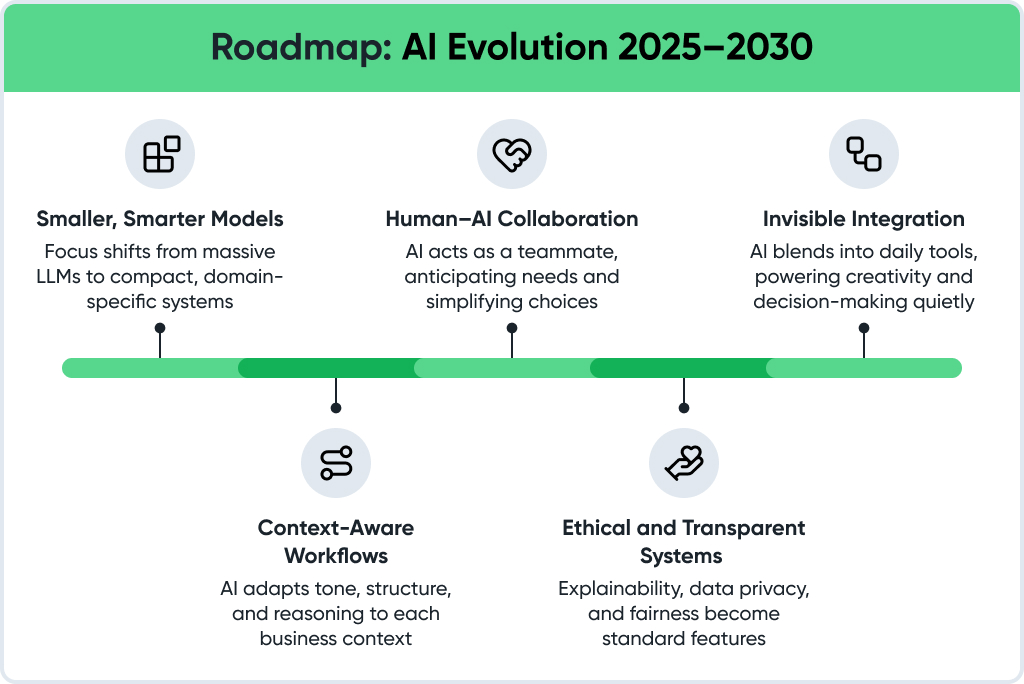
Generative AI is shifting gears. The race to build ever-larger models? That’s pretty much over. What matters now is making systems that actually work well in the real world. Companies have moved past being impressed by fancy demos. They want AI that shows up reliably and fits into their existing workflow without causing headaches.
The next generation of AI will read the room better. It’ll pick up on how your company talks, adjust based on who’s asking, and understand what you’re really after instead of giving cookie-cutter answers. We’re probably done with the idea of one giant model that does everything. What’s coming instead are smaller, focused systems built specifically for industries like finance, healthcare, marketing, or education. They’ll be quicker, cheaper to run, and a lot easier to keep in check.
Our relationship with AI is evolving too. It won’t be sitting around waiting to be told what to do. It’ll connect information across your organization, surface what you need before you think to ask, and work alongside people as they figure things out. Developers will worry less about writing the perfect prompt and more about building environments where AI, people, and existing tools mesh smoothly.
Ethics and openness are going to drive a lot of this. People want straight answers about how AI makes decisions, what information it’s pulling from, and who’s keeping an eye on it. Companies are catching on that trust matters. You can’t innovate your way out of being irresponsible.
Where’s this all heading? Generative AI will probably become less visible, not more. It’ll hum along in the background, helping create content, uncover insights, turn vague ideas into something concrete. But the humans? They’re staying in charge. That’s not up for debate.
Conclusion
Generative AI has become background noise at this point. Businesses use it constantly without making a big deal about it. It helps turn rough drafts into polished work. Gets people past the boring stuff so they can tackle problems that need actual thinking. Who comes out ahead here? Not the companies using the most AI, but the ones using it smartest.
We don’t push AI solutions at GoMage because they’re trendy. We build them because they solve real problems, and we build them to fit how your team already works. No forced adoption of some clunky system that derails everything. We focus on results that last: smarter workflows, stronger insights, and tools that fit how your people already work.
FAQ
Content creation, data analysis, smoother team communication, answering the same customer questions over and over without losing patience.
Most AI looks at existing stuff and finds patterns or makes predictions. Generative AI creates: articles, designs, music, concepts that didn’t exist before.
You’ll find it in marketing, healthcare, education, retail, and product development. Its flexibility makes it useful almost anywhere.
Completely, assuming you’re not careless. Proper security setup, clear data policies, ongoing monitoring. Skip those and you’re asking for trouble.
Bad input data ruins everything. Systems that don’t explain themselves lose user trust quickly. Ethical problems pop up when oversight gets sloppy.
Expect specialized models instead of jack-of-all-trades systems. Lighter, faster, more controllable. Purpose-built beats general-purpose.
Not even close. It handles execution, suggests directions, speeds things up. The actual creative spark? Still uniquely human.
Understand why you’re deploying it. Monitor what it’s doing. Work with partners who grasp both the tech and the human side.
Curiosity matters more than credentials. Understanding your existing processes helps tons. Willingness to experiment beats formal training most days.
It has already changed. Not through job elimination but through task redistribution. Less time on repetitive nonsense, more on strategic thinking. When it works right, anyway.