AI in cybersecurity has quietly taken a front-row seat. A few years ago, security teams spent long nights combing through logs and reacting to whatever had already happened. Today the workflow feels almost unrecognizable. AI watches everything at once and reacts before most people even notice a problem is forming.
The scale of this shift is easier to understand through numbers. IBM’s Cost of a Data Breach 2024 report found that organizations using AI-driven security detect and contain attacks about forty percent faster, and the average cost of a breach falls by around 1.8 million dollars.
Yet while defenders gained a powerful ally, attackers did too. Criminal groups now train their own models. They generate emails that feel personal, mimic real voices, and create malware that rewrites itself to stay invisible. What used to be sloppy or easy to spot now arrives polished and convincing.
This space has become a strange mix of progress and risk. AI brings speed, awareness, and accuracy, but it also introduces new openings for people who want to break through defenses. The challenge is learning how to use it without giving up control.
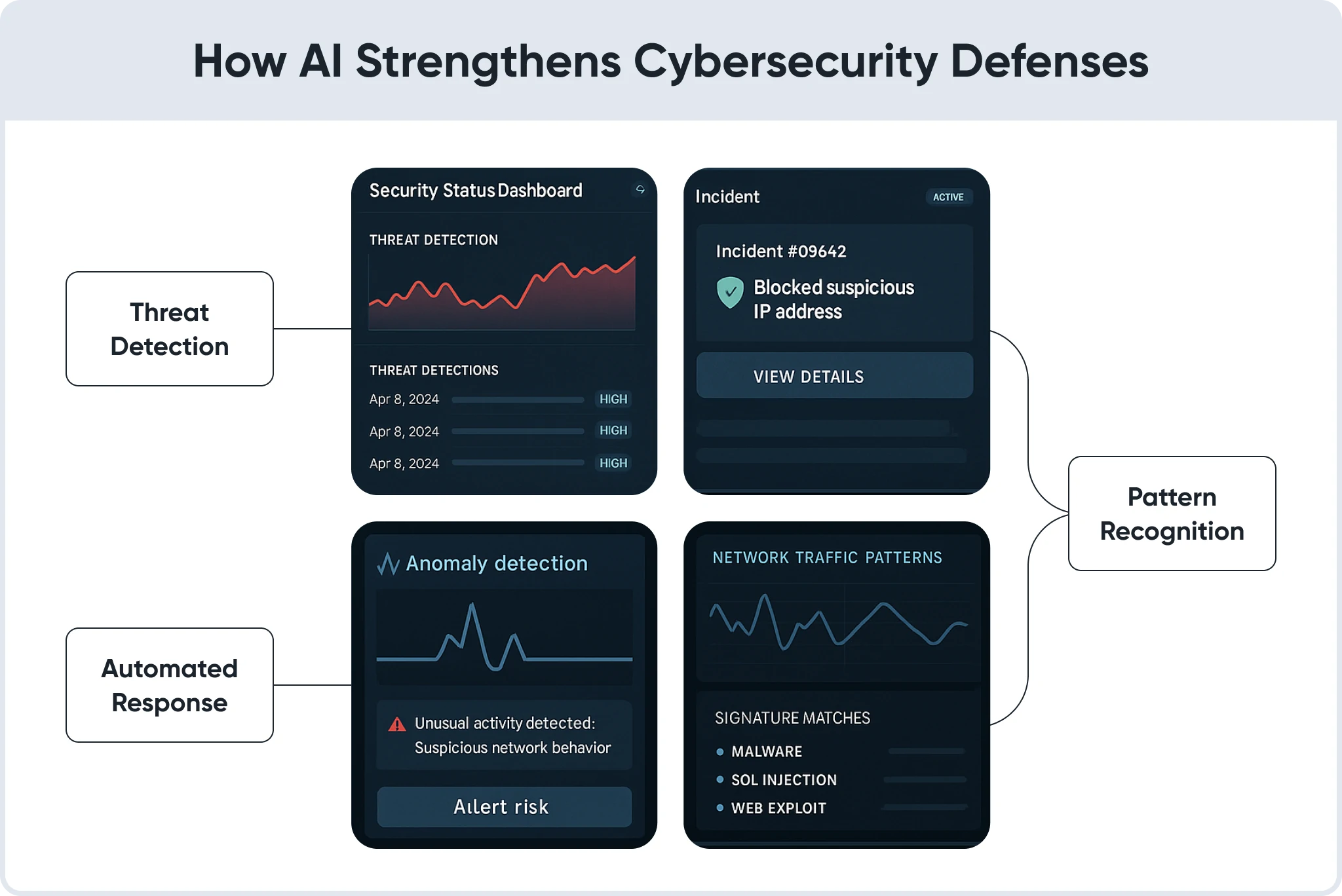
How AI Strengthens Cybersecurity Defenses
- Many companies use AI as an extra pair of eyes that watches network activity nonstop and notices unusual movement faster than any analyst.
- Models learn what normal behaviour looks like, so even small deviations stand out immediately.
- During an incident, AI brings scattered signals into one clear picture, helping teams understand where the issue began.
- Routine checks often move to automated systems, which frees specialists from repetitive work and reduces human fatigue.
- When AI filters logs continuously, security teams gain more time for planning and long-term strategy.
- Well-trained models reduce noise in alerts, which helps teams catch important warnings that would otherwise be lost.
- In financial environments, AI often spots subtle behavioural changes that point to fraud or misuse.
- Regular updates ensure that models stay relevant, since outdated logic creates blind spots.
- Human judgment remains essential, because experts verify that the system’s reaction matches the real situation.
- Organisations that mix human expertise with intelligent automation usually recover faster because they see both the technical cause and the wider context of an attack.
When AI Becomes a Tool for Attackers
Attackers have learned to use AI in ways that make their work faster, smarter, and far more convincing than before. The shift is noticeable everywhere.
- Phishing looks different now. Messages created with AI sound natural and personal, which means even trained employees sometimes hesitate before deciding whether a letter is real or not.
- System scanning has also changed. Models can sweep through networks automatically and highlight weak spots without human involvement.
- Malware is no longer static. Some malicious programs adjust their behaviour as they move, which helps them slip past tools that rely on old detection patterns.
A separate concern comes from identity manipulation. Deepfake voices and videos allow attackers to imitate executives, payment officers, or support staff with alarming accuracy. A short phone call or a quick video message can suddenly become a serious financial threat.
AI is also used to write scripts and small fragments of code that once required technical skill. People with limited knowledge can now launch attacks that previously demanded entire teams. Password testing has sped up as well, since automated bots try thousands of combinations within minutes and leave almost no obvious traces.
Once attackers collect data, they often let AI sort through it. The model finds what is valuable, what should be sold, and what can be used for future attacks. This shortens the time between a breach and the damage it causes.
The most unsettling part is the pace. Threats evolve quickly because the tools behind them learn from every failed attempt. Defenders must adjust constantly, knowing that attackers are experimenting with the same intelligence they rely on themselves.
Ethical and Legal Questions Around AI in Security
Accountability
When an automated system blocks access or interrupts work, someone still needs to understand why it happened and explain the reasoning behind it.
Clarity of Decisions
Many models struggle to show how they reached a conclusion, which creates tension when a legitimate action is flagged as suspicious.
Quality of Training Data
If the data used to teach the model contains gaps or hidden bias, the system will inherit those flaws and make uneven or unfair decisions.
Misjudged Behaviour
Harmless actions can look risky to an imperfect model, while real threats occasionally pass through unnoticed, which undermines trust.
Privacy Boundaries
AI often needs broad access to personal information, and organisations must decide how much visibility is appropriate and where to draw the line.
Slow Regulation
Legal frameworks evolve gradually, while AI in security keeps moving forward, leaving companies to navigate uncertain requirements.
Autonomy Concerns
Automated reactions can help during an attack, yet full independence from human supervision introduces risks that are hard to ignore.
Balanced Control
Most organisations now look for a structure where AI handles repetitive tasks and people remain responsible for choices that carry real consequences.
Hidden Vulnerabilities
Even advanced systems can create new weak spots if no one checks their behaviour regularly, which makes oversight essential.
Human Oversight
Good security depends on people who understand both the strengths and the limits of their tools, not only on technology itself.
The Role of AI in Automating Cyber Defenses
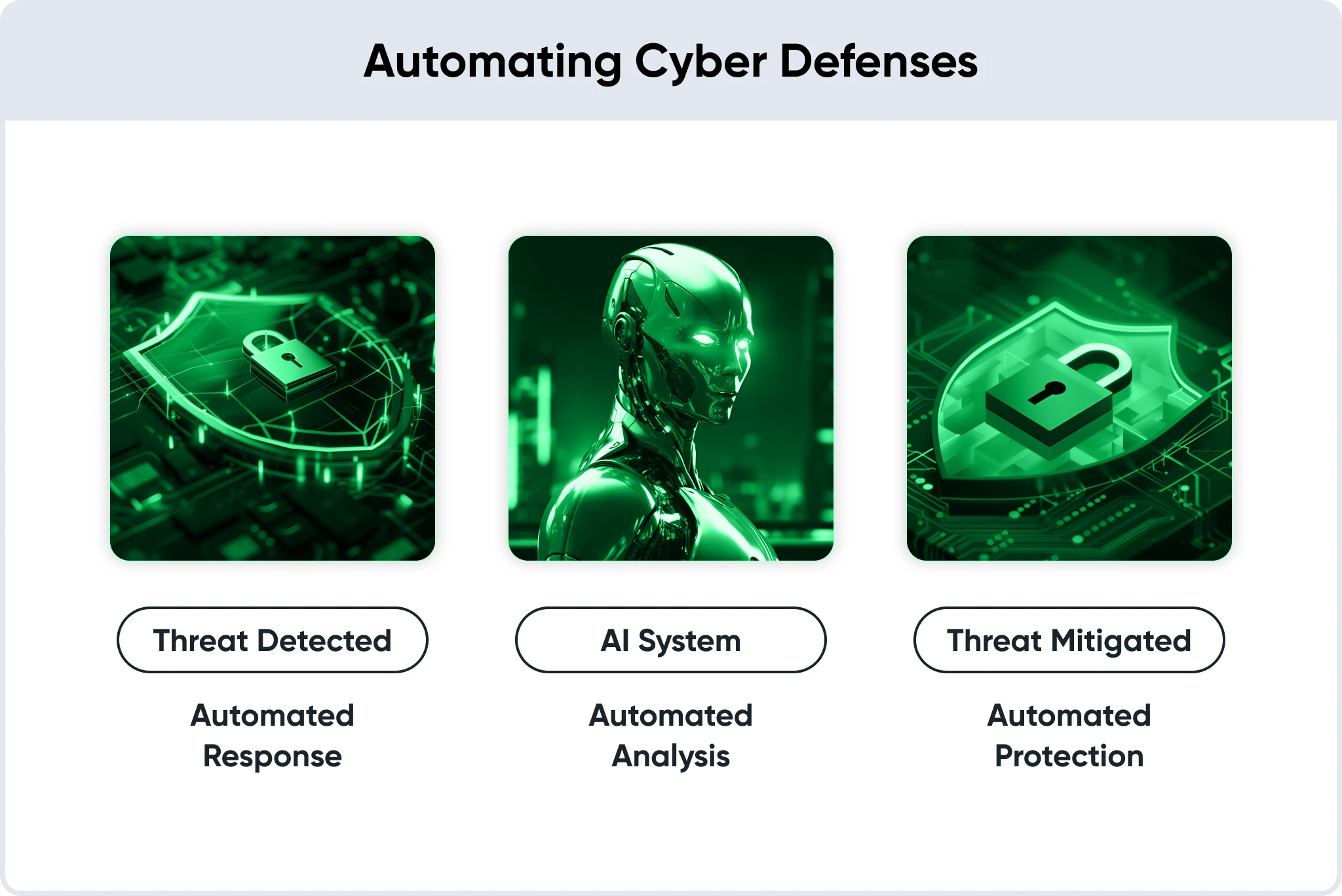
AI now handles much of the routine work that once overwhelmed security teams. It keeps an eye on network activity at all hours, notices small shifts in behaviour, and points out the things that deserve immediate attention. Issues that used to hide in long logs appear much earlier, whether it is an unusual login or sudden movement of sensitive data.
The benefits are clearest during real incidents. AI can slow an attack, limit access, or isolate part of the system while analysts figure out what is happening. Those early seconds often decide how far a breach spreads.
Many organisations also use AI to run simulated attacks. These tests reveal weak spots without exposing real systems to danger and help teams adjust their strategy before anything happens.
Automation does not replace people. It takes on the heavy monitoring and repetitive checks so specialists can focus on decisions that require judgement. Strong security comes from that combination, not from one side working alone.
The Future of AI in Cybersecurity
Smaller and More Focused Models
Organisations are moving toward compact AI systems trained for specific industries, which makes them easier to manage and more transparent in practice.
Better Context Awareness
Future tools will not only detect suspicious activity but also understand the environment around it, giving teams clearer insight into what might be happening.
Closer Human-AI Collaboration
AI will prepare options, gather evidence, and highlight patterns, while analysts decide how to act. The partnership becomes more natural and less mechanical.
More Demanding Governance
Companies want clear visibility into how AI behaves. Questions about data use, decision logic, and accountability will shape how new systems are built.
Strategic Use Over Raw Power
Security teams look for models that fit their workflows instead of relying on large systems that try to cover everything at once.
Realistic Security Simulations
AI driven testing will continue to grow, giving organisations safer ways to uncover weak points and rehearse incidents.
Greater Emphasis on Trust
Users and leadership expect AI to explain itself. Clear reasoning and predictable behaviour will play a bigger role than impressive metrics.
Faster Response Cycles
Automation will shorten the time between detection and action, helping reduce the damage caused by fast moving threats.
Integrated Defence Layers
AI will link information from different tools, creating a more unified view of security events and reducing confusion during incidents.
Human Judgment at the Core
Even as automation expands, companies will rely on people to interpret context, set boundaries, and make final decisions that shape long term security.
Conclusion
AI is becoming part of everyday security work in a way that feels almost ordinary now. Most teams rely on it without thinking twice, the same way they rely on monitoring tools or log viewers. It catches unusual behaviour at moments when no one is looking and quietly filters the noise so people can focus on the decisions that actually matter.
What really shapes strong security today is not the tool itself but how a company uses it. Clear rules, thoughtful workflows, and people who understand the bigger picture make a bigger difference than any algorithm. Technology helps, yet it does not replace experience, judgment, or common sense.
This is the kind of work GoMage handles every day. We help companies figure out where AI truly makes life easier and where it needs a human hand. Sometimes that means building smarter automation, sometimes laying out better visibility across systems, and sometimes helping teams understand how to use the tools they already have.
Our approach is simple: make sure the technology works, make sure people trust it, and make sure it actually solves the problems you have.
FAQ
It catches things humans miss and reacts faster than traditional systems, especially during busy hours.
No. It can handle the repetitive checking, but people still make the important calls.
They learn from patterns, and those patterns are not always perfect. A model can misread context the same way a person can.
Yes. Criminals use it to create convincing messages, plan targeted attacks, and move more quickly.
Some tools explain their reasoning. Others do not. Many teams add their own review steps to keep track of decisions.
It depends on the setup. Companies need clear boundaries so data stays private and is used responsibly.
Better data, regular audits, and a mix of technical and non-technical reviewers who can spot issues early.
Not without human involvement. Automation is helpful, but complete autonomy introduces unnecessary risk.
Patterns hidden inside massive amounts of network traffic, especially behaviours that change slowly over time.
Begin with one clear problem, test the results, and adjust from there. If the process feels overwhelming, GoMage can guide the setup and help your team understand each step.