We live surrounded by smart technology that quietly shapes everyday routines. It is in our entertainment, in our maps, even in the way our emails are filtered. Most of the time we hardly notice it. Yet whenever the conversation turns to “intelligent machines,” people react in very different ways. Some feel excited, imagining progress that makes life easier. Others feel cautious, worried about hidden risks or loss of control. Between optimism and fear, the real story often gets lost.
The truth is much simpler than the headlines. What we call intelligence in a machine is really a process of learning from examples, recognizing patterns, and improving step by step. No mystery, no magic. Just careful design, a lot of data, and the ability to practice until the system becomes useful. This is the essence of how AI works in practice.
In the next sections we will look closely at how this learning works, where it already shows up in daily life, and what it might mean for the future. By the end, the idea of smart technology should feel less abstract and far more familiar.
What Do We Mean by Smart Technology
When people hear about smart systems, they often imagine something close to science fiction. The picture that comes to mind is a robot that thinks, speaks, and acts just like a person. Reality is far more down to earth.
Smart technology is simply a way of teaching computers to handle tasks that once needed human judgment. Recognizing a voice on the phone, sorting photos by faces, suggesting a faster road on a navigation app. These are not signs of a digital mind, they are the result of machines practicing on vast amounts of examples until they become reliable.
Think about a child learning to read. At first every letter feels strange, but after repeating the same shapes again and again, the child starts to recognize words instantly. Computers learn in much the same way, only faster and with more data. What looks like intelligence is really pattern recognition refined through endless practice.
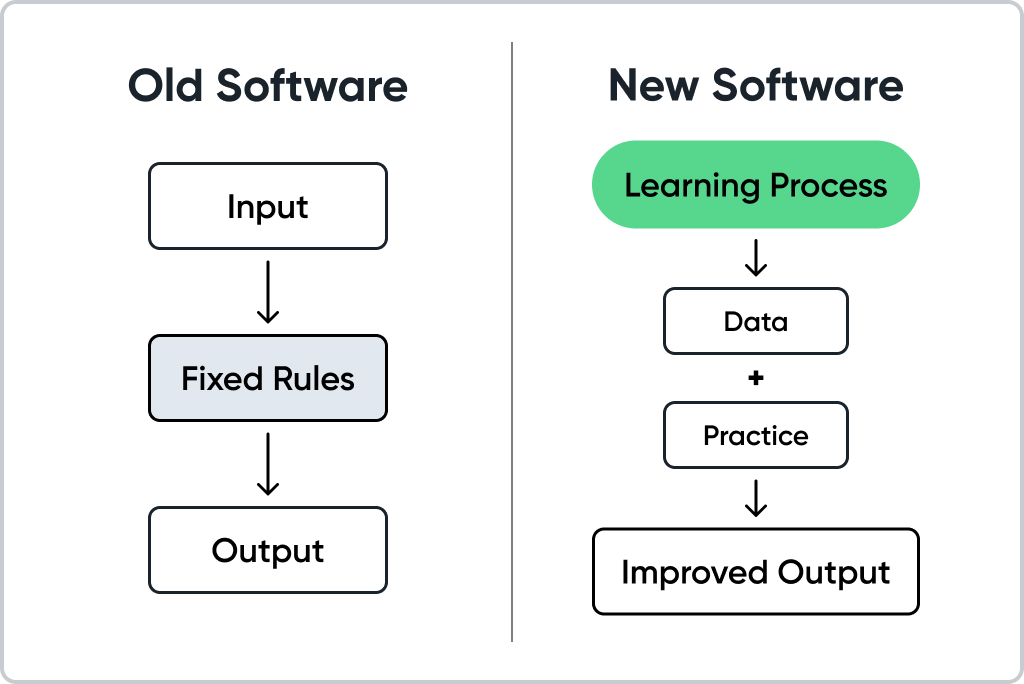
This makes smart systems different from the programs we grew up with. Old software follows strict instructions. If you give it something unexpected, it breaks. A learning system adapts. It adjusts, remembers, and improves the more it is used. That is why the results often feel natural, even if the process behind them is nothing like human thought.
The Role of Algorithms
Every smart system needs a set of instructions that tells it what to do with the information it receives. These instructions are called algorithms. Unlike rigid step-by-step rules in old programs, modern algorithms are flexible. They adjust when new data arrives and improve after every round of practice.
Think of algorithms as the playbook of the system. Here is how they work in familiar situations:
- Email filters: An algorithm learns to separate unwanted messages from the ones you care about. At first it makes mistakes, but after seeing millions of examples it gets much better.
- Photo recognition: The system studies countless pictures until it can identify whether an image shows a cat, a dog, or a person.
- Navigation apps: Algorithms analyze traffic reports and past patterns to suggest the fastest route, even before the first cars slow down.
- Voice assistants: They rely on algorithms to recognize speech, break it into words, and respond with a meaningful answer.
In each case the algorithm is not thinking like a person. It is calculating, comparing, and searching for patterns. The magic is not in creativity but in speed and accuracy.
Why Data Matters
Brains are nothing without experience. The same is true for smart systems. You can design the most clever set of rules, but if there is no material to learn from, the system just sits there.
Think about a student cramming for an exam. If they only read one page of the book, the test will be a disaster. If they read the whole thing, practice with examples, and check their mistakes, they will do much better. Machines learn in exactly that way, only faster.
You’ve probably seen this yourself:
- When you talk to a voice app and it suddenly understands your accent after months of messing it up. That comes from being trained on millions of voices.
- When your phone gallery starts grouping your family photos correctly. It got there by studying endless examples of faces.
- When a shopping site recommends the exact gadget you were thinking about. It compares your clicks with millions of other people’s clicks.
- When hospitals use software to highlight shadows on an X-ray. The system saw so many scans that unusual spots began to stand out.
Without data, all of this collapses. With data, even the messiest handwriting, the noisiest recording, or the most chaotic traffic jam can start to make sense.
Pretty amazing, right? And at the same time, it shows something important: the real power does not come from fancy math alone but from the mountain of examples behind it.
How Learning Happens Step by Step
Clever systems do not wake up one morning fully formed. They improve little by little, through practice. The process looks simple on paper but makes all the difference in reality:
- Collecting examples – Images, voices, numbers, or records are gathered. Without them, nothing can begin.
- Training the model – The system studies these examples, tries to find patterns, and makes its first guesses.
- Testing – Mistakes appear quickly. Each error becomes feedback.
- Correction – Rules are adjusted so that the next round is better.
- Real-world use – Once reliable enough, the system is put into daily practice.
- Continuous growth – New information arrives all the time, so the learning never stops.
It is a loop rather than a straight line. Every cycle makes the outcome sharper, faster, and more useful.
Smart Technology in Everyday Life
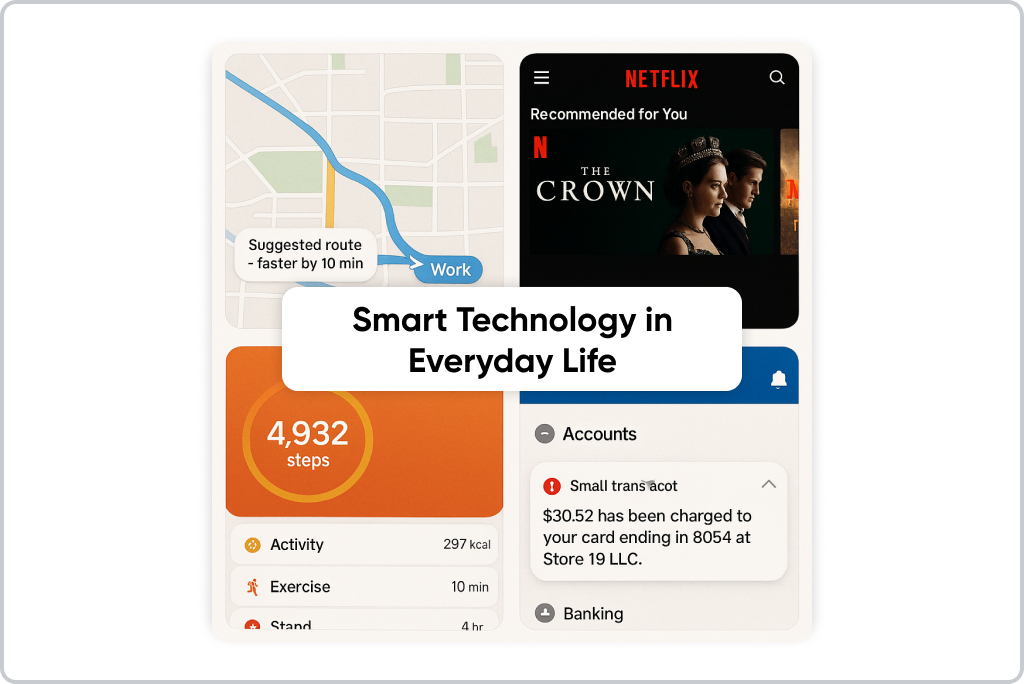
We do not usually think about the tools that run in the background of our daily routines. They do not call attention to themselves, yet the effect is hard to miss once you notice it.
- On the road: You open your map before work and it shows a red line on your usual route. A suggestion pops up for a smaller street you had never tried before. You follow it, and ten minutes later you realize you have avoided a traffic jam.
- At home: You sit down after dinner, open a streaming platform, and the first title looks like it was chosen for you that very evening. Not magic, just the result of hours of viewing history quietly shaping the list.
- For health: A watch records your steps and sleep, then sums it up into a simple message: “You need a walk.” It feels obvious, but sometimes obvious is exactly what we forget.
- In the store: Browsing online, you find products lined up as if the shelves were arranged for you alone. Some you ignore, others catch your eye, and sooner or later one lands in the cart.
- With money: A small notification from the bank arrives while you are at lunch. A strange transaction was stopped automatically. Worry turns into relief as you realize your account is safe.
Each of these scenes seems ordinary on its own. Taken together, they show how invisible systems already guide choices, save time, and add a layer of safety to everyday life.
Why It Matters for Decisions
Beyond convenience, these systems play a role in serious choices:
- Healthcare – Highlighting early signs in scans that doctors can then examine more closely.
- Retail – Estimating demand so shelves are stocked without waste.
- Finance – Spotting unusual card activity in seconds and preventing fraud.
- Logistics – Guiding delivery vans through the most efficient routes.
What makes them powerful is speed and scale. People still make the final judgment, but the information comes faster and more clearly than ever before.
Looking Ahead
The next few years will not bring science-fiction robots into our kitchens. Change will be quieter but more profound.
- In schools, each student may receive lessons tailored to their level.
- In hospitals, treatment may be adjusted to each patient’s needs instead of relying only on averages.
- At work, reports, schedules, and planning may be handled in the background, freeing time for creative problem-solving.
Conclusion
Smart tools are no longer something distant. They are already part of daily life, helping people plan routes, choose what to watch in the evening, and even track health. The real question for businesses is how to use these tools in a way that creates real value for customers.
GoMage helps with that. If you want to see how this can work for your business. We know how to turn modern technology into practical results that help stores grow, build loyal buyers, and stay ahead of competitors.