Magento merchants lose revenue every second their sites lag. Amazon’s research proves every 100ms delay cuts sales by 1%. Traditional Magento themes load 300KB+, creating 8-10 second mobile wait times that hemorrhage customers to faster competitors. Hyvä Theme solves this by delivering sub-2-second loads that convert browsers into buyers.
The Business Case Driving Mass Migration to Hyvä
E-commerce operates on razor-thin margins where performance directly impacts profitability. Traditional Magento themes create three critical business problems:
Revenue leakage through slow mobile experiences. Mobile represents 60-70% of traffic, but traditional themes deliver 9-12 second load times on cellular networks. Research shows 53% of mobile visitors abandon sites after exceeding 3 seconds. You’re losing half your potential customers before they see products.
Declining search visibility as Google punishes slow sites. Core Web Vitals became ranking factors in 2021. Sites failing these metrics lose 20-40% organic visibility to faster competitors. Traditional Magento consistently fails, costing thousands monthly in lost organic traffic that would otherwise convert without ad spend.
Escalating infrastructure costs compensate for inefficient code. Heavy JavaScript requires expensive servers handling concurrent users. Merchants spend $3,000-5,000 monthly on hosting that efficient architecture could handle for $1,500-2,000.
Smart operators recognized that optimization delivers diminishing returns. CDNs, caching, and compression provide marginal gains. The architecture itself creates the bottleneck.
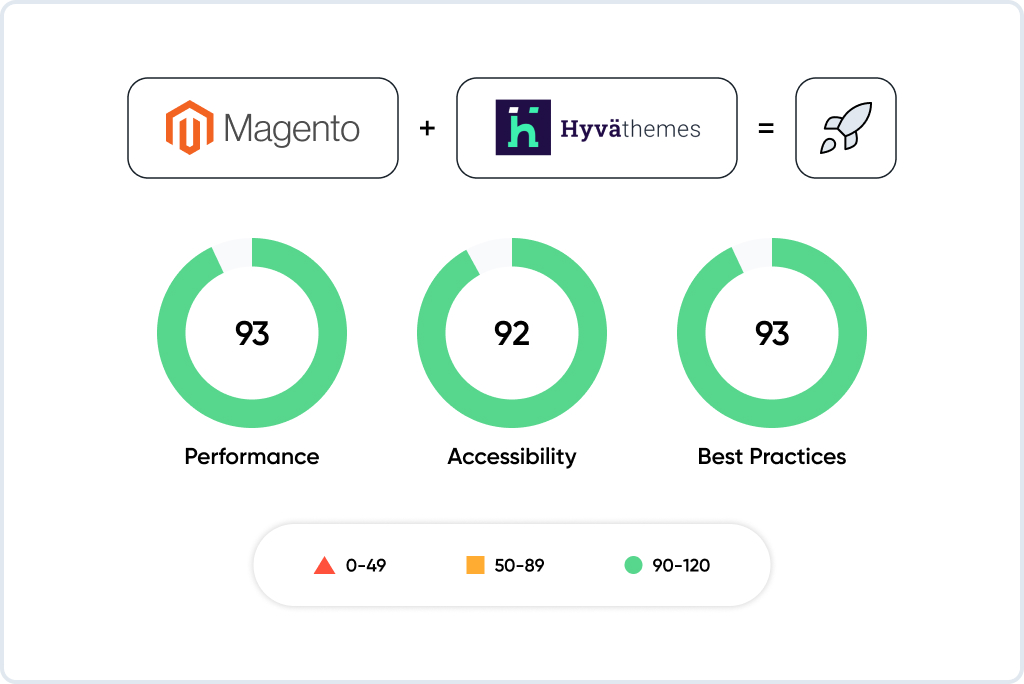
Performance Comparison: Traditional Magento vs Hyvä
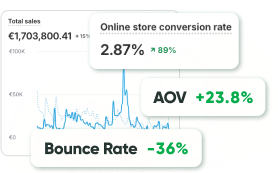
Bouwkampioen’s transformation quantifies Hyvä’s business impact:
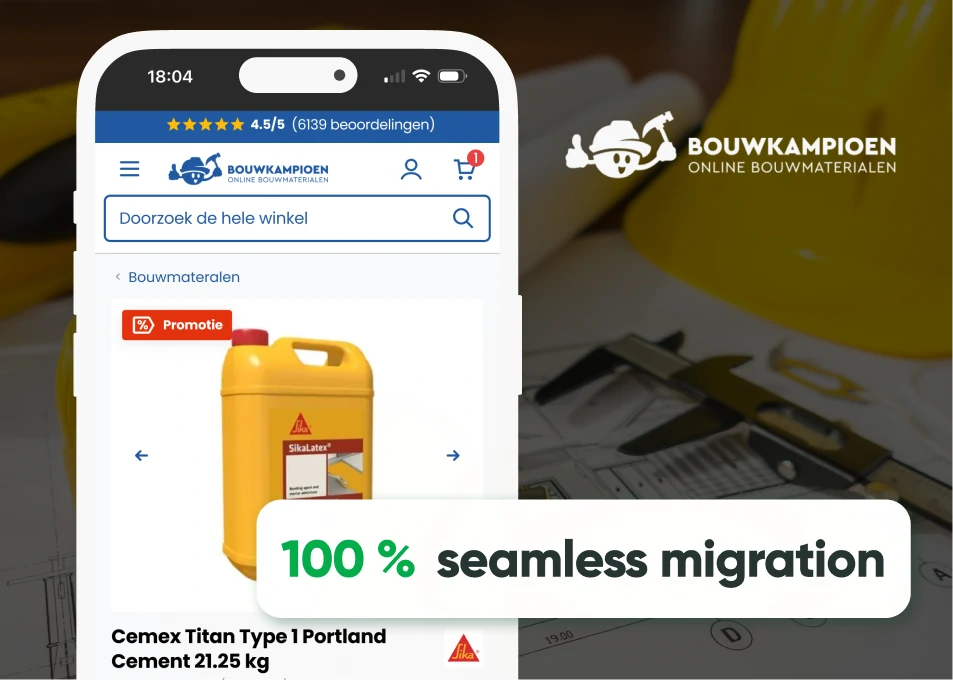
- 6 months project duration
- 100 % seamless migration
- 40-50% refactoring of heavy modules
BryteSoft’s implementation proved Hyvä works for complex B2B operations, not just consumer retail.
B2B buyers research extensively, viewing dozens of products per session. Traditional Magento degraded as sessions lengthened. Post-Hyvä, they maintained consistent sub-2-second loads regardless of session complexity.

- 6 months project duration
- 100 % successful migration
- 15 % organic traffic growth
Cross-Industry Performance Gains
GoMage’s Hyvä portfolio across 40+ implementations reveals consistent patterns:
Fashion retail: 280-320% mobile performance improvement, 0.6-1.1% conversion gains
Electronics: 190-250% desktop performance, 0.4-0.8% conversion gains
B2B operations: 200-275% catalog speed increase, 15-25% quote request growth
Food and beverage: 310-380% mobile improvement, 0.9-1.4% conversion gains
Every vertical achieves 85+ PageSpeed scores. The technology delivers predictable business outcomes.
How Hyvä Achieves Superior Performance
Hyvä replaces Magento’s 2015-era architecture with modern technology:
Alpine.js replaces Knockout.js and jQuery: 15KB vs 180KB, handling identical functionality
Tailwind CSS replaces LESS bloat: Generates only used styles, 25KB vs 180KB typical
GraphQL optimizes data transfer: Requests exact fields needed, reducing payloads 40-60%
Combined effect: Total page weight drops 75-85%. JavaScript specifically decreases from 330KB average to 32KB.
The reduction isn’t merely a technical achievement but a revenue enabler. Pages that load in 2 seconds convert customers that 8-second pages lose.
Core Web Vitals: Meeting Google’s Revenue-Driving Standards
Google weighs user experience heavily in rankings. Core Web Vitals quantify three aspects directly impacting organic visibility:
Largest Contentful Paint (LCP)
Measures the main content loading speed. Google threshold: under 2.5 seconds.
Traditional Magento: 5.2-7.8 seconds (fails)
Hyvä: 1.2-1.8 seconds (passes)
First Input Delay (FID)
Tracks interaction responsiveness. Threshold: under 100ms.
Traditional Magento: 280-420ms (fails)
Hyvä: 60-90ms (passes)
Cumulative Layout Shift (CLS)
Measures visual stability. Target: under 0.1.
Traditional Magento: 0.18-0.32 (fails)
Hyvä: 0.04-0.08 (passes)
Meeting all three metrics improves rankings. Merchants report 15-35% organic traffic increases within 3-6 months as Google recognizes improvements.
For stores where organic represents 40% of revenue, a 25% traffic increase means 10% total revenue growth without marketing budget increases.
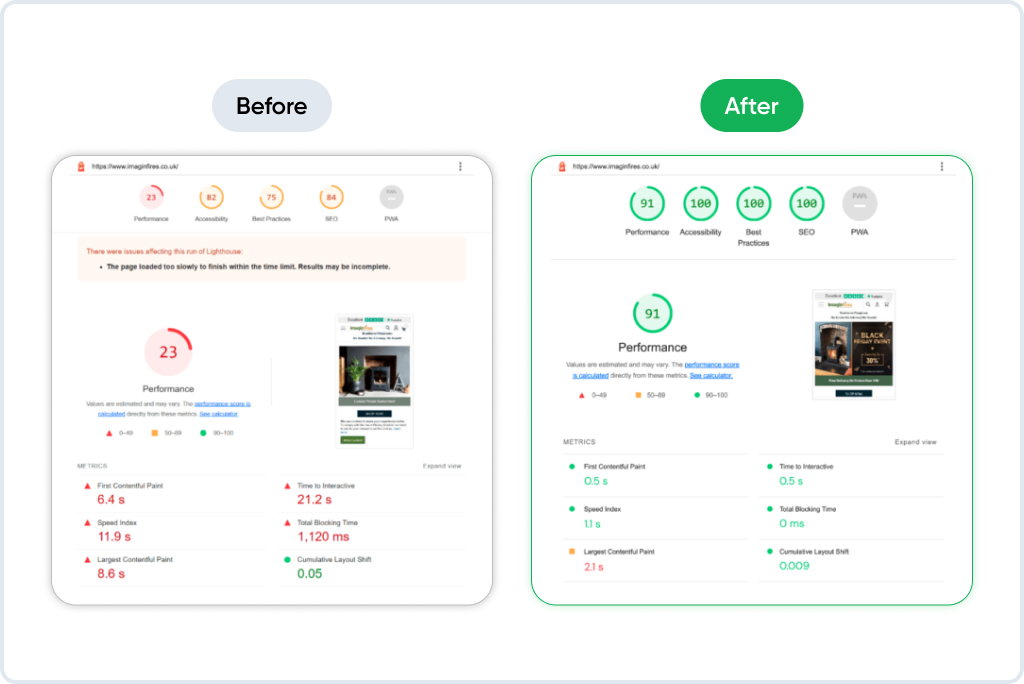
Mobile Performance: Capturing Mobile-First Markets
Desktop and mobile performance gaps cripple traditional Magento. Stores achieving 3-second desktop loads suffer 9-second mobile times.
Why Mobile Matters More
Mobile commerce represents 60-70% of total e-commerce and is growing. Yet mobile users are the most performance-sensitive. 53% abandon sites exceeding 3-second loads.
Traditional Magento’s 330KB JavaScript overwhelms mobile processors and cellular networks. Budget smartphones representing a significant global market share take 2-3x longer to process heavy JavaScript than desktops.
Hyvä’s Mobile Advantage
At 32KB JavaScript and 250KB total page weight, Hyvä loads quickly even on 3G networks with budget devices. The efficiency opens markets that traditional themes can’t serve:
Emerging markets with slower infrastructure
Data-conscious users are avoiding heavy sites
On-the-go shoppers on cellular networks
Budget device users are unable to run heavy sites
Fashion retailers where 75% of traffic is mobile report 0.9-1.4% conversion improvements post-Hyvä. That translates to $90,000-140,000 additional annual revenue per $10M baseline.
Financial Impact Analysis
Revenue Growth Drivers
Conversion rate improvement: Industry research shows a 1-second load time improvement drives 7% conversion increase. Hyvä typically reduces loads by 3-6 seconds. Conservative 0.5% conversion gain on $5M revenue adds $25,000 annually. Typical 0.8-1.2% gains add $40,000-60,000.
Organic traffic growth: Better Core Web Vitals improve rankings gradually. Merchants report 15-40% organic increases within 6 months. For stores where 40% revenue comes organically, 25% traffic growth means 10% total revenue increase without marketing spend.
Cart abandonment reduction: Faster checkout reduces abandonment by 8-15%. For stores with a $100 average order and 1,000 weekly carts, 10% abandonment reduction recovers $270,000 annually.
Customer lifetime value increase: Fast sites create better first impressions. Research shows customers experiencing quick initial visits are 40% more likely to return. For businesses where lifetime value exceeds single transaction profit, repeat purchase impact outweighs immediate conversion gains.
Cost Reduction Opportunities
Infrastructure savings: Efficient code requires less server capacity. Merchants report 30-40% hosting cost reductions. For businesses spending $3,000 monthly, that’s $10,800-14,400 annual savings.
Development efficiency: Simpler architecture accelerates feature development by 30-40%, reducing ongoing development costs. For teams spending $10,000 monthly on Magento development, efficiency gains save $36,000-48,000 annually.
Marketing ROI improvement: When paid traffic converts better, marketing spend delivers more revenue. A 0.8% conversion improvement means 40% more revenue from identical ad spend.
Investment and Returns
Typical Hyvä implementation costs:
Small to mid-market stores: $40,000-70,000
Enterprise implementations: $80,000-150,000
ROI calculation for $5M revenue store:
- Conversion improvement: +0.6% = $30,000 annually
- Organic traffic growth: +20% = $150,000 annually
- Infrastructure savings: $12,000 annually
- Total annual benefit: $192,000
With a $60,000 implementation cost, the ROI period is 3.8 months. Three-year cumulative benefit: $576,000.
Even a conservative 0.3% conversion and 10% organic growth delivers a sub-6-month ROI.
Strategic Implementation Roadmap
Phase 1: Business Case Development (2 weeks)
Audit current performance, conversion rates, and organic traffic. Document quantifiable pain points. Build a financial model showing conservative, expected, and optimistic scenarios.
Phase 2: Partner Selection and Planning (3 weeks)
Evaluate implementation partners based on proven Hyvä experience. GoMage’s Hyvä services include migration planning, development, and post-launch optimization.
Define success metrics, timeline, and resource requirements. Establish governance structure and rollback procedures.
Phase 3: Staged Development (10-14 weeks)
Build incrementally rather than attempting a complete migration simultaneously:
Weeks 1-3: Homepage and landing pages
Weeks 4-6: Category pages
Weeks 7-9: Product pages
Weeks 10-12: Checkout
Weeks 13-14: Testing and refinement
The modular approach allows business review at each milestone, reducing late-stage change costs.
Phase 4: Launch and Optimization (4-6 weeks)
Deploy during a low-traffic period. Monitor real-time conversion, bounce rates, and average order values. Compare against pre-launch baseline. A/B test variations. Refine based on actual customer behavior data.
Competitive Market Positioning
Industry-Specific Advantages
Fashion and luxury retail: Visual merchandising drives sales. High-resolution photography and video create bandwidth challenges. Hyvä handles media-rich pages without degradation. Customers browse collections fluidly, aligning experience with luxury brand positioning.
B2B manufacturing: Complex catalogs with thousands of SKUs challenge traditional themes. Hyvä maintains performance regardless of catalog scale. Quick order forms, bulk purchasing, and customer-specific pricing work efficiently. Performance advantage reduces sales cycle length and increases close rates.
Consumer electronics: Technical buyers research specifications thoroughly. Product comparison tools and configuration options create complex pages. Hyvä loads information-dense pages quickly. Comparison tables respond instantly. The technical performance matches sophisticated buyer expectations.
Food and beverage: Mobile-dominant customer base needs fast experiences. Hyvä’s mobile optimization captures impulse purchases that slow sites lose. The performance advantage is particularly pronounced where 70-80% of traffic is mobile.
Competitive Differentiation Strategies
Speed-as-marketing: Promote site performance directly in advertising. “Our store loads 3x faster than competitors” becomes a competitive advantage, attracting efficiency-minded customers.
Mobile-first positioning: Target mobile-dominant segments that competitors serve poorly. Capture market share from competitors with slow mobile experiences.
Sustainability messaging: Efficient code consumes less energy. Position environmental responsibility as a brand value appealing to sustainability-conscious consumers.
Risk Management
Technical Risks and Mitigation
Extension compatibility issues:
Mitigation: Audit extensions during planning. Budget compatibility development. Identify alternatives where needed. Most popular extensions have Hyvä versions available.
Custom feature migration complexity:
Mitigation: Prototype complex features early. Validate the technical approach before full development. Consider simplification if migration proves expensive.
Performance regression:
Mitigation: Establish performance budgets. Automated testing catches regressions. Continuous monitoring maintains gains.
Business Risks and Mitigation
Revenue disruption during migration:
Mitigation: Develop on staging. Run both themes in parallel initially. Gradual traffic migration validates stability before full cutover.
Stakeholder alignment:
Mitigation: Regular executive updates with working prototypes. Quantify benefits early and often with concrete metrics.
Resource availability:
Mitigation: Secure dedicated development resources. Plan around business peak seasons. Build a buffer into the timeline for unexpected delays.
Financial Risks and Mitigation
Cost overruns:
Mitigation: Fixed-price contracts where possible. Clear scope definition upfront. Change the order process for additional requirements.
Delayed ROI:
Mitigation: Conservative financial projections. Focus on quick-win optimizations post-launch. Measure and communicate early improvements to maintain stakeholder confidence.
Long-Term Strategic Value
Future-Proofing Technology Investment
Technology choices impact agility for years. Legacy architecture creates technical debt, limiting innovation velocity.
Hyvä’s modern foundation using Alpine.js, Tailwind CSS, and GraphQL aligns with web development evolution. The architecture supports emerging capabilities:
Headless commerce readiness: GraphQL-first approach enables progressive decoupling. Add mobile apps, voice commerce, and IoT channels without frontend rebuilding.
Progressive web app support: Lightweight architecture makes PWA implementation practical. Offline browsing and push notifications become achievable.
Emerging channels: Voice assistants, augmented reality, and social commerce integrate more easily with modern architecture.
Organizational Capability Building
Hyvä adoption builds valuable capabilities:
Developer skill advancement: Modern technology stack attracts better development talent. Skills transfer to other projects.
Faster innovation cycles: Simplified architecture accelerates feature development. Business responds faster to market opportunities.
Reduced technical dependency: Cleaner codebase reduces reliance on specialized Magento expertise. Standard web development skills become sufficient.
Decision Framework for Leadership
High-Priority Scenarios for Hyvä Investment
- Your business generates $3M+ annual online revenue
- Current mobile PageSpeed scores below 40
- Organic traffic represents 30%+ of revenue
- Competitive pressure from faster sites
- Planned growth initiatives require better performance
- International expansion targeting mobile-first markets
Moderate-Priority Scenarios
- Annual revenue $1M-3M
- Current PageSpeed 40-60
- Planning significant marketing investment where better conversion improves ROI
- Recent customer feedback indicates speed frustration
Alternative Considerations
Incremental optimization if current performance is adequate and budget constrained. Recognize ceiling exists in traditional architecture.
Platform migration for Magento creates challenges beyond frontend performance. Factor in total migration costs and disruption.
Headless architecture if omnichannel requirements demand maximum flexibility. Recognize higher complexity and cost.
Hyvä often represents optimal balance: dramatic performance improvement without platform abandonment or headless complexity.
Conclusion
When frontend limitations start affecting conversion, SEO, and costs, incremental fixes stop making sense. Hyvä removes those limitations instead of working around them.
The result is a store that loads faster, behaves predictably, and is easier to scale without constant optimization.
If performance is already impacting your business, it is worth looking at how this is implemented in real projects with GoMage Hyvä services.
FAQ
Most merchants achieve a 3-6 month ROI. Bouwkampioen’s €65,000 investment returned in 9.7 months through €80,000 additional annual revenue. Timeline depends on current performance gaps and revenue scale. Higher-revenue stores and poorer-performing sites see faster returns.
CDN, caching, and compression deliver 10-20% improvements, typically costing $15,000-30,000. Hyvä delivers 200-400% improvements for $40,000-100,000. The magnitude difference makes Hyvä more cost-effective for stores with significant performance gaps. Incremental optimization makes sense only after Hyvä establishes an efficient foundation.
Experienced partners like GoMage develop on staging environments with full rollback capability. Parallel running both themes initially allows traffic validation before full cutover. Most implementations encounter minor issues resolved during the testing phase. Major problems are rare with proper planning and experienced execution.
A/B testing on the percentage of traffic validates conversion improvements before full launch. Staged rollout by region or customer segment allows real-world validation. Most merchants see positive indicators within the first 2-4 weeks of partial deployment, building confidence for complete migration.
Hyvä establishes baseline efficient performance. Competitive advantage then shifts to merchandising, pricing, service, and marketing execution. Early adoption captures a 6-18 month lead while competitors plan and implement. The performance foundation enables innovations like PWAs and headless architecture that create new differentiation opportunities.
External partners handle technical implementation. Internal needs: executive sponsor for decisions, business analyst for requirements, marketing for design approval, IT for infrastructure coordination, and QA for testing. Expect 20-30 hours weekly internal time during a 12-16 week project. Post-launch maintenance requires less time than traditional themes due to simpler architecture.