Talk to people who work with SEO every day, and the same tools come up again and again. Ahrefs. SEMrush. Ubersuggest. Sometimes all three in the same conversation.
They often get compared as if they were built for exactly the same job. On paper, that almost looks true. Each platform promises keyword research, backlink analysis, and competitor insights. Yet the experience of using them is not identical.
So the discussion about Ahrefs vs. SEMrush vs. Ubersuggest usually turns into something more practical. Not which tool is universally better. The real question sounds closer to this: which platform actually fits the way your team works?
According to HubSpot research, SEO remains one of the most important sources of long-term website traffic for many companies. Without keyword insights, competitor analysis, and backlink tracking, understanding why certain pages rank becomes much harder.
That is the problem SEO platforms try to solve.
What SEO Tools Actually Help Marketers Do
At first glance, SEO tools appear to be keyword research platforms. That is usually how people discover them. Type a phrase, check search volume, maybe look at difficulty, and move on.
After a few weeks of real SEO work, the picture changes.
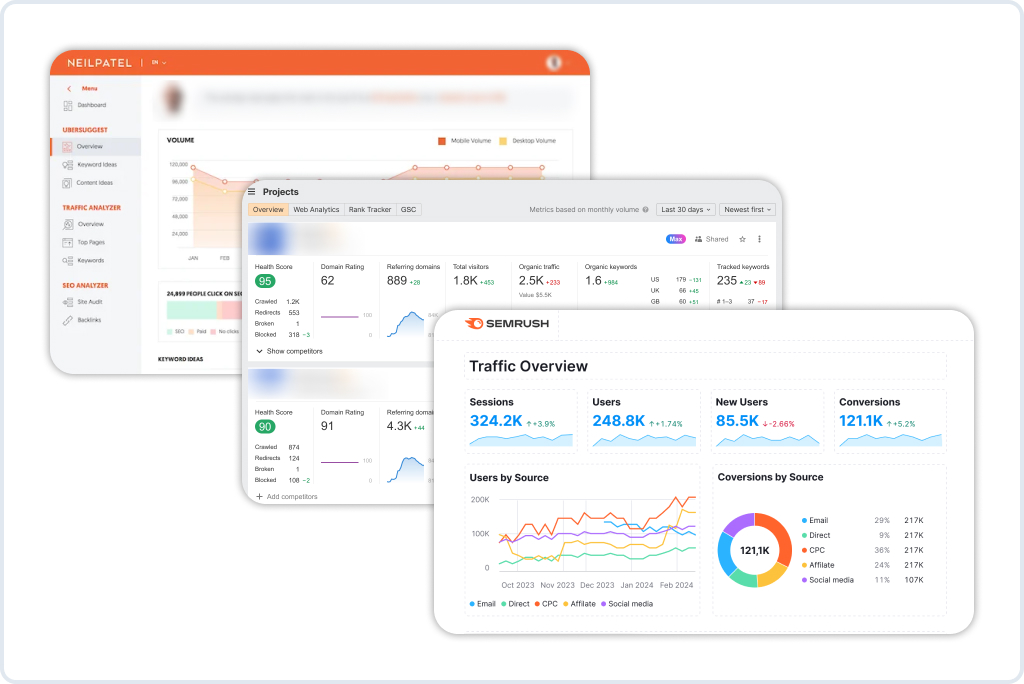
Keyword research becomes only one small part of the process. Marketers start opening tools for completely different reasons. Sometimes it is about understanding why the traffic suddenly dropped. Other times, the goal is to see how a competitor managed to outrank everyone else for a topic.
Backlinks are another reason tools stay open most of the day. A quick look at a competitor’s link profile often explains more than hours of guessing.
Then there is technical SEO. Broken pages, indexing issues, internal links that quietly disappear. None of those problems looks dramatic at first, but they accumulate over time.
That combination explains why tools like Ahrefs, SEMrush, and Ubersuggest are used far beyond simple keyword discovery. They help teams answer practical questions that appear during everyday SEO work.
Sometimes the question is about search demand.
Sometimes about competitors.
And occasionally it is simply about figuring out what went wrong.
Ahrefs vs SEMrush vs Ubersuggest: Where the Real Differences Start
Most comparisons between SEO tools begin with feature lists. Keyword research. Backlink analysis. Rank tracking.
In reality, the differences appear later, usually after a few days of actually using the tools.
Ahrefs, SEMrush, and Ubersuggest overlap in many areas. Yet the experience of working inside them feels different. Sometimes noticeably.
Ahrefs
Ahrefs is often the first tool SEO specialists open when they want to look at backlinks.
That habit has been around for years. The platform built much of its reputation on link data, and many marketers still trust its backlink index more than anything else.
Keyword research tools are strong as well, but the real strength usually shows when analyzing competitor pages. A quick look at referring domains often explains why a page ranks.
SEMrush
SEMrush usually feels broader.
Instead of focusing only on SEO metrics, the platform mixes several marketing datasets in one place. Keyword research, traffic estimates, advertising insights, and content tools.
For some teams, that combination is convenient. Everything lives inside one dashboard.
Others prefer more specialized tools. It depends on how marketing workflows are structured.
Ubersuggest
Ubersuggest enters the discussion for a different reason. Simplicity.
The interface is easier to understand, and the pricing is lower than most professional SEO platforms. Many freelancers and small businesses start there simply because the tool feels less intimidating.
A comparison such as ubersuggest vs ahrefs comparison often highlights that trade-off. One platform provides deeper data, the other keeps the process simple.
Keyword Research: What Actually Feels Different
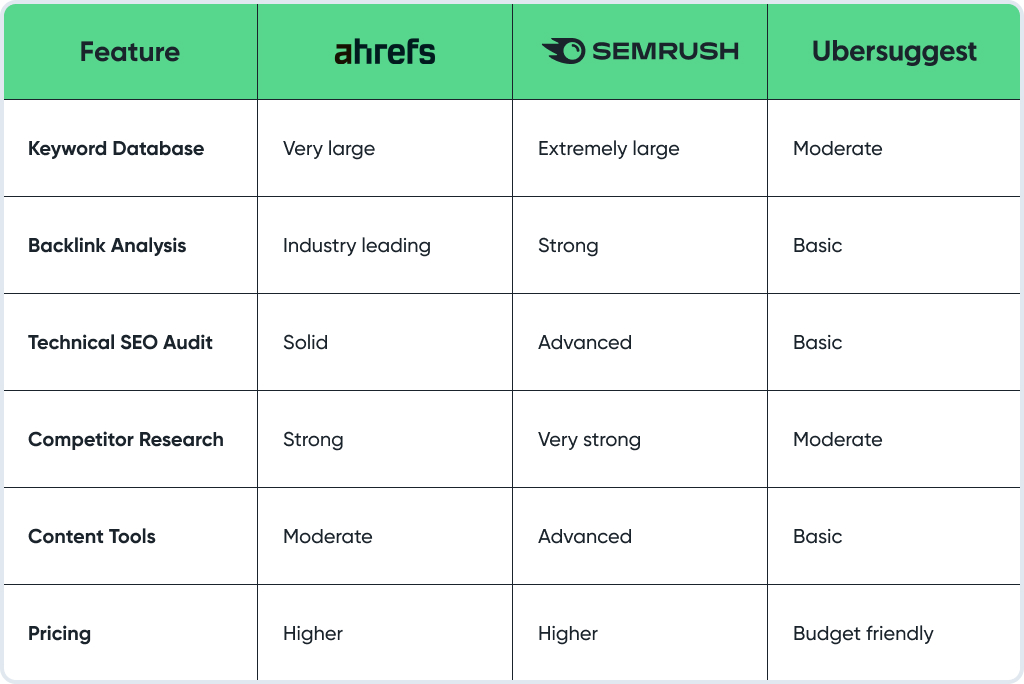
Most SEO tools promise the same thing at the start. Keyword ideas. Search volume. Difficulty scores. On paper, Ahrefs, SEMrush, and Ubersuggest look very similar.
Open them side by side, and the difference becomes obvious.
Ahrefs tends to push you toward competitive analysis almost immediately. You type a keyword, and the first thing that grabs attention is the list of pages already ranking. Strong domains, backlink profiles, and estimated traffic. Sometimes that information changes your decision in seconds. A keyword may look attractive until you notice that the entire first page belongs to high authority sites.
SEMrush approaches the same problem from another angle. The platform tries to organize keyword research into broader topic structures. Instead of scrolling through endless keyword lists, you see groups of related queries. That structure helps when planning multiple articles around one subject.
Ubersuggest feels lighter. The interface avoids showing too many indicators at once. For someone running their first SEO campaign, that simplicity is actually helpful. You type a phrase, check search volume, review keyword suggestions, and move on.
Backlink Analysis: Where the Tools Really Differ
Backlink analysis is still one of the main reasons SEO teams invest in professional tools. Search engines evaluate authority partly through links, so understanding where those links come from remains critical for competitive research.
Ahrefs, SEMrush, and Ubersuggest all provide backlink data, but the depth of their indexes and the way they expose that data can differ significantly.
Ahrefs
Ahrefs built its reputation around link intelligence. The platform maintains one of the largest publicly accessible backlink databases and updates it frequently through its own web crawler.
For SEO specialists, this matters because backlink growth often explains ranking changes. Inside Ahrefs, you can examine:
- referring domains and their authority
- anchor text distribution
- link velocity over time
- historical link acquisition patterns
SEMrush
SEMrush also offers backlink data, but the workflow is slightly different. Instead of emphasizing deep link exploration, the platform integrates backlink monitoring with other marketing signals.
Users can track:
- new and lost backlinks
- toxic domains that may require disavowal analysis
- overall domain authority trends
- competitor backlink overlap
Ubersuggest
Ubersuggest also provides backlink reports, though the level of detail is lower than in larger SEO suites.
The platform still highlights key signals, including referring domains, domain authority metrics, and newly discovered backlinks. For many small websites, that overview is sufficient to monitor link growth and basic competitor activity.
Ahrefs vs SEMrush vs Ubersuggest: Pricing Comparison (2026)
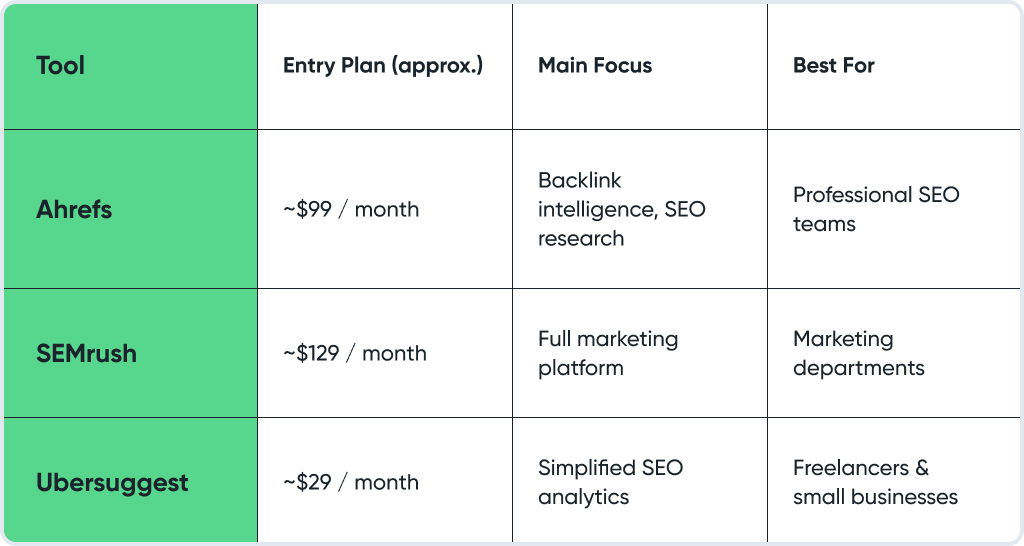
Pricing often becomes the final factor when teams compare SEO platforms. Keyword research and backlink analysis may look similar at first, but the subscription cost changes how accessible each tool is for different types of businesses.
Ahrefs, SEMrush, and Ubersuggest follow very different pricing strategies.
Which Tool Is Better for Keyword Research and Backlink Analysis?
Sooner or later, most SEO discussions return to the same question. Which tool should you actually rely on for research?
Comparisons like which is better, Ahrefs or SEMrush, usually appear once teams move beyond basic SEO work. At that stage, keyword discovery, competitor analysis, and backlink intelligence start influencing real business decisions.
Both platforms provide large keyword databases and backlink reports. The difference becomes noticeable only after using them for real projects.
When Keyword Research Is the Main Priority
SEMrush is often chosen by teams that build large content plans.
The keyword tools inside the platform are designed for exploring related queries and topic variations. Instead of showing only one keyword and a few suggestions, SEMrush expands the search into hundreds or sometimes thousands of related phrases.
That structure helps when building content clusters or planning multiple pages around the same subject.
For editorial teams working on large websites, this approach saves a lot of research time.
When Backlink Analysis Matters More
Ahrefs is frequently preferred when backlink analysis becomes the main task.
Many SEO specialists use it to examine competitor link profiles and understand how authority was built over time. Referring domains, anchor text patterns, and link growth trends are easy to explore.
Those signals often reveal opportunities for outreach or partnerships. If several competitors receive links from the same websites, those domains immediately become potential targets for link building.
Because of that, Ahrefs remains a common choice for agencies and SEO teams working in competitive niches.
Where Ubersuggest Fits
Ubersuggest approaches SEO research from a simpler angle.
The platform provides keyword ideas, traffic estimates, and basic backlink information without requiring complex workflows. For many smaller companies, that level of data is enough.
This is why the tool often appears in conversations about the best SEO tool for small businesses.
Freelancers and small marketing teams usually prioritize accessibility and lower cost over extremely detailed analysis.
The Practical Reality
The debate around ahrefs vs semrush vs ubersuggest rarely produces a single winner.
Some teams rely on Ahrefs for backlink intelligence. Others prefer SEMrush because keyword research connects with broader marketing insights. And many smaller businesses begin with Ubersuggest before adopting larger SEO platforms later.
The “best” tool usually depends less on the platform itself and more on the workflow of the team using it.
Choosing the Right SEO Tool for Your Business Goals
At some point, every team asks the same question: which SEO tool should we actually use every day?
Ahrefs, SEMrush, and Ubersuggest all promise similar things. Keyword data. Competitor insights. Backlink reports. The real difference usually appears only after you start working with them on real projects.
Small Teams and Independent Marketers
If a company is just starting with SEO, the goal is often straightforward. Understand what people search for. Check whether competitors rank for those queries. Track a few keywords.
In that situation, a complex platform is not always necessary.
Tools like Ubersuggest are often enough to get started. The interface is simple, keyword ideas appear quickly, and the reports are easy to read. That is why the platform often comes up in conversations about the best SEO tool for small businesses.
For freelancers or local companies, clarity sometimes matters more than depth.
Marketing Teams Working With Content
Content teams usually approach SEO differently. Instead of focusing on a few keywords, they plan entire topic areas.
This is where SEMrush becomes useful. The keyword tools inside the platform make it easier to explore variations around a topic and see how search demand spreads across related queries.
That structure helps when planning blog articles, category pages, or content clusters.
SEO Specialists and Agencies
Agencies often look at search data through a different lens.
Their work usually involves competitive analysis and link building. Understanding where competitors get backlinks from can explain why certain pages rank higher.
Because of that, many agencies rely heavily on Ahrefs. The platform exposes detailed backlink data and historical link patterns that help analysts identify potential link opportunities.
What Happens in Practice
In reality, the debate around ahrefs vs semrush vs ubersuggest rarely ends with one final choice.
Many teams end up using several tools depending on the task. One platform for keyword discovery. Another for backlink analysis. Sometimes, a simpler tool for quick checks.
Each of them reveals a different piece of the search landscape.
Conclusion
People often try to pick a single winner between Ahrefs, SEMrush, and Ubersuggest.
In reality, it rarely works that way.
Each platform solves a slightly different problem. Ahrefs is often used when teams need deeper backlink analysis. SEMrush works well when SEO is part of a larger marketing workflow. Ubersuggest is popular among freelancers and smaller businesses seeking something simpler.
So the real question is usually not which tool is better.
It is which one fits the way your team actually works?
And even then, tools only get you part of the way.
Keyword data and backlink reports help explain what happens in search. They do not automatically improve rankings. Technical structure, content quality, and consistent optimization still matter much more.
This is the stage where many companies start looking for experienced SEO partners.
The GoMage team works with businesses that want to grow organic traffic in a predictable way. Instead of focusing only on dashboards or keyword lists, the work usually starts with technical audits, site structure improvements, and a long-term search strategy.
FAQ
Ahrefs, if you live inside backlink data. Seriously, if your day involves pulling referring domains, checking anchor ratios, or figuring out why a competitor jumped 30 positions overnight, Ahrefs gives you that without making you dig for it. SEMrush is a different animal. It’s less of an SEO tool and more of a marketing command center: PPC data, traffic estimates, content gaps, brand monitoring, all sitting next to each other. Some SEO purists find that annoying. Marketing directors usually love it. A lot of agencies quietly pay for both and use them for different clients depending on the work.
Honestly, yes. Not because it’s powerful, but because it doesn’t punish you for not knowing what Domain Rating or referring IP diversity means yet. You get keyword ideas, rough volume numbers, and a peek at what competitor pages rank for. That’s enough to start. The moment you need to do serious link prospecting or build out a content cluster strategy, you’ll hit its ceiling pretty fast. But for a local business owner figuring out SEO for the first time? It does the job.
Ahrefs built its reputation on one thing: knowing more about backlinks than anyone else. SEMrush decided to become the platform where a whole marketing team, not just the SEO person, could work. Ubersuggest is neither of those things. It’s cheaper, simpler, and aimed at people who need answers without a learning curve. Three different products for three different users, really.
Ubersuggest is the safe starting point. Low cost, no overwhelming dashboards, covers the basics. If organic search starts driving real revenue and you need to understand why a competitor outranks you for everything that matters, that’s when Ahrefs or SEMrush starts making financial sense. Jumping straight to an enterprise tool before you have a content strategy or someone who can read the data is just expensive noise.
For most teams, close enough. Keyword research, tracking, site audits, and competitive visibility: SEMrush handles all of it competently. But ask someone doing manual link building in a tough niche whether SEMrush’s backlink data is enough, and they’ll probably say no. Ahrefs crawls more, updates faster, and the link explorer just feels more trustworthy to people who spend hours inside it. If backlinks aren’t central to your work, you won’t miss what Ahrefs does better.
No. This comes up constantly, and the answer never changes. A tool tells you that your page is missing internal links, loads slowly, and targets a keyword nobody searches for. What it can’t do is fix any of that. Rankings move when someone publishes something better, resolves the technical debt, or earns links from sites that actually carry weight. The tool is the diagnosis. The work is still yours.
Because every platform has blind spots. Keyword volume estimates vary wildly between Ahrefs and SEMrush for the same terms. Backlink indexes update on different schedules. Some tools catch cannibalization issues that others miss entirely. Cross-referencing two datasets takes more time but catches things that would stay invisible otherwise. The practical split most teams land on: SEMrush for keyword and content work, Ahrefs when the question is about links.
How accurate is the keyword data for your specific market, not English-language averages, in your market? How fresh is the backlink index? Stale link data is worse than no data when you’re making decisions. And whether someone on your team will actually use it regularly, because the best tool in the world doesn’t help if it sits unused after the first month.
Every single time. The tools got better, and the specialists didn’t go anywhere. If anything, the volume of data these platforms produce makes experienced interpretation more valuable, not less. Knowing which metrics to ignore is half the job.