Five years ago, the conversation in most boardrooms was still “should we be looking at AI?”
That question is gone now. What replaced it is a more challenging issue: how do we actually use this in a way that produces results?
The shift didn’t happen because executives suddenly got excited about machine learning. It happened because the problems AI addresses kept getting worse.
Companies working with advanced AI solutions, including those built on Addepto AI expertise, are adopting this technology because the alternative is falling behind competitors who already make the most of it.
Early automation was narrow and rules-based. If X, then Y. It did exactly what it was programmed to do and nothing else.
What machine learning changed is that systems now improve with exposure to data. They find patterns that weren’t anticipated when the model was built.
That’s a fundamentally different kind of tool, and it’s why AI stopped being relevant only in specific technical contexts and started showing up everywhere.
What Is Artificial Intelligence and How Is It Used in Business?
The technical definition is less useful than the practical one. AI is technology that replicates some of how humans learn, reason, and decide.
A system won’t replace human judgment on genuinely complex decisions. But it can process ten thousand data points in a second, which no human can.
That capability turns out to be valuable in a surprising number of contexts.
One thing that often gets underestimated is that AI needs the right training data to produce reliable outputs. So, it needs human oversight, or bias in the data will result in biased decisions.
The implementations that work best treat AI and people as complementary. The system handles volume and pattern recognition, while people provide context and accountability. Neither works as well alone.
Key Definitions and Core Capabilities
First, let’s take a closer look at a few terms.
Machine learning is a part of AI that lets systems learn from data without being explicitly programmed for every scenario. More data generally produces better performance over time.
Deep learning is a more advanced form using layered neural networks. It’s what powers image recognition, speech understanding, and other tasks that require finding highly complex patterns.
Natural language processing (NLP) is what makes AI feel conversational. It’s the difference between a chatbot that matches keywords and one that understands what someone is actually asking.
Computer vision extends this to images and video: reading product defects on a factory line, analyzing medical scans, verifying identity.
These capabilities combine to do four things for businesses:
- automate repetitive tasks
- predict likely outcomes
- personalize experiences
- support decisions that previously required significant human analysis
Types of AI Technologies in Business
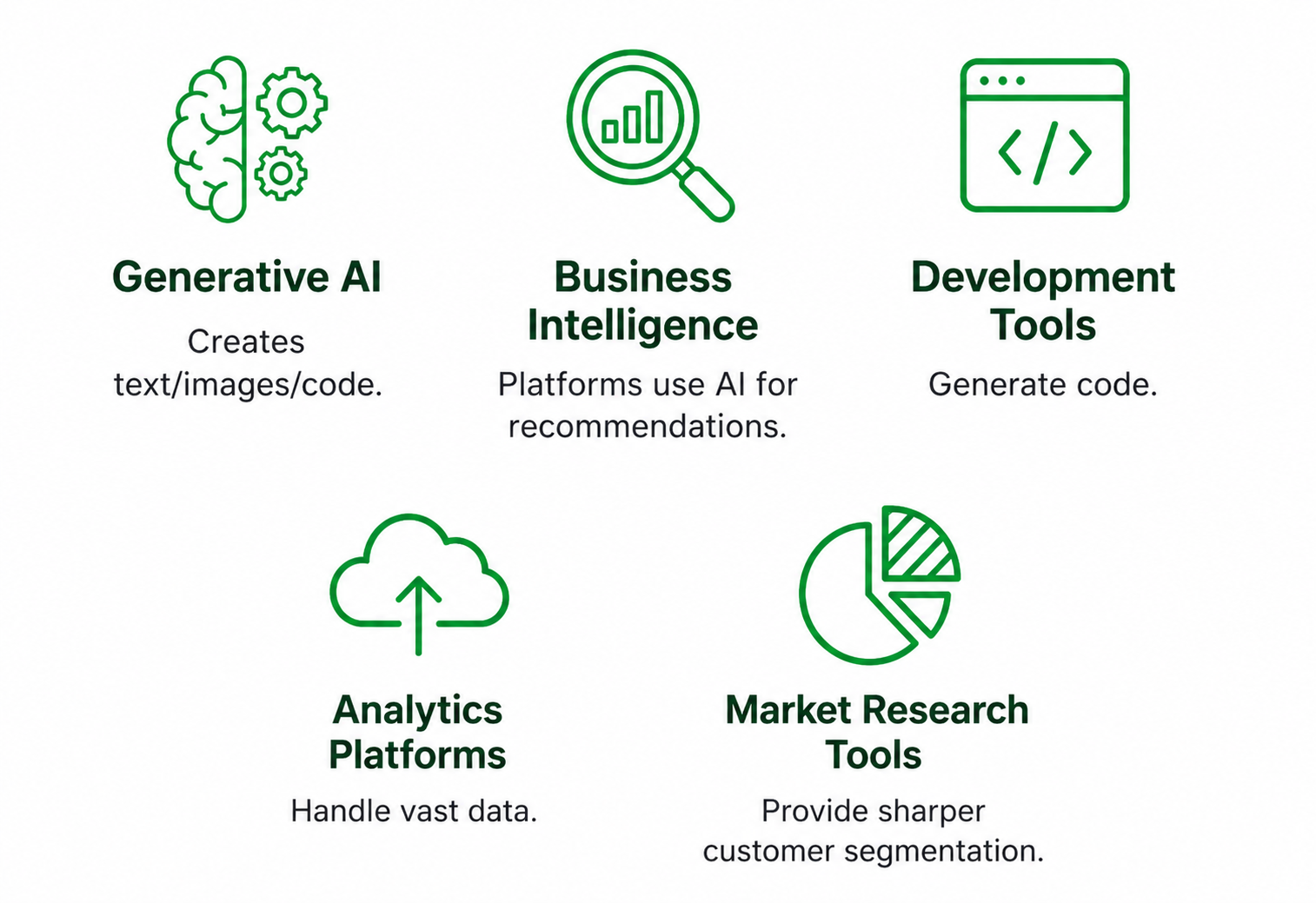
Generative AI has attracted the most attention recently, and for good reason. Systems that produce text, images, and code from prompts have obvious practical applications in content creation, product design, and personalized marketing.
Whether the output quality justifies the hype depends heavily on the specific use case, but the technology is genuinely useful in the right contexts.
Business intelligence platforms use AI to surface patterns in large datasets and translate them into recommendations. The shift from “here’s what happened” to “here’s what you might do about it” is subtle but commercially significant.
Development tools that generate code snippets and flag issues help engineering teams move faster. As a result, they spend less time on routine tasks and more on the work that requires real thinking.
Analytics platforms handle data volumes that would take human teams weeks. For example, cybersecurity AI detects threats at a speed that determines whether an attack does real damage before anyone notices.
Market research tools give sharper customer segmentation than manual analysis can produce.
The list keeps going, which is part of why AI has found a foothold in almost every business function rather than staying confined to technical teams.
Why Is AI Becoming a Strategic Priority for Business Operations?
The early incentive for using AI was cost reduction. AI tools were used to automate the routine work and improve margins.
That framing hasn’t disappeared, but it’s been layered over with something more ambitious — and frankly more interesting.
Many executives now treat AI as a decision-making partner. They set up a system that processes current data and surfaces patterns that human analysis would miss. Then they review its evidence-based recommendations.
The other shift is from solving specific problems to building infrastructure. AI used to get deployed for defined use cases. However, now it’s becoming a base layer that supports people across entire organizations.
That’s a different category of investment, and it changes how the business case gets evaluated.
Drivers Accelerating AI Adoption in Business
The volume of data being generated every day long ago exceeded what traditional analysis methods can meaningfully process. AI is one of the few practical ways to extract useful signals from that volume, which makes it necessary rather than optional in data-intensive environments.
Global competition compresses the timeline. Every efficiency AI enables is an efficiency that competitors might be capturing if you’re not.
At least 50% of businesses now report using AI in two or more functions. McKinsey’s research shows every major industry is planning significant investment over the next three years. These numbers reflect where the pressure is actually coming from.
Competitive Advantage Through AI Integration
The compounding effect is what makes AI strategically significant rather than just operationally useful.
Better demand forecasting reduces waste and improves availability. That improves customer satisfaction, which drives retention. Which, in turn, improves unit economics.
The cumulative effect is an operation that’s genuinely more responsive to market conditions than competitors running on slower information cycles.
AI also enables products and services that weren’t previously feasible. Possibilities include personalization at the individual scale and prototyping cycles that run in days.
How AI Transforms Key Areas of Business Operations
AI’s impact isn’t confined to one type of task or one industry. It’s showing up in operations, customer experience, supply chain, finance, and product development.
Earlier enterprise technology waves tended to solve specific, well-defined problems. AI surfaces new applications as it gets deployed.
The consistent thread is scale.
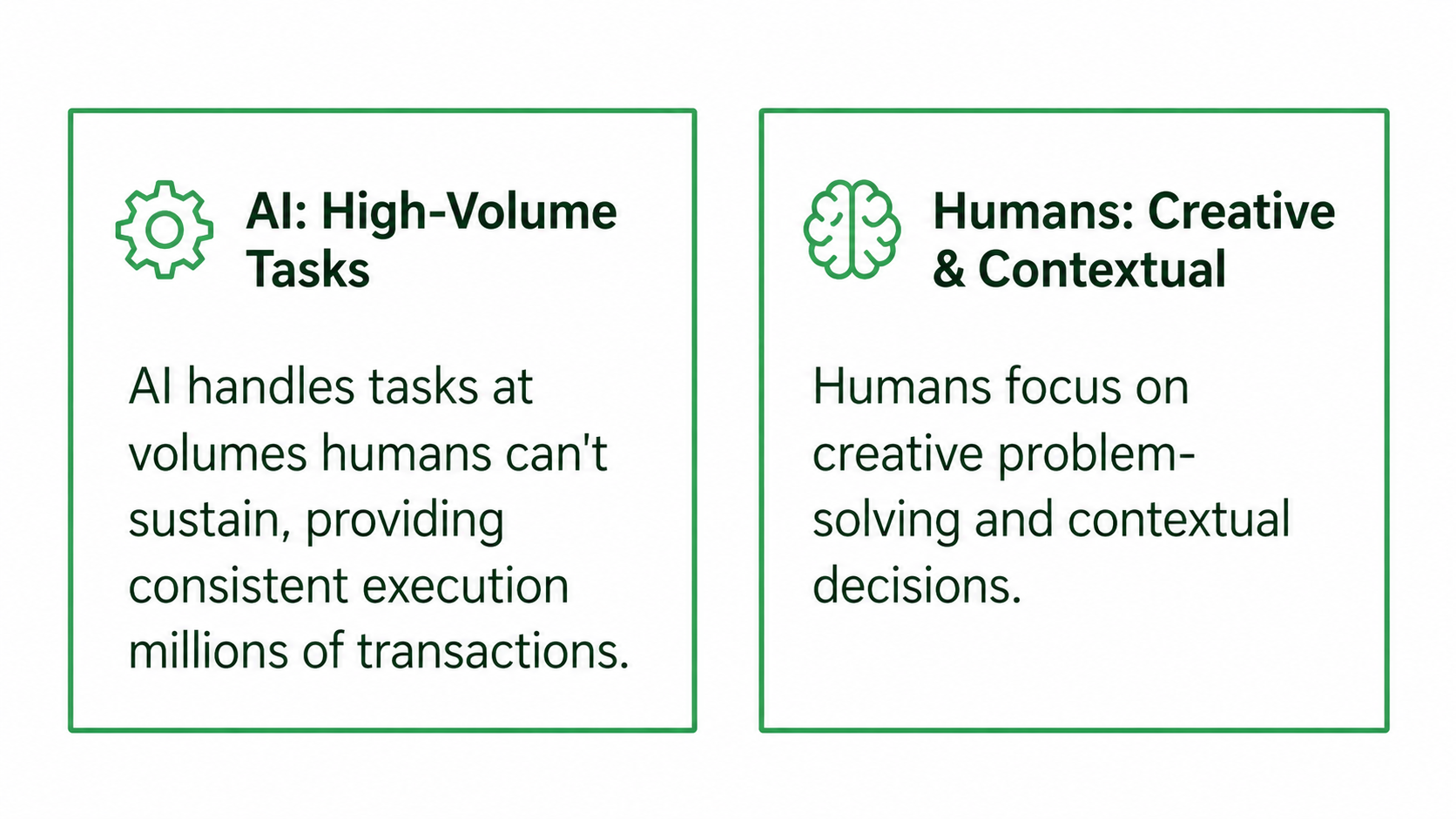
AI handles tasks at volumes that humans can’t sustain. Not because people aren’t skilled, but because consistent execution across millions of transactions or interactions is physically impossible without automation.
The role humans play in this equation is creative problem-solving and making decisions that require context a model can’t fully capture.
AI and Operational Efficiency
Two places where efficiency gains from AI tend to be most visible are task automation and real-time operational adjustment.
On the automation side, AI typically runs faster, with fewer errors, and without the consistency problems that come from doing the same task for hours at a stretch. It also runs continuously, which means critical workflows don’t stop at 6 pm.
The real-time adjustment piece is often more valuable and less talked about.
Predictive maintenance is the clearest example: AI monitors sensor data from equipment and identifies early warning signs of failure. Then it flags issues before they cause downtime.
The principle extends to energy, logistics, healthcare — anywhere that operational continuity has significant financial or safety stakes.
Finding the problem early, when intervention is cheap, is categorically better than finding it after failure, when it isn’t.
Improving Customer Experience With Intelligent Systems
Amazon and Netflix’s recommendation engines generate a meaningful share of the revenue those companies produce. That’s worth sitting with for a moment.
The capability behind it is commercially significant enough to be responsible for a large portion of two of the largest companies in the world. That’s what personalization at AI scale actually means in practice.
Chatbots and virtual assistants have changed baseline customer expectations in ways that are hard to reverse. They offer round-the-clock availability and proactive support based on predicted needs.
These are now the floor, not a differentiator.
Omnichannel consistency is part of this. A customer who contacted support last week via email and calls today shouldn’t have to re-explain their situation. AI aggregating data across touchpoints makes that continuity possible.
Without it, the experience feels fragmented, which is what customers notice and remember.
AI-Driven Decision Support and Business Intelligence
Traditional business intelligence was retrospective. It was useful for understanding history, but limited for making current decisions.
AI-driven BI is predictive.
The commercial significance of that shift depends entirely on how fast the relevant context changes. In a stable market, retrospective analysis is fine. In markets that move quickly, the ability to act on emerging trends before competitors do is an actual competitive advantage.
Bradesco Bank’s credit decision system automated 95% of credit analyses. It reduced decision time from days to minutes, while improving accuracy and lowering default rates. Human analysts moved to the complex cases where judgment genuinely adds value.
That’s the reallocation pattern that good AI implementation produces. Businesses have employees working on harder problems while the system handles the volume that doesn’t require their specific capabilities.
Automating Repetitive and Routine Tasks
AI handles repetitive tasks faster and with more consistency than humans. Why? Because consistency across volume is exactly what these systems are built for.
AI-powered systems don’t make the errors that come from doing the same task for the fifth hour in a row.
Automation changes what work looks like. That transition is real for people experiencing it.
Nevertheless, what the evidence does show is that businesses managing this deliberately tend to get better long-term results than those treating it purely as a cost-cutting exercise.
AI in Supply Chain and Logistics Management
Supply chains were complicated before recent disruptions. They’re more complicated now, and there’s limited evidence that they’ll simplify significantly.
AI addresses several of the most persistent problems, such as insufficient visibility across the network and slow detection of disruption.
ML-based demand forecasting studies historical sales and market factors to predict future demand with enough accuracy to act on.
Better predictions mean better inventory positioning, including fewer stockouts, less capital tied up in stock that doesn’t move, and improved availability for customers when they want products.
Predictive Analytics and Forecasting Applications
Predictive analytics is a bet on the future made with data. What AI improves is the quality of that bet. It processes historical data at scale, finding patterns that statistical models miss and updating predictions as new information arrives.
A retailer using AI-based forecasting can anticipate demand increases months ahead and reduce both overstock and stockout situations before trends fully materialize.
The financial impact is noticeable. Businesses enjoy higher sales through better availability and lower carrying costs through tighter inventory management.
The principle is consistent across industries: acting on what’s likely to happen is structurally better than reacting to what already has. AI improves how reliably that’s possible.
Key Takeaways for Businesses Adopting AI
A few things stand out clearly, once you look past the hype in either direction.
AI isn’t a technology upgrade in the conventional sense. It changes how organizations process information, make decisions, and create value. Treating it as an IT project consistently underdelivers.
The companies getting the best results treat AI as a business strategy question from the beginning: what outcomes matter, how will we know if we’re achieving them, and what needs to be true about our data and our organization for that to happen?
The practical frame is to identify specific problems worth solving, build the data foundation required to solve them, prepare the organization to act on what the system produces, and govern it seriously. It’s less exciting than the headlines, but it’s what consistently works.