In such circumstances, operational chaos is a growth killer.
The real question isn’t whether problems will come up; they will. The question is whether your operation can absorb them without falling apart.
Something as basic as how you store and access business data might be the final nail in the coffin. Teams that rely on secure cloud storage solutions tend to handle growth better, simply because they’re not hunting for files or working from outdated versions.
From the moment someone clicks “buy” to the moment a package lands on their doorstep (and sometimes comes back), every step depends on the one before it. Split those steps across disconnected tools or bury them in manual work, and chaos becomes inevitable.
The fix isn’t to push harder. It’s to build smarter systems that run reliably and scale as you grow.
What Are eCommerce Operations?
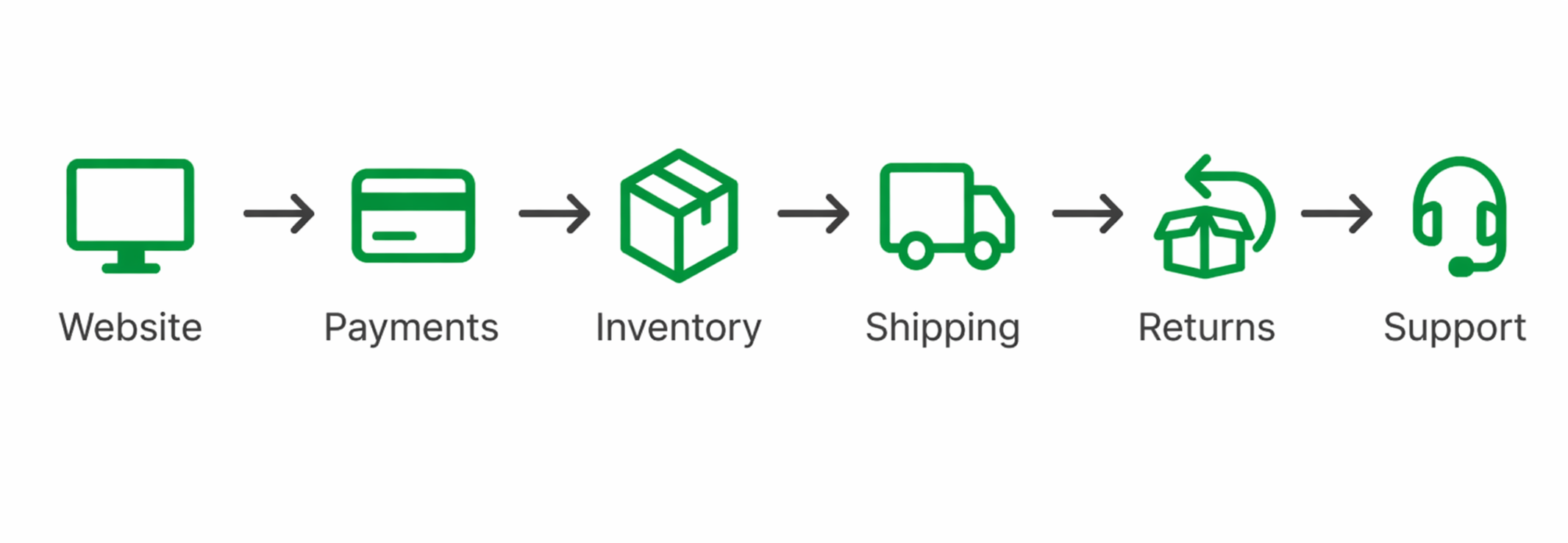
The textbook definition is simple enough: eCommerce operations are everything that has to happen for a business to sell products online. The website, payments, inventory, shipping, returns, support — all of it.
But that definition undersells how much complexity the word “everything” contains.
When a business is small, operations feel manageable. Two people can run it from a spare room.
The problem is that growth doesn’t just bring more orders. It brings more of everything.
Now you have to take care of more sales channels, more suppliers, more carriers. And more edge cases that don’t fit the original process.
What was once a simple loop expands into something that covers:
- sourcing
- storage
- marketing
- fulfillment
- delivery
- returns
- reporting
Miss a step anywhere in that chain, and the customer feels it, even if they can’t name exactly what went wrong.
Key Challenges Leading to Operational Chaos
1. Manual Processes
Spreadsheets and manual data entry might work when you’re shipping a dozen orders a day. They stop working when volume picks up. Overselling or shipping the wrong items are symptoms of a business that outgrew its tools and didn’t notice until something broke.
2. Siloed Data and Poor Visibility
When each team or sales channel operates on its own version of the truth, coordination becomes a guessing game. For multichannel sellers, this kind of fragmentation is especially common. And costly.
3. Scaling Pressure
Growth should feel like a reward. Too often it feels like chaos. More orders mean more pressure on every process, and weak workflows that were barely holding up tend to break entirely.
As a result, fulfillment slows down, quality slips, costs rise, and customers notice.
4. Shipping Fragility
Depending on a single carrier or running shipping steps manually is fine until it isn’t. A strike, a capacity crunch, or a system outage can stop orders from going out entirely. Without backup options, one disruption becomes everyone’s problem.
5. Security and Fraud
eCommerce stores handle sensitive customer data at scale. Fraud and security risks don’t go away, and ignoring them early tends to make them much more expensive to fix later.
Why Do eCommerce Operations Become Chaotic?
Chaos usually builds up over time. Small issues add up until everything feels out of control.
Retail eCommerce sales reached $316.1 billion in Q4 2025. It shows the potential for growth in this market. However, as orders and customer expectations rise, weak processes create bottlenecks that slow things down and block this growth.
Adding channels like eBay, Etsy, Walmart, TikTok Shop, or Instagram Shop can increase reach and reduce risk. But it also adds more moving parts.
In many cases, chaos happens because systems and processes don’t grow at the same pace as the business.
How Standardized Processes Prevent Operational Chaos
There’s a version of “standardization” that sounds bureaucratic and slow, thick SOPs written to satisfy an audit rather than actually guide work. That’s not what a good process looks like in eCommerce.
What it actually looks like is this: every order gets handled the same way.
That consistency is what separates an operation that scales from one that produces a different result every time and can’t figure out why.
With SOPs in place, teams follow proven steps, and when something goes wrong, you can usually find exactly where in the process it happened.
Standardization also doesn’t mean rigidity. The point isn’t to lock everything in place. It’s to have a clear baseline.
Once you have that, spotting slowdowns is easier, and efficiency stops being something you achieve occasionally and starts being the default.
Order Management and Fulfillment Workflows
An order workflow that isn’t documented is far from perfect. Because if something isn’t written down, it’s easier to forget about or intentionally skip.
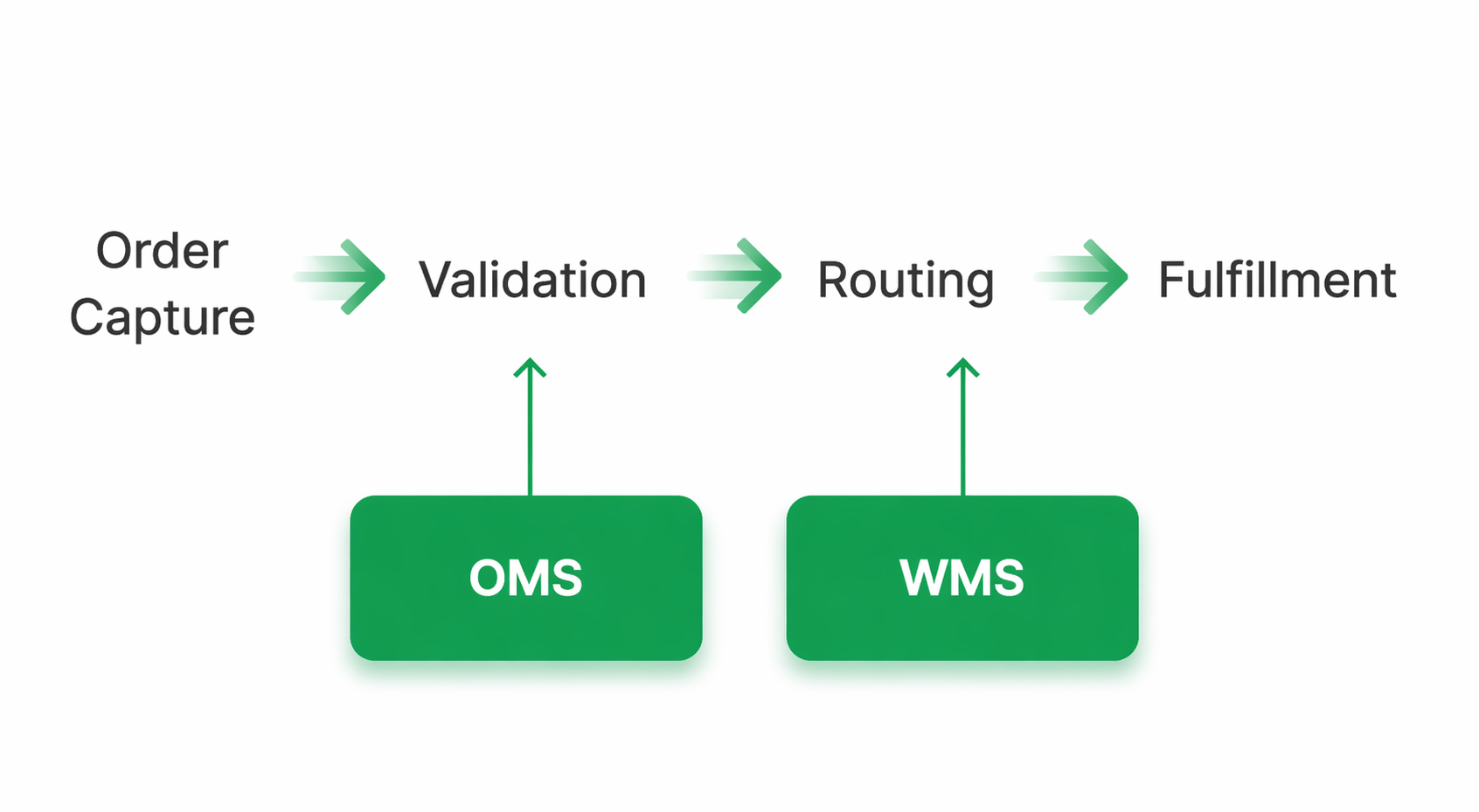
A proper order workflow starts the moment a customer checks out and follows the order through capture, validation, routing, and status updates, all the way to delivery.
An OMS manages this centrally, pulling in orders from every channel and applying routing rules based on stock availability, shipping cost, delivery targets, and location. The system makes the decision; staff executes it.
Fulfillment follows the same logic. Standard steps define exactly how orders are picked, packed, and shipped. They determine which picking method is used (wave, batch, or cluster), how the warehouse is organized, and the barcode workflow for receiving and put-away.
WMS-driven fulfillment steps raise throughput, reduce errors, and make delivery promises something you can actually keep rather than just hope for.
Inventory Control and Warehouse Management
Inventory work has a particular way of falling apart — quietly, and then all at once. Numbers might start to drift out of sync across channels, or a stockout may get discovered after a customer pays.
Most of these problems aren’t caused by bad luck. They’re caused by inconsistent procedures.
The goal is real-time accuracy across every channel, so no overselling, no sitting on dead stock while top sellers run dry, and no surprises after checkout.
Getting there means having a defined process for every inventory movement: receiving, put-away, picking, shipping, returns.
A WMS connected to the OMS and sales channels handles all of this through mobile scanning, tracking quantity, bin location, lot numbers, serial numbers, expiry dates, and item status in real time.
Shipping, Delivery, and Returns Procedures
Shipping and returns are where operations become visible to the customer. Everything upstream can be running smoothly, and none of it matters if the wrong item arrives or the returns process takes two weeks and three emails.
Standardizing this layer means automated label creation, automatic carrier selection, and consistent tracking communications. You need the kind of setup that holds up during peak season when volume spikes and there’s no time to make individual decisions for every order.
On the delivery side, the standard worth aiming for is simple: accurate estimated dates and real-time tracking, presented as one consistent experience even when multiple carriers are involved behind the scenes.
Flying Tiger Copenhagen expanded pickup and drop-off options through multi-carrier checkout and saw conversion increase by 20% — a pretty direct illustration of how much delivery flexibility influences whether someone actually completes a purchase.
Returns need the same procedural attention. When returns run smoothly, inventory stays accurate, and customers come away with a better impression of the brand than when they initiated the return.
That last part sounds unlikely, but it happens more than you’d expect.
Customer Service Best Practices
The numbers on delivery experience are stark enough to repeat again and again: 17% of consumers say they’d stop buying from a brand they actually like after a single bad delivery, and 85% hesitate to reorder after a poor experience.
Customer service isn’t a soft function sitting adjacent to operations. It’s what happens when operations fail, and its quality determines whether that failure costs you the customer permanently.
- Standard service procedures cover the basics: response time targets, training that produces consistent and genuinely helpful replies, and follow-up steps to confirm the problem is actually resolved rather than just closed.
- A self-service help center handles the high-volume, low-complexity questions before they become tickets.
- AI chatbots extend that capacity further, absorbing the repetitive queries so human agents can focus on the cases that actually require judgment.
- A unified platform gives support teams a full view of order and shipping history so they’re not asking customers to repeat information they’ve already provided.
What a good process also does here is surface patterns.
Recurring issues in shipping, product descriptions, or returns tend to show up in support data before they show up anywhere else. Catching them early is considerably cheaper than fixing them after they’ve compounded.
Conclusion
Managing eCommerce operations without chaos is ongoing work. In 2026, higher costs, labor shortages, and higher customer expectations push businesses to run tighter operations and invest in new solutions.
But technology alone isn’t enough. The best results come from clear processes, aligned teams, regular measurement, and steady improvement based on data and customer feedback.
When businesses treat fulfillment and delivery as a key part of the customer experience, operations stop being a constant problem and start supporting growth.
By improving each operational touchpoint, brands reduce risk, raise efficiency, and stand out in a crowded online market.